

Solo Exhibition
Solo Exhibition
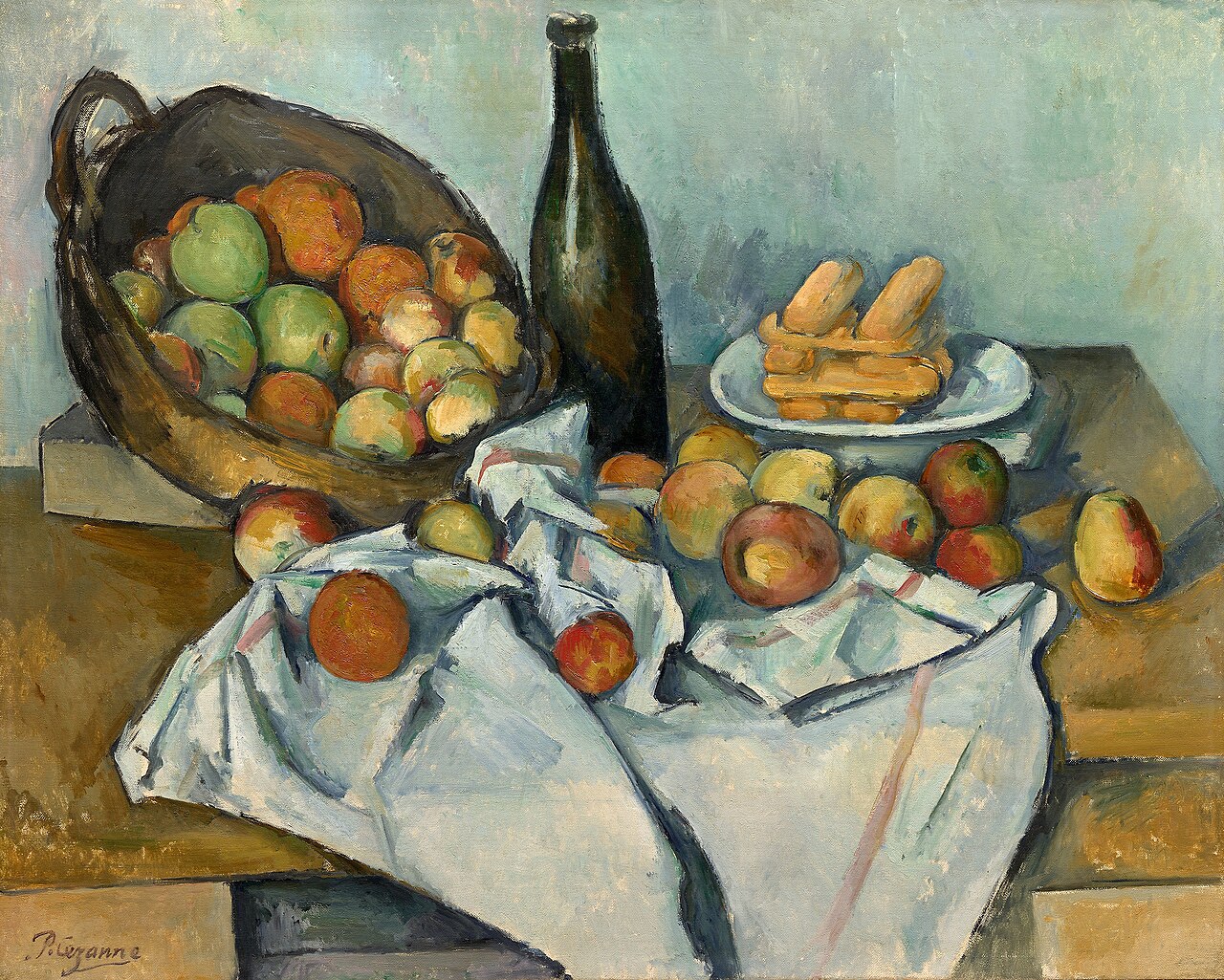
What you are looking at is a still life, though it is neither still nor drawn from life. The very formulation still life is a bit of a misnomer, if we think about it, given that these images depict inanimate objects, and not particularly grand ones. Since still life, by definition, excludes the human form, the everyday objects it depicts become stand-ins for human life—a carafe of wine that has been passed around the table, a lush spread of blushing apples, a melancholic bouquet past its prime. For Casey Reas, still life is not a literal genre of image-making but a conceptual framing device. He belongs to a lineage of artists who have used still life to defamiliarize everyday objects, rendering familiar shapes in a new light while also creating an inventory of things quintessential to their time and place in history. For Reas, the most ubiquitous object of our time is the digital image. While his still lifes have no bowls of fruit or tablecloths, they generate age-old questions about representation, simulation, and attention. Reas invites us to slow down and consider what we are really seeing when we look at images on a screen.
Read Zsofi Valyi-Nagy’s essay, “Still Life of the Cosmos.”
Works in the exhibition
The Still Life software works (2015–present) transpose the still-life tradition in painting into a generative, computational register. Each of the works in the series generates a kinetic, geometric still life composed of one type of Platonic solid—the tetrahedron, cube, octahedron, dodecahedron, or icosahedron—realized in both RGB and HSB color systems. Long regarded as elemental structures of matter, these logical and essential forms link antiquity’s metaphysical geometry to the pragmatic origins of computer graphics, where they served as standard test objects for rendering. In the Still Life series, Platonic solids are not depicted as stable volumes, but rather decomposed into pixels, with each pixel’s values translated into lines of varying position and color. From these simple rules emerge visual fields that oscillate between structure and dissolution. As each work is designed to run continuously, images are never repeated, and the series unfolds as a system rather than as a set of fixed compositions.
Casey REAS
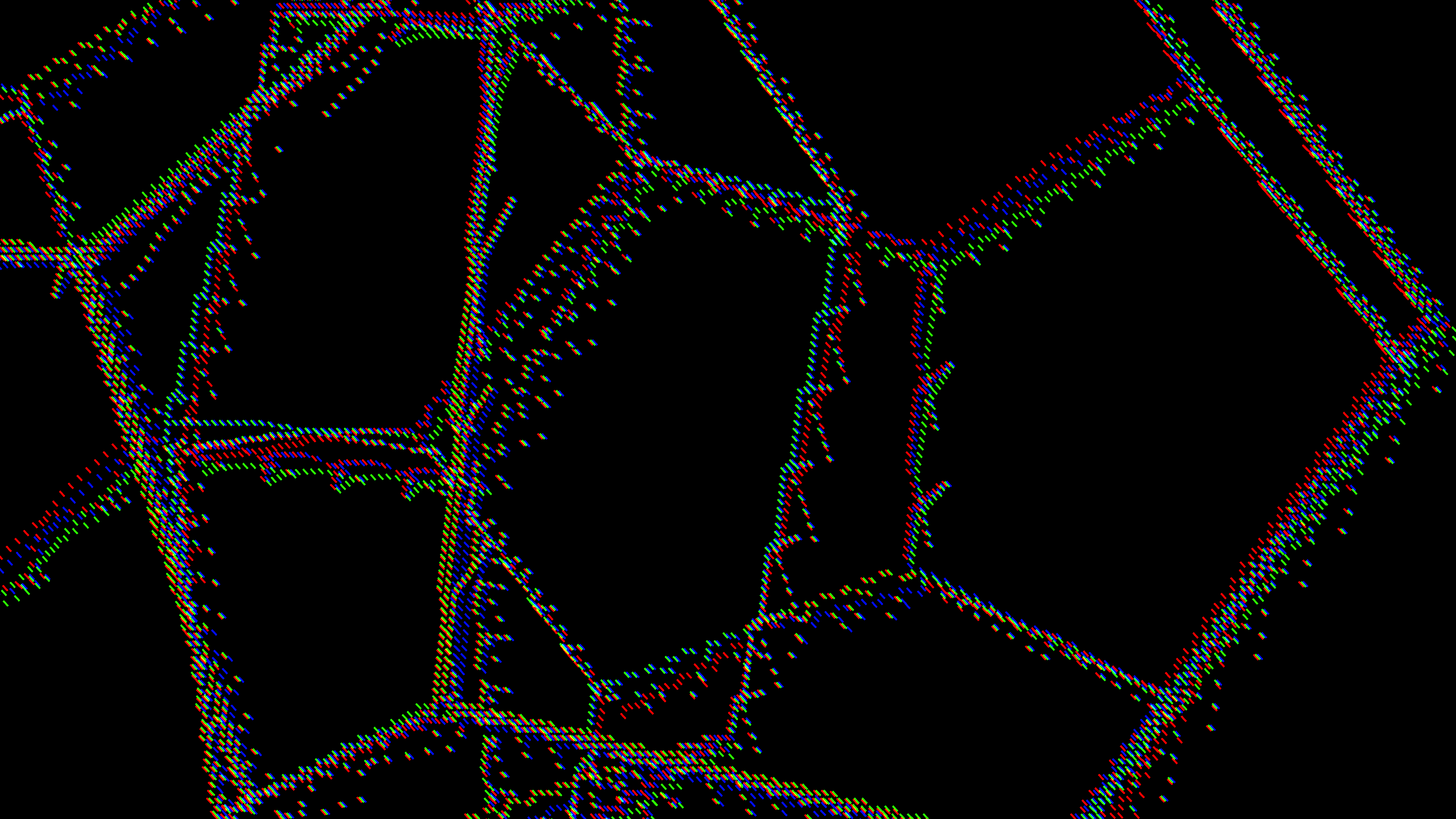
Ex Nihilo (Cosmos)Long-form generative work, series size 256 minted on Art Blocks
Mint complete: 256 works; ranked auction 10 March 2026 to 11 March 2026, base price 0.05 ETH. Showing #165.
Art Blocks record as of .
Casey REAS
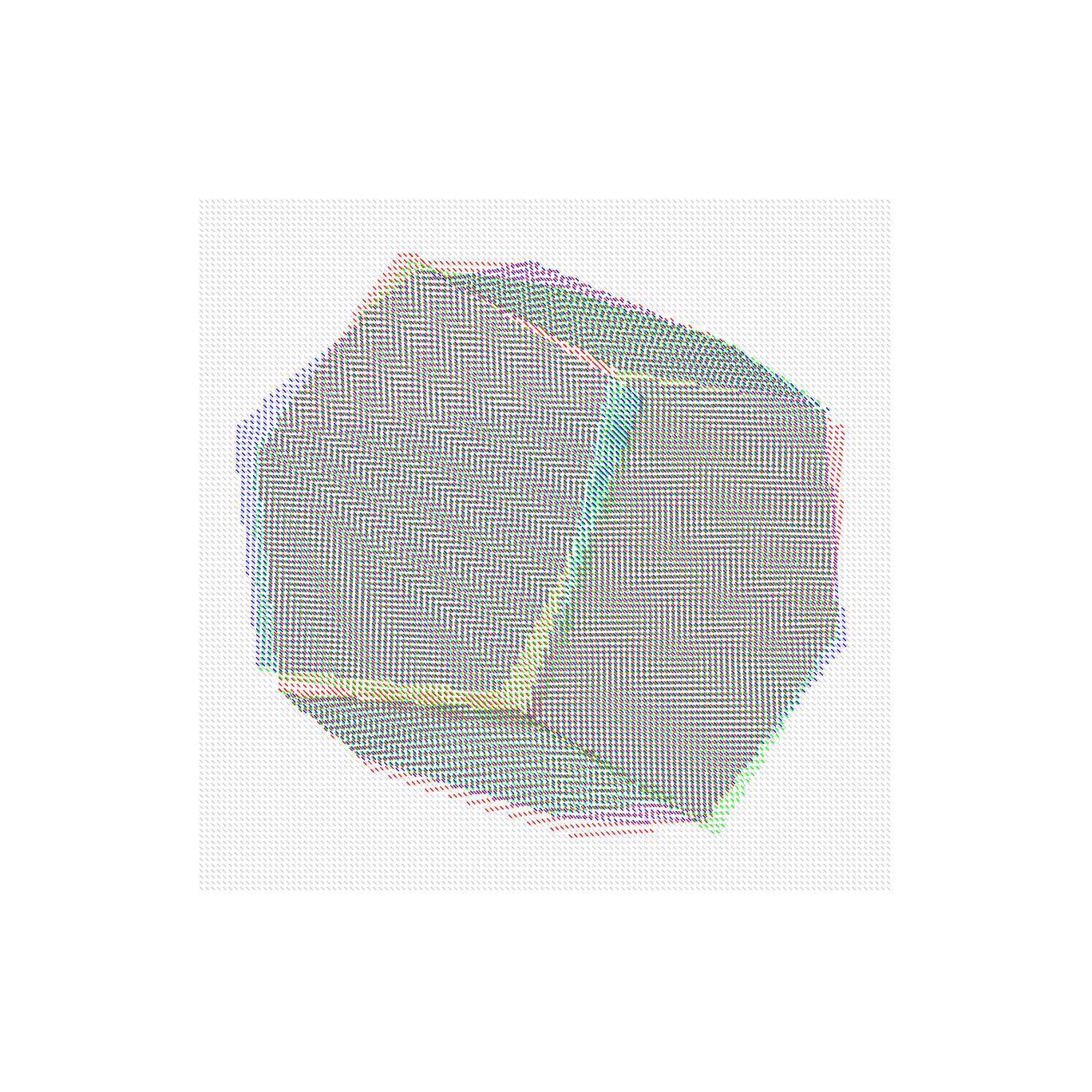
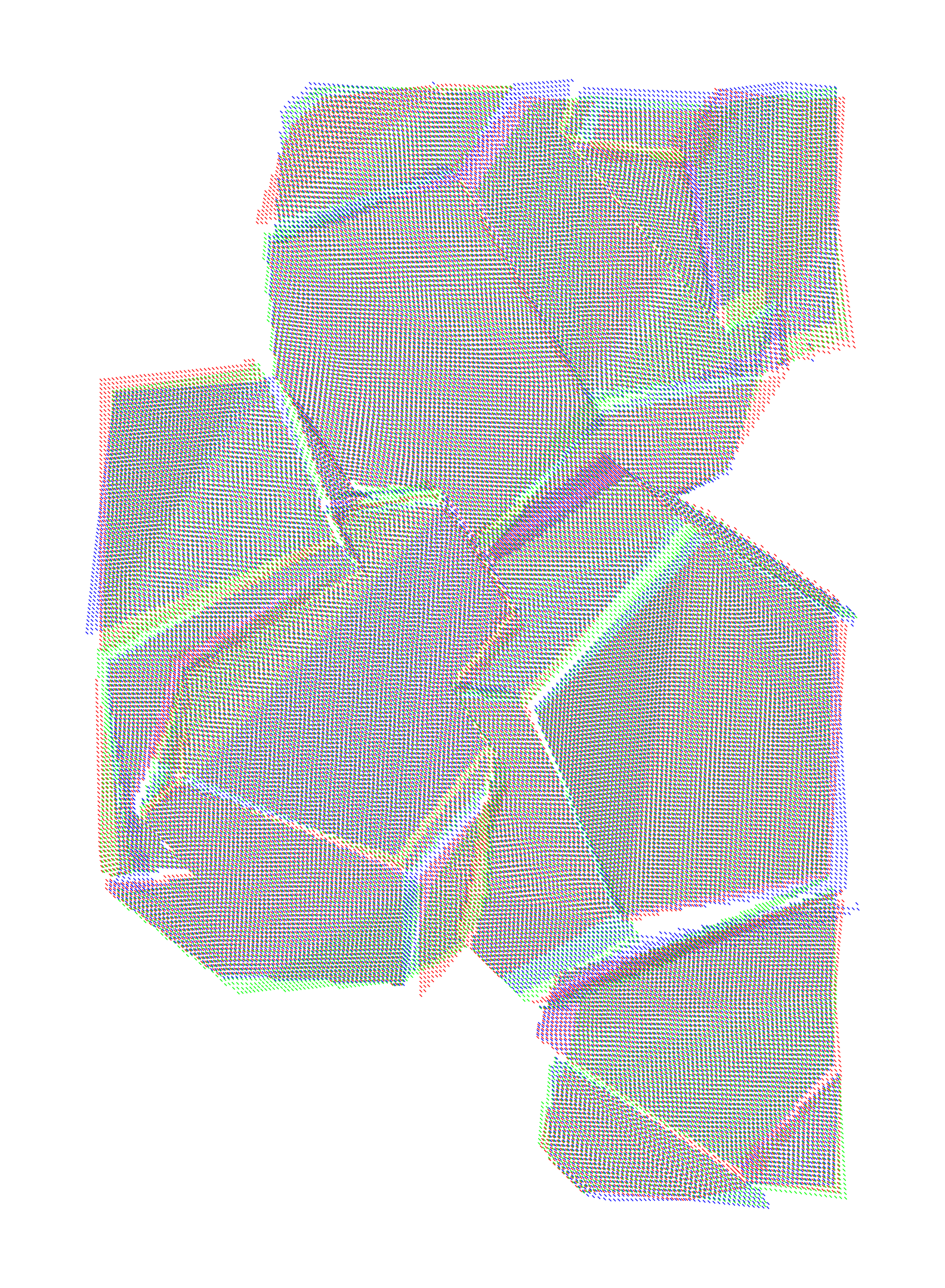
COSMOS–SIMULACRUM–RGB–7087313-353-371Plotter drawing on bristol paper minted on Feral File
Casey REAS
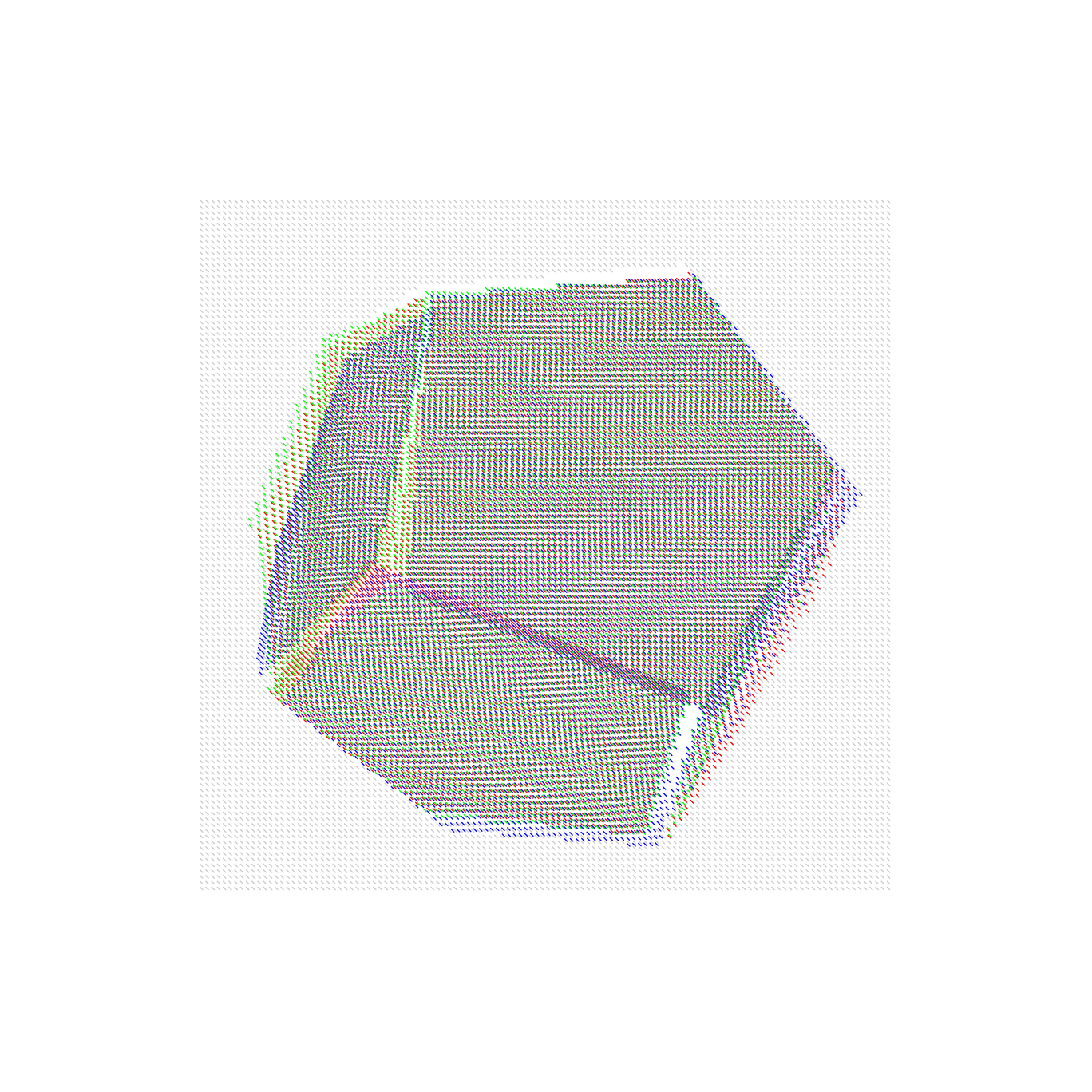
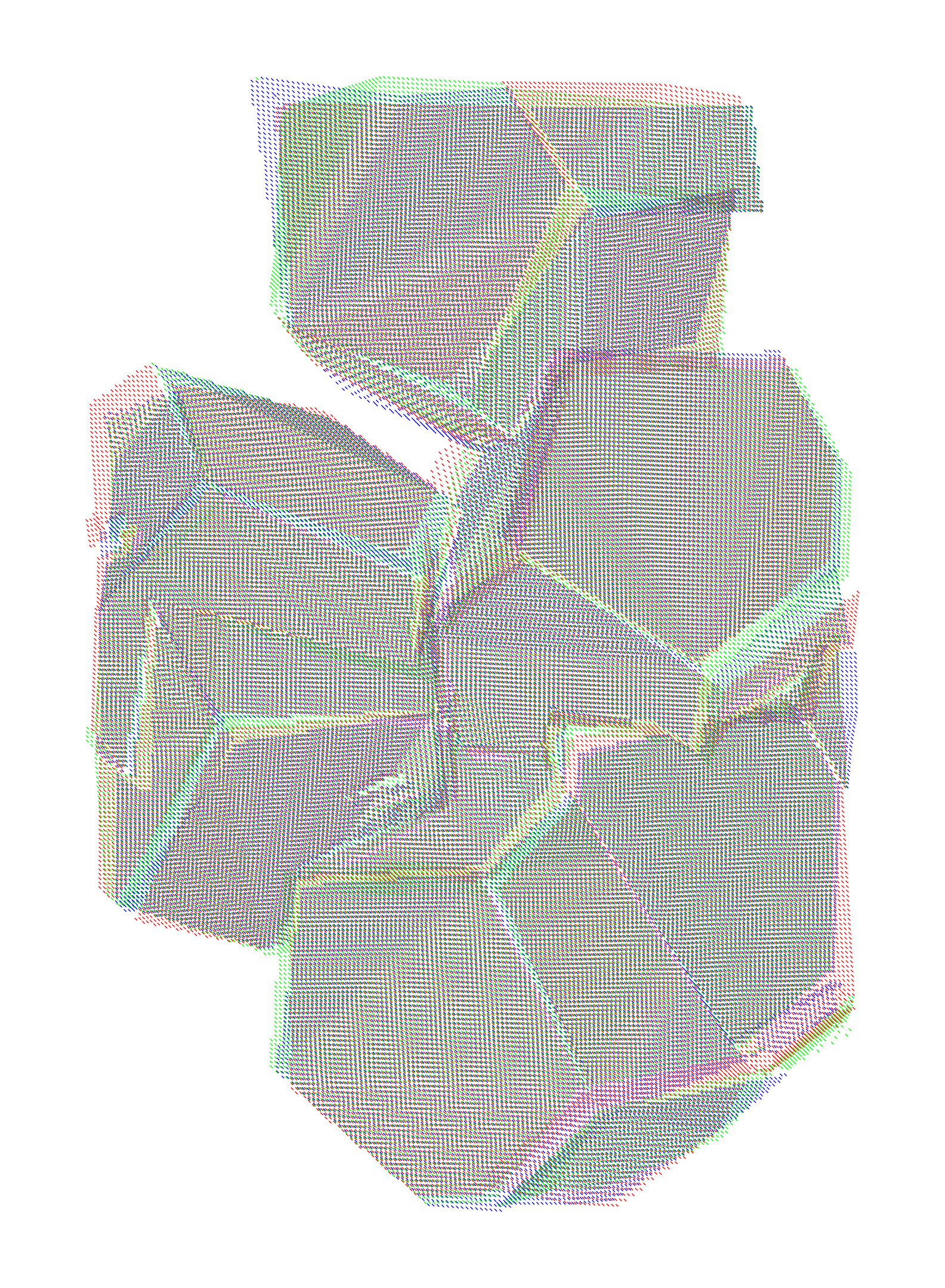
COSMOS–SIMULACRUM–RGB–7105313-170-455Plotter drawing on bristol paper minted on Feral File
Casey REAS
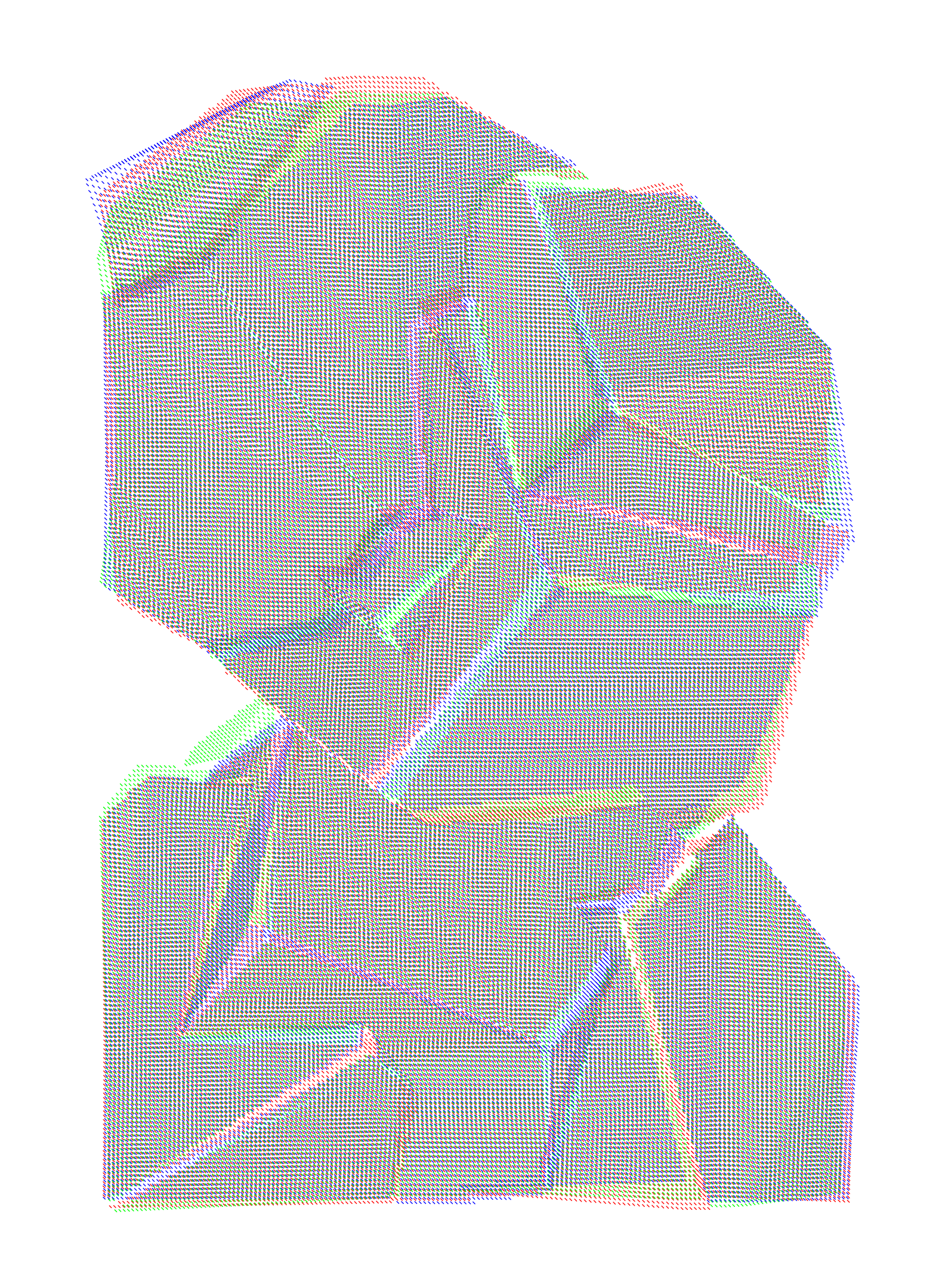
COSMOS–SIMULACRUM–RGB–7135313-183-489Plotter drawing on bristol paper minted on Feral File
Artist
Casey REASCasey Reas (b. 1972, Troy, Ohio) is an internationally recognized artist and educator based in Los Angeles. His work spans software, installations, prints, and drawings to explore the relationship between computational systems and contemporary visual culture. Engaging with the history of conceptual art, drawing, and photography, Reas creates generative systems that unfold over time.
Reas’ work has been exhibited at the Whitney Museum of American Art, New York; Los Angeles County Museum of Art; San Francisco Museum of Modern Art; Centre Pompidou, Paris; Victoria and Albert Museum, London; and Ullens Center for Contemporary Art, Beijing. It has also appeared in major group exhibitions across Europe, Asia, and the Americas.
Alongside his studio practice, Reas is deeply engaged in expanding the ecosystem for software-based art. He co-founded Processing (2001), the open-source programming language and environment that has widely expanded creative coding for artists and designers, and the Processing Foundation (2012), which supports visual literacy and access to creative tools worldwide. In 2020, he co-founded Feral File, an online platform for exhibiting and collecting digital art.
What you are looking at is a still life, though it is neither still nor drawn from life. The very formulation still life is a bit of a misnomer, if we think about it, given that these images depict inanimate objects, and not particularly grand ones. Since still life, by definition, excludes the human form, the everyday objects it depicts become stand-ins for human life--a carafe of wine that has been passed around the table, a lush spread of blushing apples, a melancholic bouquet past its prime. For Casey Reas, still life is not a literal genre of image-making but a conceptual framing device. He belongs to a lineage of artists who have used still life to defamiliarize everyday objects, rendering familiar shapes in a new light while also creating an inventory of things quintessential to their time and place in history. For Reas, the most ubiquitous object of our time is the digital image. While his still lifes have no bowls of fruit or tablecloths, they generate age-old questions about representation, simulation, and attention. Reas invites us to slow down and consider what we are really seeing when we look at images on a screen.
In his seminal book on still life, Looking at the Overlooked, art historian Norman Bryson outlines how still life was historically considered a "lower" genre of painting because of its depiction of the mundane. And yet this very banality, which he calls "rhopography," or the depiction of things that lack importance, are precisely what make these images almost archaeological, turning their subject matter into historical and cultural artifacts. "Since still life needs to look at the overlooked," he writes, "it has to bring into view objects which perception normally screens out."[1] For Bryson, the objects of still life exist in their own aesthetic space and are "tuned to a slow, almost geological rhythm that is all their own."[2] Look closely and you will see that Reas' objects, like the very Earth we inhabit, are slowly, subtly turning in their own space and time.
Bryson published his book in 1990, the same year that the first website went live on the World Wide Web. The internet, as we know it today, would forever transform the way we interact with images and digital artefacts. It also had a profound impact on Reas, who began working in web design after graduating from the University of Cincinnati in 1996, and found himself questioning why design software was essentially a simulation of nineteenth-century drafting processes, when the Web was itself an entirely new medium. The limitations he felt working in these software environments motivated him to learn how to code, which in turn influenced his development of Processing with Ben Fry in graduate school at MIT a few years later--so that "people could have an education in learning to think in code" in a way that was fundamentally visual. Coding, for Reas, is "not a technical discipline. It's like philosophy. It's a way of thinking." Despite making a name for himself as a leading figure in creative coding, Reas humbly claims that learning to code was not easy for him. "I was not one of those people who just started swimming."[3] The patience he brings to his work informs his pedagogy as well as his images, which invite slow, thoughtful looking that challenges the rapid, surface-level consumption that most digital images demand.
What, then, does a still life of a digital image look like? Reas invites us to think about what digital images are made of on a granular level. "I think computer generated images are ubiquitous. They are a dominant force in culture," he says, "And thinking about what they actually are, rather than [just] their surface, is interesting to me." A main point of reference for Reas is American conceptual artist Joseph Kosuth's One and Three Chairs (1965), which MoMA describes as an installation composed of "an object, an image, and words"--a real chair, a photograph of a chair, and a dictionary definition of a chair presented as one work of art.[4] Extending the concept of Sol LeWitt's wall drawings to software, Reas has been exploring the relationship between machine instructions, natural-language instructions, and the images they give rise to since the early 2000s.
Reas also belongs to a generation of artists, including Jason Salavon, Hito Steyerl, and Rosa Menkman, interested in the ontology of the digital image--what kind of thing it is, what it's made of, and how it functions. Reas' still lifes belong to a body of work the artist terms "Atomism," named for the ancient philosophical idea that matter is composed of indivisible particles. In this framework, Reas treats digital images as assemblies of discrete parts that can be broken down and rebuilt through code. His interest in atomism can be traced back to early explorations such as Cinema Image (2000) and ORA (2003), which, in the artist's words, were the first time he thought of "images as data and data as images."[5] He first named the Still Life series in 2016 with the show "There's No Distance" at bitforms gallery in New York, following an Anderson Ranch residency in 2015 that gave rise to woodblock print editions made from generative software systems--sets of rules (code) that generate images through processes of iteration and variation. While the majority of contemporary generative art lives and permutates on the glossy, hi-res computer screen, Reas' generative projects have always kept a foot in the material world. With titles like HSB-119-006-090-1366-618 / HSB-135-006-090-1232-687, these prints inhabit a liminal space between the digital and analog. Since this earliest iteration, the Still Life works have oscillated between paper and pixel, appearing as plotter drawings, projections, and screen-based images. Most recently, these have included long-form, blockchain-based generative art projects such as 923 Empty Rooms, ATOM, and There's No Distance (all 2023).
Reas' work, and this project in particular, is deeply engaged with the histories of both permutational practices and computer graphics. While today's visual culture is permeated with hyperreal renderings that are increasingly difficult to distinguish from reality, digital images have not always been mimetic versions of the real world we live in. "Prior to the 1970s," writes media archaeologist Jacob Gaboury, "almost all rendered [digital] objects were artificial geometries constructed within a line drawing program." Instead of being "scanned, recorded and extracted from the material world for digitization," these early 3D objects were created "ex nihilo"--constructed from nothing.[6] In other words, they were built from scratch, using mathematical descriptions of geometric forms.
While the digital images we typically encounter today (JPEGs, TIFFs, etc.) are raster graphics made up of pixel grids, early computers used vector graphics--mathematically defined paths or lines that are "drawn" via (x,y) coordinates on a Cartesian plane. Vector graphics are constructed from the building blocks of geometric "primitives"--the simplest shapes that the system can compute. For two-dimensional graphics, these primitives were points, lines, and polygons. Three-dimensional graphics, however, were built from edges and vertices; these objects were rendered as skeletal models that came to be known as "wireframes." In both cases, virtual "objects" were the expression of mathematical equations.
)](/images/microsites/ex-nihilo-a3c/image-3.png)
The objects that are ever so slowly spinning in Reas' still life follow this same logic. They are wireframe models of dodecahedrons, one of the five Platonic solids that were first described by Plato in his Timaeus (c. 360 BCE) and mathematically proven in Euclid's Elements of Geometry (c. 300 BCE).[7] For Plato, each of the five solids, these perfectly symmetrical three-dimensional shapes, corresponded to a metaphysical element. The dodecahedron, having twelve sides that are regular pentagons, was the shape of the cosmos, or the structure that emerges from formlessness (chaos) in the formation of the universe. Since 2016, Reas' Still Life series has "deconstructed Platonic solids and presented them as information."[8]
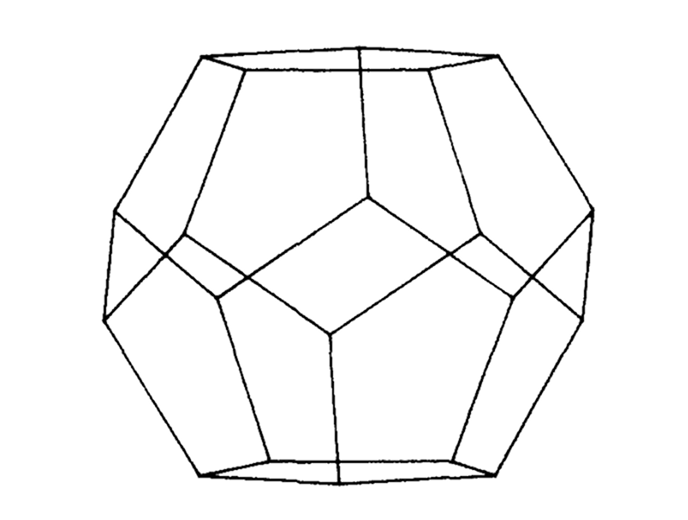
Unlike the wine carafe or bruised peach we would typically encounter in a still life, the dodecahedron is not an ordinary object. In its perfectly symmetrical form, it does not occur in nature, but rather in abstraction. It is a concept, an ideal geometric form belonging to the Platonic realm of ideas, which consists of Forms that are timeless and immutable compared to their worldly manifestations.[9] A digitally rendered dodecahedron, then, is neither simulation nor representation, but rather a shape constructed ex nihilo from a mathematical formula. While Reas previously explored the other platonic solids in his RGB and HSB Still Life works, Ex Nihilo is his first atomistic study of the dodecahedron, which renders this "solid" as a wireframe--constructed only from its edges and vertices.
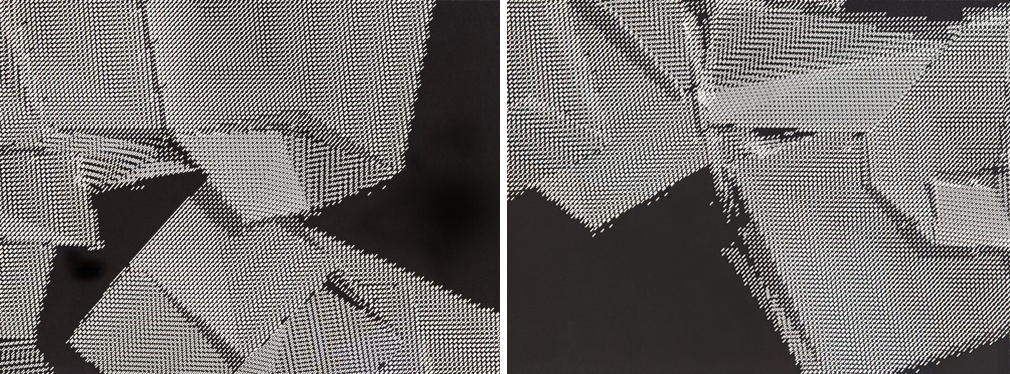
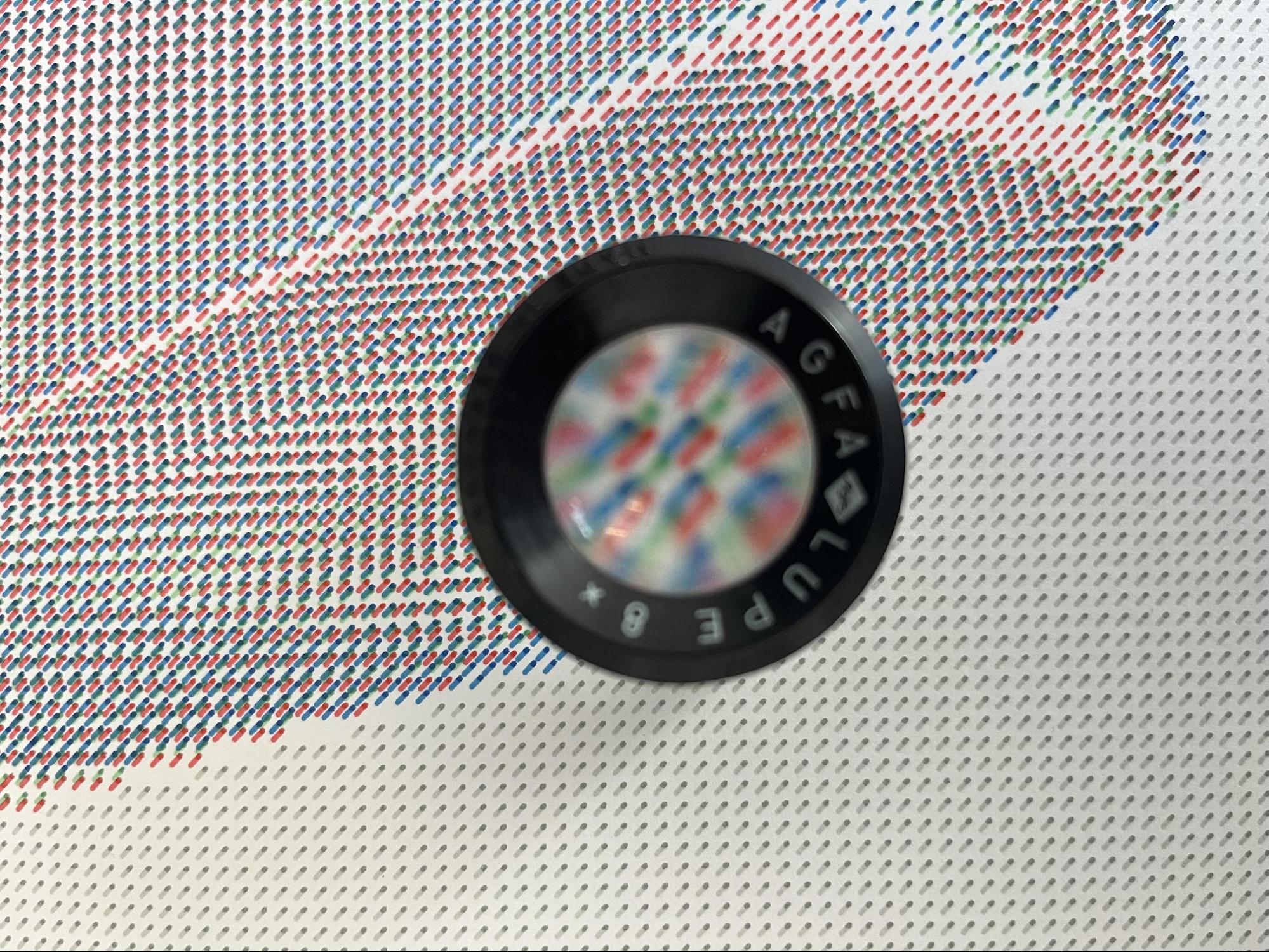
Reas' code simultaneously generates a digital image and pulls it apart. The image on screen is constantly changing, never twice the same. The edges of the dodecahedrons seem to oscillate like sound waves, adding another dimension of movement to the slow rotation of the forms. What from afar appear to be white lines--the wire frame of the dodecahedron--are, in fact, made up of smaller lines of red, green, and blue--the building blocks of digital color. We typically think of the pixel as the smallest atomic unit of every digital image, but Reas shows us how the pixel can be further broken down into subpixels: red, green, and blue (RGB) light sources whose intensities combine to form the color we perceive. As computer graphics researcher Agatha Mallett writes, "An image pixel might be a little square with a flat color, but to actually present the image on a physical display ... we illuminate discrete 'subpixels.' The perceived color in an area is then the addition of the subpixels' emissions in that area" (Figure 4).[10] The waviness of Reas' seemingly simple lines is the result of a complex, iterative process wherein each line is being displaced according to its RGB value (0 to 255), first in a simulated perspectival space (mimicking human depth perception, as in a still life painting), and then flattened into an orthographic space (the representation of 3D objects in 2D used in technical drawings and computer-aided design).[11]
](/images/microsites/ex-nihilo-a3c/image-5.png)
In his atomistic exploration of both color and space, Reas finds art historical grounding in both impressionism and cubism--the latter of which was particularly interested in rethinking the still life painting. Analytic cubism, as Bryson notes, dissected the image into its constituting pictorial parts to "release" painting from its mimetic role.[12] Reas applies a similar process to the digital image. The Still Life series signals Reas' return to working with geometric primitives after nearly a decade of experimenting with found data from mass media, from television signals to social media images--what the artist refers to as a "collage-based generative software practice." Rather than pulling from the information overload of digital visual culture, this generative work is "purely text-based .... starting from nothing."[13]
This concept of creating images from nothing--ex nihilo--is the basis of another art historical thread that laid the theoretical groundwork for what we now call generative art. In 1930, a group of artists in Paris wrote a manifesto for l'art concret (Concrete art) that called for abstraction that made no reference to the natural world, but was instead constructed from rules and relationships between geometric forms. Theo van Doesburg, Jean Helion, and their collaborators offered the term "concrete" as an alternative to "abstract," which they felt retained connotations of illusionism or representation (i.e. abstract used as a verb). "A pictorial element," they asserted, "does not have any meaning beyond 'itself'; as a consequence the painting has no other meaning other than 'itself.'"[14] These ideas were further developed by the Swiss artist, designer, and educator Max Bill, who proselytized the Concrete approach across Europe and Latin America, influencing artists and graphic designers alike, including those who would go on to educate Reas in Cincinnati in the 1990s. Bill had himself trained at the Bauhaus with Paul Klee, who approached his artistic practice and pedagogy as research into the creative process.
The "mechanical" and "anti-impressionistic" approach to painting outlined in the Concrete art manifesto later offered a blueprint for computer-generated abstract art in the 1960s and '70s. In 1971, Brazilian artist Waldemar Cordeiro referred to Concrete art as a "methodological antecedent of computer art" for its "machine language" and its reliance on algorithms, in the pre-computational sense of a set of rules to be followed in a systematic way.[15] As I have argued elsewhere, the pen plotter, with its mechanical arm "drawing" lines according to programmed instructions, offered a literal application of the Concrete principle of mechanical technique, in a sense removing artistic subjectivity from the process of mark-making.[16]
The idea of atomization--of the image and of the creative process itself--permeated the discourse of early digital art. Artists experimenting with mainframe computers, especially in Western Europe, drew heavily on Gestalt psychology and the field of information aesthetics, which in turn built on Claude Shannon's theories of communication to demystify the processes of creating and viewing artworks by breaking down visual forms and processes into smaller, discrete parts. Art historian Christoph Klutsch suggests that working with the computer allowed the artist-programmer "to break down visual problems into small, elegantly designed pieces."[17] Contemporary artist-researcher Pierre Braun, who offers a reinterpretation of Klee's pedagogical methods for the digital age, suggests that computational processes have allowed artists to build on this tradition of "de-composition" that has interested makers and thinkers since the early twentieth century.[18] Contemporary generative art is thus indebted to these earlier practices of trying to circumvent illusionistic representation by sticking to the timeless repertoire of geometric abstraction, which could be broken down into its most elemental parts of points and lines.
It is dialogue with these histories that Reas has conducted his own experiments with the plotter, beginning in 2015 with his RGB plotter drawings, first produced for AESTHETICA - 50 Years of Computer Generated Art at DAM Projects in Berlin. Reas' plotter drawings are not simply copies from screen to paper, but thoughtful transpositions of his generative process into material form. Unlike a printer, which outputs raster graphics line-by-line following the pixel grid, the plotter deals in vector graphics, "drawing" the paths or lines along the x- and y-axes of the Cartesian plane, mimicking the movement of a human hand. The artist must code the instructions for these images just as he does for the screen-based generative graphics.
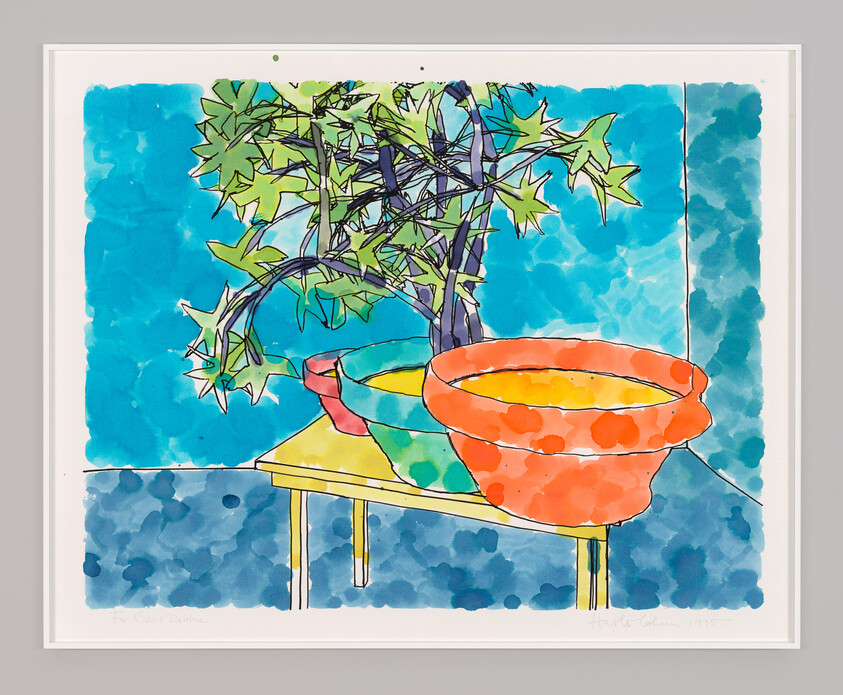
Ex Nihilo expands Reas' earlier experiments to a larger scale, using the Bantam Tools ArtFrame(TM) plotter, which was developed for the Whitney Museum's 2024 exhibition of Harold Cohen's AARON, the earliest artificial intelligence program for artmaking, which Cohen developed continuously from the late 1960s until his death in 2016, after which AARON has continued to generate colorful portraits, abstractions, and still lifes.
In Reas' plotter drawings, the concept of atomism is rendered tactile. The dodecahedrons feel equally at home on Bristol paper as they do on a high-definition screen. The forms are built up from what we might describe as analog subpixels--a matrix of precise specks of ink drawn with a combination of four carefully selected colors of Micron archival pens: a red, a blue, a green, and a gray. This fourth color accounts for pixels that do not have color information, that were black or white in the original image. While the artist's hand is technically removed from the process of mark-making, plotter drawings retain a sort of aura with their slight imperfections--the slight bleed or drag of the pen--and the visible accumulation of lines. No two are exactly alike. Each drawing takes almost twenty-four hours to complete. The plotter runs continuously overnight, meaning Reas has to babysit it, waking at wee hours of the morning to make sure the pen tip doesn't catch on a fleck of dust, sending the entire drawing off course.
Each drawing is, in a sense, its own cosmos--a well-ordered whole. Like the still lifes of centuries past, they invite us to slow down, to reexamine the ordinary and see it in a new light. For Reas, the concept of still life offers a way to look beneath the surface of the digital images that permeate our visual culture and to reconsider how we interact with them day by day.
[1] Norman Bryson, Looking at the Overlooked: Four Essays on Still Life Painting (Harvard University Press, 1990), 87.
[2] Bryson, Looking at the Overlooked, 13.
[3] Interview with the author, November 7, 2025.
[4] "Joseph Kosuth. One and Three Chairs. 1965 | MoMA," The Museum of Modern Art, accessed December 23, 2025, https://www.moma.org/collection/works/81435.
[5] Casey Reas, "ATOMS," Grails IV exhibition, August, 7, 2023. https://www.proof.xyz/grails/season-4/atoms
[6] Jacob Gaboury, Image Objects: An Archaeology of Computer Graphics (The MIT Press, 2021), 90.
[7] Smithsonian Institution, "Platonic Solids," accessed December 22, 2025, https://www.si.edu/spotlight/geometric-models/platonic-solids.
[8] "Still Life (RGB B) by Casey Reas," Bitforms Gallery, accessed December 23, 2025, https://bitforms.art/artwork/still-life-rgb-b.
[9] Gail Fine, ed. Plato 1: Metaphysics and Epistemology. New York: Oxford University Press, 1999.
[10] Agatha Mallett, "Subpixel Zoo: A Catalog of Subpixel Geometry," Geometrian.Com, accessed December 22, 2025, https://geometrian.com/resources/subpixelzoo/index.html.
[11] Interview with the author, November 7, 2025.
[12] Bryson, Looking at the Overlooked, 83.
[13] Interview with the author, November 7, 2025.
[14] Jean Helion, ed., Art Concret (Revue), N. d'introduction (1930). Translation from Espace de l'art concret. "Manifest de l'art Concret." Accessed December 22, 2025. https://www.espacedelartconcret.fr/en/histoire-et-contenu/concrete-art.
[15] Waldemar Cordeiro, "'Arteonica': Electronic Art," trans. Eduardo Kac, Leonardo 30, no. 1 (1997): 34.
[16] Zsofi Valyi-Nagy, "Between the Lines: Zsofi Valyi-Nagy on the Art of Vera Molnar," Artforum International, May 2024; Zsofi Valyi-Nagy, "Vera Molnar: Weaving Variations," HOLO: Emerging Trajectories in Art, Science, and Technology, 2022, https://www.holo.mg/dossiers/vera-molnar-weaving-variations/.
[17] Christoph Klutsch, "Information Aesthetics and the Stuttgart School," in Mainframe Experimentalism: Early Computing and the Foundations of the Digital Arts, ed. Hannah Higgins and Douglas Kahn (University of California Press, 2012), 65.
[18] Pierre Braun, ed., Digital Klee: esquisses pedagogiques: enquete sur le futur de la forme = Digital Klee: pedagogical sketchbook: an inquiry into the future of form (Present compose, 2020), 25.
*Editor’s note: This transcript was edited from an interview recording for Casey Reas’ Feral File solo show* Ex Nihilo *opening 10 March 2026. It has been lightly condensed and cleaned for readability (filler removed, minor repetitions tightened, and obvious transcription glitches corrected) while preserving the intent and tone of the conversation. Timestamps are included at topic shifts for reference.*
HUO: Hello.
CR: Hey. How are you?
HUO: I’m good. How are you?
CR: Good.
HUO: Where are you?
CR: In Los Angeles. I’m at UCLA today, but I also work a lot out of my studio.
HUO: And what are you working on right now?
CR: Two things. I’m working on the show for Feral File, based on the Still Life series I’ve been doing since 2015. This is the latest iteration.
I’m also doing machine learning work: real-time collage pieces I call Earthly Delights. It’s named after the Stan Brakhage film, not the Bosch painting.
HUO: I met Stan Brakhage once with Jonas Mekas. We invited him to Do It, and he took a film out of a box, cut a few centimeters off the original, handed it to me, and said: “Do it.” That was his contribution.
Maybe we can begin there. Instructions and prompts already play a big role in Duchamp. Chance flows through Arp, then Fluxus, and onward. What’s striking about your work is that many of your references come as much from conceptual art and film as they do from computer art.
CR: Absolutely. Kinetic sculpture too.
When I first started making work with computers, I didn’t know much about the history of artists working with instructions and notation. I first came to it through Sol LeWitt’s wall drawings, and that cracked a lot open for me: the idea that you can encode an artwork as instructions written in English, as a step between the idea and the execution.
From there I learned more about Fluxus. And Do It was important to me because it widened the range of what instructions can be. That idea of notation carrying through choreography, music, and visual art is far more interesting than focusing on one narrow area.
HUO: Do It began in 1993, and it’s essentially an exhibition made of instructions. It sits in the same lineage as Fluxus, where there isn’t one “correct” way to perform a score. We’re also thinking of Alison Knowles, who recently passed away, and of George Brecht’s event scores. That openness, and the room for chance, feels deeply connected to what you do. What role do randomness and chance play in your work, and in this idea of open scores?
CR: For me it’s two things.
One is getting out of my own bias, getting out of my own head, allowing things to emerge, allowing things to happen that I can’t fully conceive of. That was one of the original uses of randomness. Duchamp, for example, dropping strings and letting them fall where they may. It’s a way of inventing something that becomes your own, rather than something fixed in advance.
The other is variability: malleability, change, and difference over time.
My way into randomness came through John Cage, via Duchamp. Cage’s idea that there’s no “wrong” sound, that everything can be heard and experienced with attention, opened a lot for me in my early 20s. I carried that forward into visual aesthetics rather than sound.
HUO: For readers, what was your contribution when you received our invitation for Do It?
CR: It was a sequence of instructions moving from the general to the specific.
It started as loose English instructions for drawing a grid, open to many interpretations. “Make a grid or find a grid. Do one thing or another thing inside each unit.” Then it gradually became more precise, and eventually it turned into computer code, first in BASIC and then in Processing, the language I co-initiated.
So it moves from broad and ambiguous, in the human interpretive realm, into something precise enough to be implemented by a machine. It evolved over five steps.
HUO: Processing has been pivotal for artists for years, and it feels newly relevant now.
It’s also an early example of what one might call “protocol art”: work where the primary artistic act is creating the rules, systems, and constraints that can generate future works, not only producing a single final image. Do you remember the moment you decided to start Processing?
CR: I do. It was a June day in 2001.
Ben Fry and I were sitting at the MIT Media Lab in our studio. We’d been working on a project called Design By Numbers, which was John Maeda’s project. I was a research assistant in John’s Aesthetics and Computation group, and Ben was too.
Design By Numbers is an extraordinary way of bringing visual people into programming. It’s minimal on purpose: 100 × 100 pixels, grayscale. The simplicity is what lets people move into it quickly.
Ben and I wanted something that kept that minimal entry point while scaling into a professional programming environment. This became Processing: it starts simple, then opens up until you can do serious work.
We wrote the first version quickly. It started as a tool for us, then it became a tool for other people, and that shift changed everything. Once other artists started using it, the software had to become stable and legible, not just “whatever works for our project this week.”
And then it grew far beyond anything we imagined. The community carried it.
HUO: Thinking about tools and infrastructure, and about artists building things not only for themselves but for others, brings us to Feral File.
You launched it in 2020, at the start of COVID. It’s transgenerational: pioneering digital artists like Auriea Harvey alongside younger artists. Do you remember when the idea clicked, and what prompted it?
CR: I do. I do a lot of my thinking in docs, and sometimes I’ll open a document and a few hours later things will click. Feral File was one of those moments. All of a sudden it was clear and lucid: this is something we could build.
Years before that, I’d been working with Sean Moss-Pultz. Sean was the CEO of Bitmark, a blockchain company. He was doing work in health data, music, and other areas, and for more than a decade we talked about how blockchains might matter in the arts.
At first those conversations were mostly about provenance: how to register work on a blockchain. With physical work there are existing ways to track objects, but with work that’s purely digital, the blockchain felt like a missing piece.
Bitmark had been working with blockchains for a long time, and we experimented with approaches, including a project called a2p (short for artist-to-peer), a take on peer-to-peer.
Eventually it felt possible to build a platform that was native to digital work: a place that could present it well, sell it, and support artists and collectors without forcing everything into older categories.
HUO: Thank you. In an interview with J.J. Charlesworth for ArtReview, you described brilliantly the generosity and vision behind these predecessor models, this profile of the artist-to-artist exchange.
And you say there that you were trying to make a healthy relationship between artists, and then in a way extend that outward to curators, galleries, and collectors. Can you talk a little bit more about that? Originally, artists were just swapping work. It’s an old tradition from the analog context, and you adapted that for digital art.
There were 75 artists involved. It was trading and bartering. But you also say in that conversation that it wasn’t good for everybody, and that’s why you wanted to change the system and bring in collectors and editions, so that people outside the artist group could also become involved.
Can you talk a little bit more about that? The importance of these healthy relationships seems very interesting.
CR: Yes. Thank you. What we found through a2p is that for some of the artists involved, it was a game. It was fun. If you were participating in a2p with me, I’d say, “Hans Ulrich, will you trade this work of mine for your work?” And you could just say, very casually, yes or no. Everybody had ten editions and there were 75 artists. It was meant to be an enjoyable trading session. But I think some people took it a little more to heart, and it didn’t feel good if somebody rejected their trade request.
The idea of Feral File was that every artist would receive one edition from every other artist, which is another traditional way of doing it. And then, while we were at it, we thought: let’s make more editions and make those available to collectors. And let’s also make it so the curator receives editions too, so we bring more people in.
For the first shows on Feral File, they were all group shows, and they were all initiated by a curator. First, we would make those editions. We would make more than we needed. Every artist would receive one work from every other artist. The curator would receive one work from every artist.
That way, everyone was working in a very equitable way and exchanging artworks. And then the other works could be acquired by collectors, and all the artists would share that income equally. That was the original Feral File model.
HUO: And in that same conversation, you also say that Feral File is personal and biographical for you. From the beginning, there was this idea of supporting generative work and creating a place where software-based, code-based work could be distributed. But you also wanted it, by definition, not to be narrow: it could include 3D models, synthetic photography, and many other things. So in that sense it expands the notion of digital art.
CR: The catalyst for Feral File was to make a space for people to show software-based generative art. But my own world in the arts has always been very expansive. And Feral File was built to accommodate that full range of digitally native object types, and pure digital work.
And the idea too is that all the work happens in the browser. These are shows that are not meant to be installed physically. It is work created and built for the browser.
Let’s talk about Auriea Harvey, who you talked about a little bit earlier. Auriea had been searching for a way to show her digital work for a very long time, but felt like, in order to work within the art world, she needed to produce things in a physical way. And so now through things like Feral File and through other emerging environments, she's able to show those digital models as the primary work.
HUO: What's the role of Erick Calderon’s Art Blocks?
CR: Feral File started around June of 2020 and Art Blocks launched in late 2020. Art Blocks was not involved with the genesis of Feral File. But, Art Blocks 100% did influence my thinking after it launched. And what I think Art Blocks did was to create a large amount of energy. Hundreds of new artists, thousands of new collectors participating in collecting software-based work.
And for me, that really changed a lot of possibilities and opportunities for the kinds of artists who had been working with software for generations and decades. I think it was a shift that happened. And I do believe that Art Blocks and Erick’s vision was the lever for that shift.
HUO: Thank you. One more question I want to ask you about generative art, and about what Feral File makes visible and distributes, has to do with this idea of the artwork as a kind of living organism.
At the moment, this is being discussed a lot in exhibitions. There’s an increased number of museum shows. I haven’t seen it yet, but there is the Infinite Images show in Toledo, which you were part of, and which focuses on generative art. And of course there is a lot of presence of this idea in the digital space.
Where it isn’t so present yet is in public art, and I think there is actually a big potential there.
I was just the other day in Zurich, in the railway station, and they have this wonderful Niki de Saint Phalle sculpture and Mario Merz’s The Philosopher’s Egg with the Fibonacci sequence. And it is, of course, important that things don’t move, that they are there to stay. But I often think how cool it would be if we had big screens in railway stations with generative artworks, where people would always see a different work, and the works would not repeat.
CR: Yes. About 15 years ago, Tal Rosner and I were really lucky to receive a commission for that kind of work for the New World Symphony in Miami, which is the Frank Gehry–designed home of the New World Symphony. It's projected on the facade of the building. It's software-based work. It has hundreds of different modes and collage pieces that can come together. And so for me, that was the vision of realizing that idea of that work.
Well, that's one example from then. I believe that there's artists like Rafael Lozano Hemmer and Daniel Canogar who are doing public commissions, public work, that are software-based. I do see things like that. And I agree with you.
I think it's an area that is open for emergent things to happen. I think traditionally working with software, working with technology has been very fragile, and I think it's becoming more and more robust over time as the costs are continually moving down. So I think yes, that's an area of great interest to me.
HUO: Do you have any unrealized projects? I'm always interested in artist's unrealized projects because we know a great deal about architects' unrealized projects because they published them.
And then that actually helps them to somehow, in a different form, to get things built. In visual art, we know very little about artists' unrealized projects. Of course, the range of projects unrealized is so wide it can be too big to be realized, too small to be realized.
It can be too expensive and time intensive. It can be a forgotten project somewhere in a file or in a locker. It can also be a project one hasn't dared to do.
I mean, there is a thing Doris Lessing told me about: self-censorship which can lead to unrealized projects, or it can be a project which has been censored. Actually, there are so many reasons why a project is unrealized.
Do you have unrealized public artworks or maybe also, just in general, your unrealized projects. Dreams, utopias?
CR: I think the way that I work with software can be thought of as similar to how sculptors or architects work. For example, Tony Smith. Tony Smith has hundreds of drawings for artworks, models for artworks that have never been fabricated. I have hundreds of software sketches that have never been exhibited, never been shown in the way that they're meant to be shown, they exist on my screens in my studio only at small scale. But the work is really meant to be experienced at architectural scale. I would love other people to experience it and I would love to experience it realized in the way I imagine..
HUO: And can you give maybe an example?
CR: Absolutely. I did a series of artworks from 2004 to 2010 called the Process Compendium series. They are instruction based works. Those have never been exhibited together. They've never been exhibited at scale. When I made them 20 years ago, I just wasn't able to show them in the way that I imagined them to be. I think that's really been something that is present continuously in my work. I'm always struggling with the friction of not being able to realize the work in the way that I imagine it to be.
And that's largely because of just how primitive screens and projectors are. And so basically, every year since, since I've been making work, my vision for what the work will be becomes more and more possible, but I don't imagine that I will hit that in my lifetime. The way that I want the work to be exhibited in space, how slow computers are to do all of the rendering that I need them to do, to see the work in the way that I want to see them. And so, in the beginning of my career in the early 2000, I would have a room of work on paper and a room of projected work. They needed to be separated because one was giving me the image and the texture that I needed. The other was giving me the motion that I needed, and I wasn't able to do them both at the same time.
And that's still often the case for the work that I'm making now. So I would make a case that everything I've made has been not realized in the way that I imagine it to be.
HUO: Great answer. And we now want to talk about your first solo exhibition on Feral File, which is about to open, and the interview will be published in the context of this exhibition. Can you tell us about what you're planning to exhibit?
CR: I don't really know where to begin. Where is a good spot to start that story? This work is fundamentally about the nature of digital images. The idea that a digital image is a material, that it's oftentimes an illusion, that when you get down to the atoms of a digital image, its red, green and blue values in an array of pixels. And so this work is about simulation.
This work is about breaking images down according to their data and then reassembling those images again. And for me, there's a line that goes all the way back to the platonic solids and an idea of a shape, the idea of something that can never be made material because it's a conceptual object, a platonic solid like a cube or a tetrahedron, and carrying all the way forward. I don't think of things anymore as the digital reality and the physical reality, I think they're completely merged.
And in that, in that merging, digital images become as real as anything else. And digital images are based on a lot of assumptions about how we construct simulations. And so that's the through line.
And then in the end, the work is a series of generative software pieces. They are compositions. They are still life works made of these platonic solids that are then taken apart by the data from the pixels and then reassembled.
HUO: Yes. And I'm very curious about these still lifes because you, in a conversation with Peter Baumann, you said that there's basically three really essential bodies of work for you, there is the Process Compendium. Then there is the machine learning work, 2016 to 2020, which I'm, in a way, also continuing, of course, today. And then you said, last but not least, there is still live work. And you say as already you mentioned it's about the fundamental nature of digital images. So it's very much at the core of, of what your work is, but it's also at the core of what it means to simulate and render a digital environment. You say, and at the same time, there is a connection to Cubism, because it's not about photography. And I just had a conversation with David to talk to me about that, because of course, David Hockney has written a lot about that. And, we talked about the extraordinary lecture, actually, Hockney did in the early 80s at the Guggenheim about these very late works of Picasso's from the 60s. And, in that context basically, Hockney talked about the fact that it's about looking not through a photographic lens, but from many different points of views. And so I see a link there in a way of what you do digitally.
And I was very curious if you could talk a bit about, yes. Why do you consider these still lifes to be such one of the most important bodies, one of the three most important bodies of work you've been doing. Why can we, through that, really understand the essential nature of digital images?
But then I want to ask you to also talk a bit about how it connects to Cubism. And actually in an interesting way, in this lecture, Hockney brings us from Picasso to Federico Fellini and his film E la Nave Va.
CR: I think there's also a link to Impressionism here too. In that moment when Impressionism and Cubism were adjacent to each other. The idea of breaking something down into discrete colors is there.
But I think with Cubism, I'm still learning about Cubism, analytical Cubism. I picked up a book about a year ago about the use of photography in Cubism. They were also shooting these objects and looking at the photographic images of them and making models and including that in the process. I like the way that Analytical Cubism was trying to capture something about the image that is true to the object outside of the photographic lens. I think that's the connection with this work. But the fact that this work is completely simulated is also, for me, very important.
And then why the still life? I think for me, the still life is a very humble genre of painting. And I think that it's one of the greatest spaces and sources of representational innovation.
And for me, being within that context of Cézanne and the Cubists and also Hockney, the photographic works. The Cubist photographic works that Hockney produced had a great influence on me in my early 20s as well. So yes.
HUO: And, what's the role of writing in your practice? Because Hockney has written books on this space, which is very different from a photographic space.
And what's the. And that brings me to the role of writing in your practice. I'm very interested in artist writings when I think very often it's a very underestimated and under appreciated medium. The writings of artists.
CR: Writing does not play an essential role in my practice. And I mean to be very open and honest with you, that was something that created a lot of friction for me, for a long time. I felt that was something that needed to be more essential for what I was doing. I do admire a lot of artists who write. But for me, I think my thinking is fundamentally visual and that’s the kind of analysis that I do.
I've done a lot of writing, actually, but it's work that's been adjacent to my art practice. I think I've published about five books, but they've been within the realm of, I would say, didactic books about art and technology, like “how to code” for artists. I've done a series of interviews with different artists. I would say, theoretical writing about my work is not there. Maybe it will be in the future.
HUO: But this is, of course, deeply connected to your teaching. You’ve been teaching at UCLA for more than 20 years, and in a way there is also a bridge from that teaching to Feral File, because you want Feral File to support young artists and support the broader activity around the school.
So maybe you could talk a little bit about your teaching.
In a way, Zaha Hadid said that one cannot really teach architecture, one can only inspire. Do you think one can teach art? And Rainer Maria Rilke wrote Letters to a Young Poet. What would be your advice to a young artist working with technology? And then the last part of the question: how does Feral File support teaching and help students?
CR: I’ll start with the Feral File part. Feral File has always been intended to show work in context, whether through a group show or a solo show, and to provide materials that let people go deeper when they become interested in the work.
That has taken different forms: interview programs, different kinds of editorial material, and curators’ notes. These are the same kinds of materials that come out of more traditional galleries, but Feral File has made them public. They’re fully online and integrated into the work in that way.
I think there is still a lack of opportunities for artists making digital work. Artists who are able to move between more traditional art spaces and digital art spaces can generate opportunities for themselves. But for artists who are really focused on more immaterial work, the field is still lagging. It is still developing. It is still emerging.
So Feral File creates opportunities for some artists who otherwise would have fewer, because of the kind of work they make. We put that work out into the world, and then we contextualize it. That also makes it more accessible for students, because they can encounter the work and the surrounding materials together. So that is one connection to teaching.
I have a hard time separating that from the way I teach. I work with both graduate and undergraduate students. With the graduate students in our MFA program, the role is really to encourage them to make work that is distinctly their own, work that can only be made by them. A lot of that comes down to listening and asking the right questions.
For the undergraduates, the classes are more pragmatic. It’s about exposing them to what feels most exciting right now: what is most exciting to look at, to learn, to discuss, and then creating an environment where they can thrive. That’s my mode for undergraduate education.
And there’s also quite a lot of reading. In all of the courses, reading, analysis, and making are mixed together.
Here’s another example of what Erick Calderon did with Art Blocks that I think really changed things. This idea, which Tyler Hobbs framed as “long-form” generative artwork, was a new way for many people to think about generative art. The idea is that you have one system, one algorithm, and everything that system produces belongs to that series. There is no editing.
So for my exhibition with Feral File, there will be one long-form generative work from the Still Life series. That will be a series of 256 works, created and collected as that set of 256. In addition to that, there will be five works on paper.
Those will all be drawings. I’ve been working on drawings very intensely over the last nine months, and these are also part of the Still Life series. I’m going to grab one really quickly.
So this is one example. Here’s the full frame, and here’s a closer view.
These drawings are made using plotter technology. Plotters have evolved since the 1960s, but they are still fundamentally the same thing.
HUO: Because if it’s a long-form generative artwork, that would mean that the individual work you just showed me would be an integral part of the collection as a whole, no?
CR: It’s split into two pieces. The long-form generative work is one of the artworks in the show, and it’s the primary artwork in the show. And then there will be five drawings as well.
HUO: And do these works, do your works, have titles? What’s the role of titles in the work?
CR: The titles are coded to recreate the work. Included in the title is both a random number seed and two other integers. And when you have the software, when you input that random number seed and those two integers into the software, it recreates the image.
And so the works have very general titles. I think the drawings are called Simulacrum. And then you have those, those values that really define the work within the larger piece.
For me, generative art is about creating a field of possibilities. And that's really where the primary work lies. It's in that field of possibilities.
And then for a work like this, we are at random picking 256 locations within that field, and then that becomes the series of the work.
HUO: So are these editions?
CR: We no longer think about things in terms of editions anymore. Editions are in the realm of the woodcut and the lithograph and the silkscreen. With generative art, I talk about things being in series. You can have a series of 12 pieces from one piece of software, but each one is unique, each piece is different. With an edition, each is usually identical to each other.
These are ideas that, for me, go back to the early 2000s, like 2002, 2003, when I was having my first exhibitions. Now they are more well defined than they were at that time.
HUO: One thing we haven’t gone into yet, and that I’d like to explore a little more deeply, is the connection to cinema.
In his Picasso lectures, David Hockney talks about multi-perspective vision and connects it to cinema, including Fellini’s And the Ship Sails On. You also often connect your work to cinema, and you’ve said that a major moment here was Gene Youngblood’s Expanded Cinema from 1970.
Then there are other important figures in this history, like Lillian Schwartz, Stan VanDerBeek, and Billy Klüver through Experiments in Art and Technology. I once interviewed Lillian when she was almost one hundred years old, and she told me about going to the lab every day, working side by side with scientists. In a way, it was a kind of long-duration residency inside a technical environment. And of course, her early films are pioneering works in generative art.
So when people see your exhibition on Feral File, how do these works connect to cinema?
CR: That’s a great question. One of the reasons I started working with software in the 1990s was that I needed a way to bring different media together. I was equally interested in motion, image, and sound.
So artists like Stan VanDerBeek and Lillian Schwartz are people I’ve looked to with admiration for many decades. For me, the key questions are: How do you cut time? How do you move things through time?
One thing I don’t talk about very often is that I was a percussionist for fifteen years. There was a moment when I had to decide whether I was going to continue with percussion or move fully into visual art. In the end, that wasn’t a hard decision, because I’m very much a visual artist.
But rhythm, and the cutting of time into beats, has always stayed with me. I think that’s actually part of my connection to abstraction. I’ve never been especially interested in melody or lyrics. I’ve been much more interested in the way drums create rhythm and composition in time, even if it’s something as minimal as clapping, or systems of repeated beats.
What I learned from Lillian Schwartz, especially, was how to edit. I think the film was UFOs. She took found material and turned it into something extraordinary through editing, optical printing, and color. And she worked with sound and cuts in a really powerful way. That’s one important connection for me.
And then there’s also the way both Stan VanDerBeek and Lillian Schwartz collaborated with Ken Knowlton, creating emergent generative systems, things inspired by crystal growth or artificial life, and bringing those processes into the work.
HUO: It’s fascinating about the percussionist in you, because I didn’t know that. Dan Graham always told me that if you really want to understand the work of a visual artist, you have to understand what music they are listening to.
So for our readers, who are going to see the exhibition on Feral File, it might be interesting, and of course for me as well, to know what music you were listening to while you created these Still Life works.
CR: What’s been going on in the studio? Jlin has been happening in the studio. Nala Sinephro too. And I’ve been listening a lot to André 3000’s last album, the flute music.
Jlin is about beats and rhythm, while the others are very fluid and ambient at the same time.
HUO: That’s a great answer. And how do you work? How do you act? I mean, you’re now in the studio at the school, and you’ve also got your own studio. Do you have a ritual, a way of working, or is every day different?
CR: I work on projects for, oftentimes, multiple years. And every project has a beginning, and it has a flow in the middle, and then it has that final push toward getting things done. So those rhythms are very different for me.
And they often overlap with different projects. So I’m starting something at the same time I’m concluding something else. Some days I’m really active with my assistant, getting things done, and other days I’m alone, writing code with music on.
One thing that I do is really actively curate going to shows, watching films. I try to feed myself with what’s happening in Los Angeles at different times. So I don’t have a fixed process. It’s very fluid. And a lot of things happen through conversation.
HUO: And how do you see the change happening right now with AI and, with Andrej Karpathy, the whole idea of vibe coding? How do you see that? And how does that change the idea of coding?
CR: Totally. We’re in very uncharted territory with that. I felt that coding was stagnant for decades.
A lot of the ideas go back to the 1960s. A lot of other fundamental ideas go back to the 1980s. Very little had radically changed since that point. And now students are using these AI augmentations to learn how to code, and the majority of the professional programmers I talk to, people who have been doing this for decades, are using it as well.
And people say things like: I did this in a day, whereas before it would have taken a month. But it didn’t bring any excitement, or it wasn’t interesting, or it didn’t have that challenge of programming that used to make it rewarding.
I see a really positive side to this for the visual arts. Over the last 20 years, there has been a lowering of the barrier to working with technology, and with emerging technology. Twenty years ago, if an artist wanted to make generative art, wanted to make software in the tradition of Roman Verostko or Manfred Mohr, that would have been a multi-year process. They would really have to commit, or they would have to collaborate with someone else.
And now people can begin to explore. They can experiment. And I think that’s a really positive and exciting thing. I don’t have a crystal ball for the future. But one thing I believe to my core is that it’s fundamentally different than it was two years ago.
I’m doing a research project right now. I got a Smithsonian research fellowship specifically to work on what I’m calling “performance scores,” which is, once again, looking at scores and notation. So I’m going to be taking trips to Washington and New York within the next six months to look at those archives.
So I think that what was happening then and what’s happening now are very different. But I still believe there is a lot of material in archives from the 1960s, 70s, and 80s that can inform how we think about protocols now.
HUO: This was a great conversation. So exciting.
CR: Cool, cool. Thanks.
HUO: Thank you. See you soon. Bye.