Feral File logoFeral File logo

On Screen Presence - Art exhibition on Feral File

Curator’s Note

Regina Harsanyi avatar

Regina Harsanyi

23 May 2022

Notes On Domestic Virtual Display

The computer monitor has been a viewing apparatus for the public exchange and exhibition of art since the early 1970s. When, for example, the first publicly accessible bulletin board system, Community Memory, was launched in Berkeley, California, it was not long until the digital sharing of computerized creative expression took hold.1 Yet, after 50 years, a majority of art galleries and institutions only recently, and due to the forced hand of SARS-CoV-2, collectively scrambled to adapt to virtual, public exhibition. With multifarious projects, webpages, and organized shows to learn from, galleries and museums at large instead resorted to ubiquitous OVRs, or “online viewing rooms.” Often displayed as flat, glorified e-commerce pages, OVRs only helped to emphasize galleries as luxury goods retailers. This is not to say that an individual is incapable of having a visceral, intimate experience with a particular configuration of materials and ideas, distilled into an image from a photoshoot in an off-limits location, but it remains an independent experience from standing with the same work in the flesh. How can objects intended to live in the “real” recreate the reflexivity of shared space while simultaneously being scaled down and represented as a thumbnail in a row of other thumbnails waiting to be clicked? OVRs have come to represent inaccessibility — a reminder that the glass, glowing screen is a mediator that blocks the corporeal experience of standing among objects with weight and dimension. And simulated, 3D-modeled virtual environments for art exhibition, which also have a multi-decade history, could not save anyone from the fate of isolation, as it could never be a satisfying replacement for sudden absence of fleshy, biological presence that the world had to face. Furthermore, many 3D-modeled environments built for exhibition promise comparative relationships between art objects but often fail by relying on skeuomorphic white cube or physics-compliant architectural space, which barely render as uncanny and do not take variability of medium specificity and intent into account. With little choice, in April 2020, the New York Times began highlighting online exhibitions on Sundays with a column titled “Art Gallery Shows to Explore From Home,” which included web pages hosted by bitforms and Silicon Valet. Although many of these shows were thoughtfully organized and broke from standard OVR configuration, they still failed to address a flattened, screen mediated experience that was no longer a choice but an obligatory compromise. It seemed there was no hope that the art world would reconcile reversion and isolation from the Steinbergian picture plane as flatbed2 to simply flat, but there was little interest in addressing the emotional and corporeal loss that came with inaccessibility to the tangible experience of embodiment, space, and its relationship to material. Like most of the working world, arts workers were also spending more time in front of the screen on video conferencing software. The most intimate, bodied experience one could have was through a webcam in real-time. Although translated to ones and zeros, webcam video has the capacity to create a portal into “real” space beyond the screen, a space that doesn’t exist in polygon modeling but organic compounds. Access to another’s brick and mortar interior has the capacity to psychologically break through the flatness and connect onlookers to the “other side.” Even with a rich 30-year history of what has been referred to as cyberformance, a dated term to describe performance art that often happens live and over the internet, these practices during the global lockdown remained on the fringes. On Screen Presence began as a frustrated retaliation against scrolling through thumbnails of decontextualized artwork, both digitized and digitally native. This exhibition offers up live streamed presence of artists in their studio among tangible components in the production of their work. While still remaining just out of reach from corporeal intimacy, this selection of process art performances, which end with the creation of a singular work, are interactive. For a few minutes, viewers form a dynamic, active relationship with the artwork that at least temporarily veils isolated experience. Many of the works that will be created during the performances will be tangible, achieving a complete unchaining from the screen and into the hands of a single collector. Live engagement is ephemeral, leaving only the indexical recording of the process behind. And, incidentally, a majority of works in the program require a transient webpage — a networked component to facilitate interactivity. Both factors are reminders that On Screen Presence never truly solves but only explores the problematics of computer screen archeology, equally as vulnerable to the digital dark age.

1. Felsenstein, Lee. “Community Memory: The First Public-Access Social Media System.” In Social Media Archaeology and Poetics, edited by Judy Malloy, 89-101. Cambridge, MA: MIT Press, 2016. 2. “Excerpt from Other Criteria: The Flatbed Picture Plane,” Leo Steinberg. Originally published as “Reflections on the State of Criticism” in Artforum, March 1972. Available online: http://web.mit.edu/allanmc/www/othercriteria.pdf Accessed March 23rd, 2022

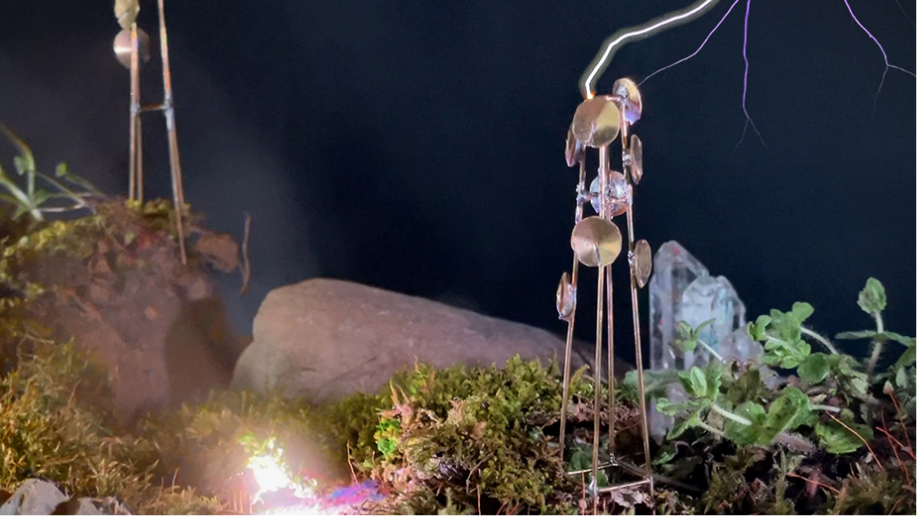
Sketches in Iron by 0xDEAFBEEF

0xDEAFBEEF

Sketches in Iron

Edition of 100

Sketches in Iron thumbnail

0xDEAFBEEF

Sketches in Iron

1/1
Every Icon: BlockPrint by John F. Simon Jr.

John F. Simon Jr.

Every Icon: BlockPrint

Edition of 100

Every Icon: BlockPrint thumbnail

John F. Simon Jr.

Every Icon: BlockPrint

1/1
Rewilded Topography #1  by Wiena Lin

Wiena Lin

Rewilded Topography #1

Edition of 100

Rewilded Topography #1  by Wiena Lin

Wiena Lin

Rewilded Topography #1

1/1
The Interfered Microscopy Plot by Golan Levin

Golan Levin

The Interfered Microscopy Plot

Edition of 100

The Interfered Microscopy Plot thumbnail

Golan Levin

The Interfered Microscopy Plot

1/1
Movie on 06-03-22 at 1.00 PM by Molly Soda

Molly Soda

Movie on 06-03-22 at 1.00 PM

Edition of 100

Movie on 06-03-22 at 1.00 PM by Molly Soda

Molly Soda

Movie on 06-03-22 at 1.00 PM

1/1
0xDEAFBEEF avatar

0xDEAFBEEF is an artist and engineer based in Toronto, Canada. Over the past 20 years he has been tinkering in diverse areas overlapping art and technology including music, sound recording, computer animation, blacksmithing, and generative art. He received his BASc in electrical engineering and MSc from the University of Toronto, where he contributed to internationally recognized research in the field of computer animation. As a classically trained musician with a strong background in sound technology, he brings together all of his interests in a bespoke art practice, using low-level computer code and a minimal toolset to craft raw information into audiovisual artworks. His recent generative works explore the unique affordances of programmable blockchains as both subject and medium.

View Full Profile
John F. Simon Jr. avatar

LocationNew York, U.S.

John F. Simon Jr.’s art career spans over 25 years. He began with pen plotter drawings, continued onto Internet Art, then created software artworks shown as sculptural wall hangings with LCD screens called “art appliances.” Most recently, he uses computer controlled fabrication techniques to sculpt bas-relief wall hangings out of mixed materials. Having written his own software since the 1980s, he is fluent in the use of the computer, manipulating his tool’s potential in imaginative and innovative ways. He produces new artworks each year that continue to be exhibited internationally and acquired by museums. A contemplative drawing practitioner, Simon’s daily drawings inspire his larger artworks. After carefully observing his own intuitive markings, he interprets them using the unique properties of digital media to create artworks in diverse mediums such as: software, laser engraved plastic, machine carved HDU, laser-cut linoleum, inlaid plastic laminate, charcoal, and hand painted gouache drawings. His seminal work “Every Icon” was included in the Whitney’s Biennial Exhibition (2000). Simon’s artworks can be found in the permanent collections of the San Francisco Museum of Modern Art, The Phillips Collection, Collezione Maramotti, The Brooklyn Museum, and the The Los Angeles County Museum of Art, among others. He is represented by the Sandra Gering Inc. gallery in New York City.
View Full Profile
Wiena Lin avatar

Artist

Wiena Lin

LocationNew York, U.S.

Wiena Lin is an artist exploring shared timelines: contemporary lived experiences, the epoch of explosive innovation, and the impending extinction of the human species. Working as a creative director focused on experience design and emerging technology, Lin co-opts and manipulates traditional corporate strategies used to drive individual consumerism to seed a personal “conversion experience” toward climate activism. As such, Lin’s sculptural works document moments of time from the horizons of the near future, capturing the tensions between the lived Anthropocene, impending Singularity, and the natural world destined to survive humankind. In her artwork, Lin seeks to spark a visceral sense of urgency. She wants to empower the individual and collective audience to envision optimistic futures as a first step in individual climate advocacy and an exponential amplification around climate action. Lin’s work has been exhibited internationally with institutions including The Smithsonian Museum, The Himalayas Museum, Institute for the Future, and BMW / ADO. She has created interactive new media experiences for clients including Intel, IBM, Microsoft, Samsung, Google, Bell Labs, Adidas, and Cartier.
View Full Profile
Golan Levin avatar

LocationPennsylvania, U.S.

Golan Levin is an artist, engineer, researcher, and educator interested in new intersections of machine code, visual culture, and critical making. His work combines equal measures of the whimsical, the provocative, and the sublime in an eclectic variety of online, installation, and performance media. Through responsive artifacts, virtual environments, and media provocations, Levin applies creative twists to digital technologies that highlight our relationship with machines, expand the vocabulary of human action, and awaken participants to their potential as creative actors. His projects have engaged themes and materials such as interactive gestural robotics, the tactical potential of personal digital fabrication, new aesthetics of nonverbal interaction, and information visualization as a mode of critical inquiry. Levin has spent more than 30 years as an artist embedded within technological research environments, including the MIT Media Laboratory, Ars Electronica Futurelab, Interval Research Corporation, and the Eyebeam Center for Art and Technology. His work is included in the permanent collection of the Museum of Modern Art (MoMA), has appeared in the Whitney Biennial, and has been recognized with grants from Creative Capital, the Rockefeller MAP Fund, and others. A two-time TED speaker, Levin was named one of “50 Designers Shaping the Future” by Fast Company magazine. He has exhibited widely in Europe, America, and Asia. Levin is currently professor of electronic art in the School of Art at Carnegie Mellon University, where his pedagogy is concerned with reclaiming computation as a medium of personal expression. He teaches “studio courses in computer science” on themes like interactive art, generative form, critical making, and audiovisual performance. With Tega Brain, Levin is co-author of Code as Creative Medium (MIT Press, 2021), an essential guide to creative coding for software arts educators. Levin holds additional appointments at CMU’s School of Design, School of Architecture, Computer Science Department, and Entertainment Technology Center. Since 2009, Levin has also served as director or co-director of CMU's Frank-Ratchye STUDIO for Creative Inquiry, a laboratory for atypical and antidisciplinary research across the arts, science, technology, and culture.
View Full Profile
Molly Soda avatar

LocationNew York, U.S.

Molly Soda is an artist based in Brooklyn, NY. Nearly all of her work lives online, as she uses a variety of social media platforms to host her work, allowing the work to evolve and interact with the platforms themselves. Soda makes videos, installations, and web-based, interactive works that touch on concepts around performing the self, memory, aspiration, and consumer culture.
View Full Profile

On Screen Presence smart contract:ethereum