The Medium is the Medium
A P1×3L is the atomic unit of digital and generative art. It can’t be quantified. A P1×3L is vibrant and alive. Artists choreograph P1×3Ls and P1×3Ls possess artists. P1×3Ls are ideas about image-making that transcend the technology they flow through.
I’m thrilled to bring together Nicolas Sassoon, Francoise Gamma, Andreas Gysin (aka ertdfgcvb), Raquel Meyers, and p1xelfool for the P1×3L exhibition. This is a remarkable group of artists, and each has pushed the boundaries of the fields of digital and generative art in their own ways. As a counterpoint to the stream of technology being developed to make itself invisible, these artists foreground the materiality of their medium. I’ve been looking at their work on sites across the network for a long time, and I felt it was necessary to see it all together.
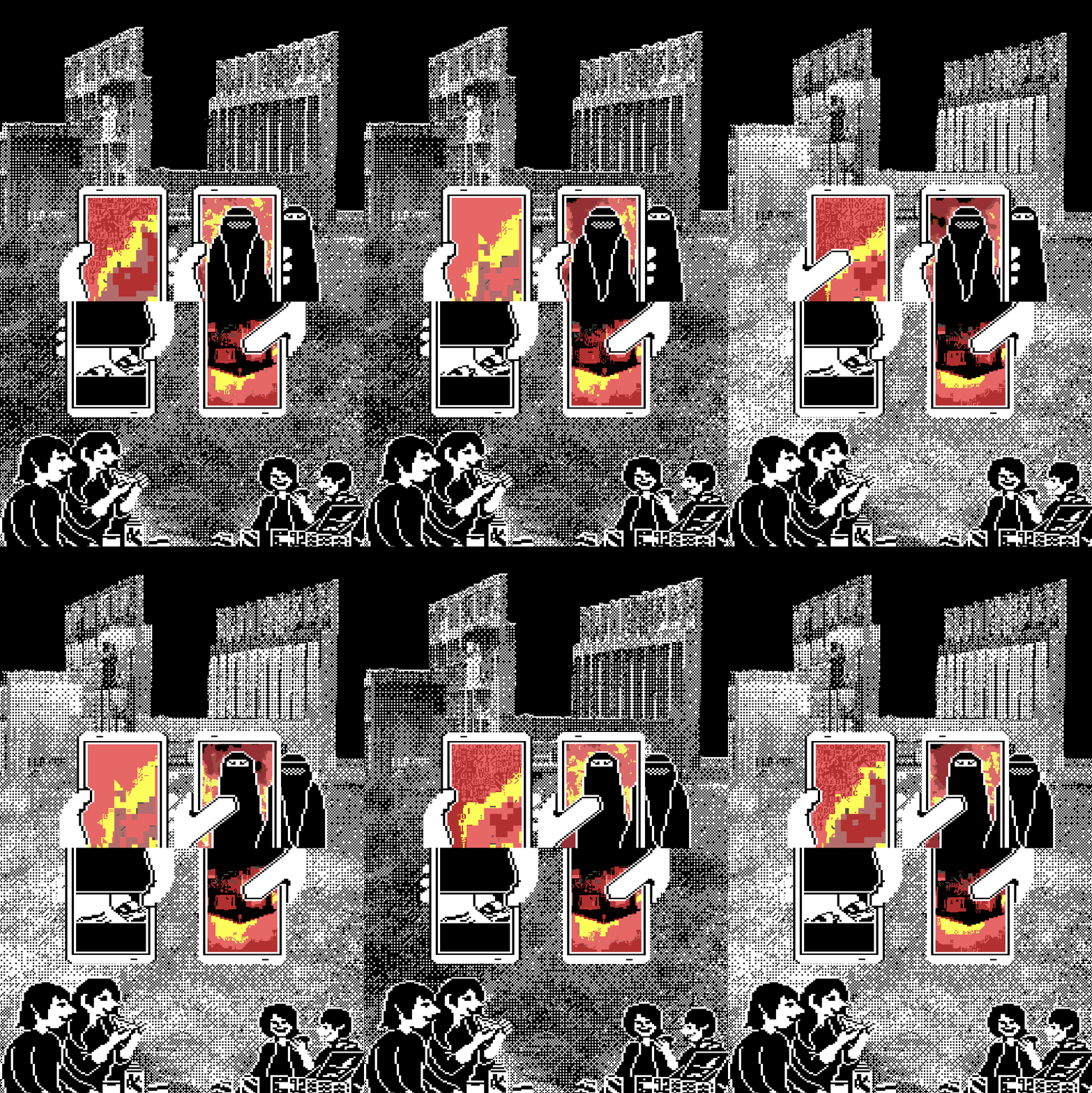
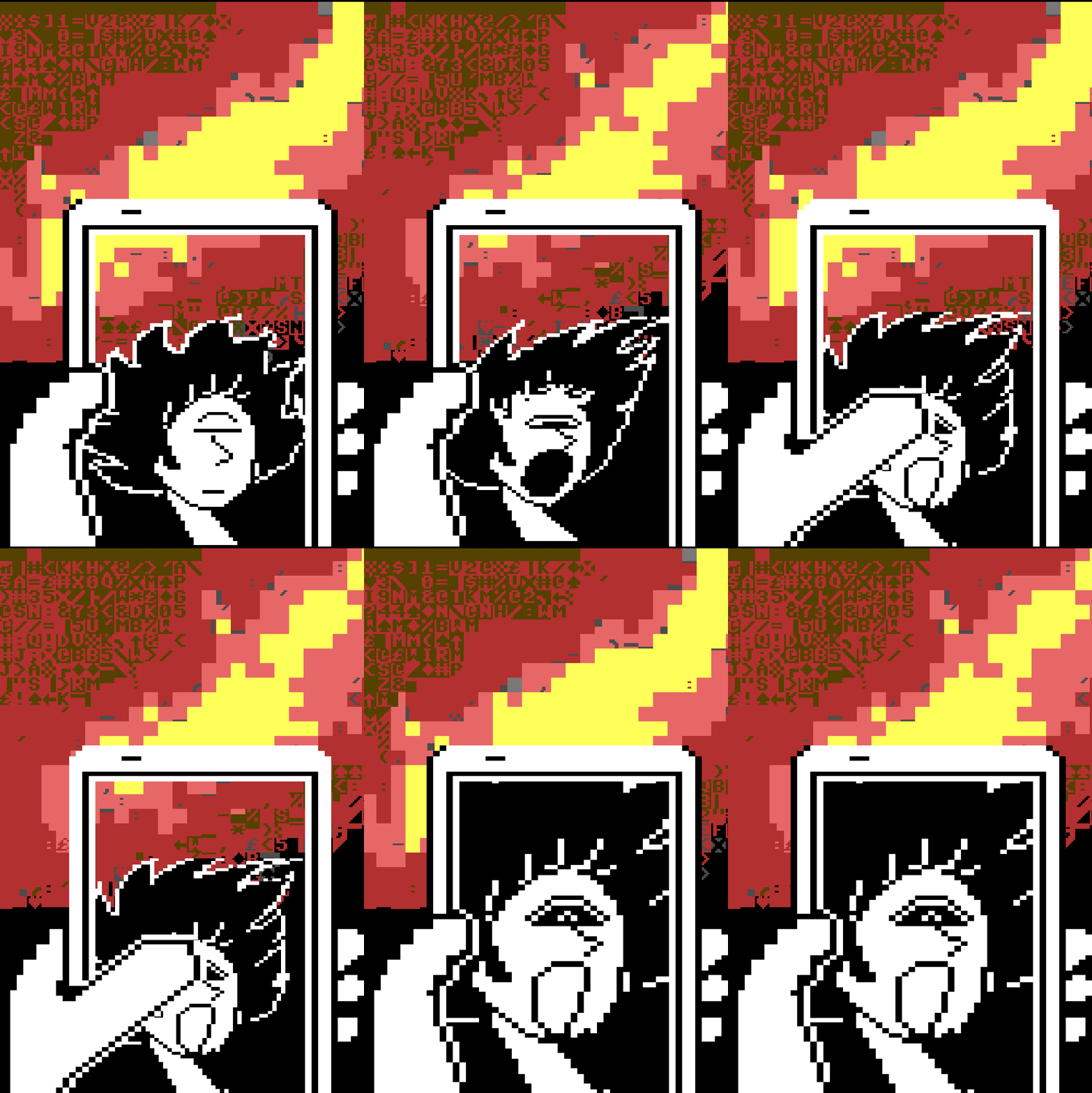
Each of the artists in the P1×3L exhibition use digital media at the core of their practice, but many also have experience making art prior to working with software. When I was speaking with Raquel last month, she began the conversation with a story about her early experiences with photography. Vision through an analog camera of this era is a hybrid analog/digital sight— looking at the world through a glass lens, but with the image divided into crisp grid units. It doesn’t take a stretch of the imagination to see how this early experience informed Rachel’s work from the last decade, in which she creates uniform grids of text and symbols with vintage Commodore 64 computers and Teletext systems. She performs these images live by adding text and symbols from the upper-left corner of a computer screen to the lower right, one symbol at a time. The machines focus her energy and attention — they require her complete concentration. There’s no undo and no distraction from social media notifications or emails coming through. Older computers are her instruments and she is a virtuoso. Yet, even though Raquel uses retro computers to create her work, these actions aren’t performed through the haze of nostalgia.
ertdfgcvb also creates works that refer to bygone decades of computing, and he also does so without feelings of sentimentality. His works are contemporary; they feel unlike anything made before. ertdfgcvb has written code as long as he can remember and has worked for many years within a visual arts practice that spans design and media arts. In the last year, his work has evolved down a few different paths within the growing network of NFT platforms. His long history of sharing sketches and experiments online has transitioned into finalizing works, recording them onto blockchains, and moving on to the next idea. All of ertdfgcvb’ work starts with graphic symbols such as the characters of the Latin alphabet or marks like + and *. These symbols are combined into undulating textures and architectural forms, or deconstructed into smaller pieces of geometry. In all of ertdfgcvb’s work, there’s a strong focus on movement and choreography, and the work is always striking and incredibly well crafted. For Feral File, ertdfgcvb is premiering two new generative software works.
Even though Francoise and I have had an ongoing text conversation for the last couple of months, he remains an enigma. He is a “digitally embodied entity” who emerged from Computers Club, an online art collective founded in 2008 by Krist Wood. Francoise and I have never met and we likely won’t (or maybe we have?), but the work speaks to me with clarity. Francoise’s work has manifested in many different ways over the years, including as low-resolution text displays similar to those of Raquel and ertdfgcvb. The pieces Francoise is exhibiting on Feral File are grounded in drawing, but they represent two distinct lines of visual exploration presented as GIF files. In both, there’s a paradox with jittering lines coexisting with subtle, smooth movement. This disconnect keeps me engaged as my focus shifts from one to the other. Francoise doesn’t include dates for his work, preferring to think of them as at odds with the fast pace of commercial technology. In a technical sense, this work could have been made in another era, but Francoise’s art is timeless. It transcends its method of production.
Nicolas was also active within Computers Club, which he notes was formative for his precise interests in earlier computer graphics. His work has a strong focus on pixelated images and low-polygon 3D models that have limited motion and color palettes. Nicolas has a specific interest in computer graphics that are from the mid-1980s to the mid-1990s, an era of mass distribution of home computers that required image dithering to represent moving and still images. Within this zone of visual culture, Nicolas has gone deep by reading old text sources and spending countless hours running older software. He cites as an influence Steina and Woody Vasulka’s approach of “exploring the matter of the medium,” and aptly describes himself as an analog animator working within a digital video environment. For the pieces Nicolas is debuting on Feral File, he works with aesthetic elements of landscape painting such as depth, color, and atmosphere, but he does this by constructing meticulous, hard-edge pixel terrains without representational elements, using a technique of digital moiré animation that he has developed over years of experimentation. These new works are also informed by imagery from 1960s and 1970s science fiction literature and space opera.
On the topic of precision and pixels, let’s discuss p1xelfool, the anonymous artist who spontaneously appeared on the Hic et Nunc platform in its early days with a looping GIF of prismatic, undulating lines. In the months since, p1xelfool’s work has evolved and diversified. It is characterized by color values that push pixels to their maximum intensity and low-resolution graphics with engorged pixels. It is work that vibrantly activates on the screen, but there’s more to it than just surface—with each piece, the aim is to connect the viewer to the work with complete attention. Through creating software simulations of natural phenomena that focus on the abstractions of forces, rather than how things look, p1xelfool is examining the phenomena of time and consciousness through our relationship to nature. p1xelfool creates all of his work in the Processing software and usually renders out images that are combined into looping GIFs. With this exhibition on Feral File, he is presenting his first software editions. We’re thrilled to premiere this new direction within his work.
The P1×3L exhibition opens on 23 September 2021. Online spaces for digital and generative art are at the highest energy I’ve seen in over two decades, and things have shifted even since we started organizing this exhibition in June. I’m thrilled to present this new work from this group of artists who committed to digital and generative art over a decade ago and remain vibrant creators. Their past work has stood the tests of time and their current work pushes forward.
— Casey Reas, August 2021
P.S. Yes, the name of the P1×3L exhibition was inspired by p1xelfool’s moniker, but my tendency to “hack” English goes back to the original name of the Processing project and it’s early permutations encoded along with Ben Fry: Proce55ing, proc3ssiNg, Pr()ce5s1ng, etc. I’m not sorry if you find it distasteful, but I do ask for your forgiveness. ¯\_(ツ)_/¯