Feral File logoFeral File logo

Reflections in the Water - Art exhibition on Feral File

Curator’s Note

Luba Elliott avatar

Luba Elliott

06 October 2021

Through the lens of AI into the hidden depths of the datasets

Working with AI art sometimes feels like gazing into a pond of water—we are not sure what we will get as a reflection. The exhibition artists’ continued explorations into the natural form and its possibilities of representation with AI over the years have encouraged me to consider what distinguishes this type of art practice from the myriad other ways of depicting humans and the natural world. Looking into a still pond, we see a clear, gently blurred version of ourselves staring back at us, while turbulent waters return mere rippled echoes of our shape. These changing reflections of ourselves are similar to images generated from data, which can be hyperrealistic depictions of the original, or images that are surreal and barely recognizable, as flaws and errors creep in. Reflections in the Water looks at the way artists represent nature and humans, using the latest machine learning technologies to conjure seascapes, imaginary marine creatures, autumn leaves as well as musing on the human form, its shapes and possibilities. Masks and faces akin to the grotesque rear their heads, reminding us both of the early errors of these technologies and the eternal human fascination with depicting ourselves. These artists present AI as a tool to both craft new reflections on perennial subject matters as well as a creative partner, conjuring new landscapes, creatures, and human forms. The focus on nature and human form was because of my desire to present a show that is accessible, tangible, and relatable to the human experience: AI provides ample opportunities for developing artwork that is rooted in technology and its concerns, yet it is also a tool for dealing with our ever present preoccupations and fascinations. As my curatorial practice has been about showcasing the latest AI artworks to broad audiences, it felt right to theme this exhibition on humans and nature—here, after all, technological progress can be most easily measured: humans, creatures, and natural powers are all around us in real life and as art historical subject matter. My time in creative AI began with the rush of excitement occasioned by DeepDream, a neural network that brought out slugs, puppies, and hypnotic colors out of mundane images. Many scientists and emerging artists of the time experimented with DeepDream and related technologies that followed, most notably the GAN, a superior form of generating images by using two neural networks, one that creates and another that judges. GAN technologies have improved much over the years, from producing  lopsided faces and limbs in wrong places to photorealistic images. In a way, this has presented a surprising challenge to AI art practitioners—what to do now that perfect realism is within reach? This limitation has led to an increased focus on the development of individual, non-technology reliant artistic styles as well as more thought out conceptual developments. Reflections in the Water is relevant now. Partly, because the water is becoming increasingly polluted, the algae is blooming, the climate is warming, and therefore the commonplace aesthetics and visual properties of what we know as water may change drastically soon. And partly, because working with AI has the potential to change too, as the technology becomes more predictable and controllable, rendering blurry reflections, distorted forms and uncertain outcomes a thing of the past. The exhibition artists provide a snapshot of the current point in the evolution of our artistic relationship with AI technology, bringing out its occasional formal confusions, distinctive textures and ever present aspects of realism.
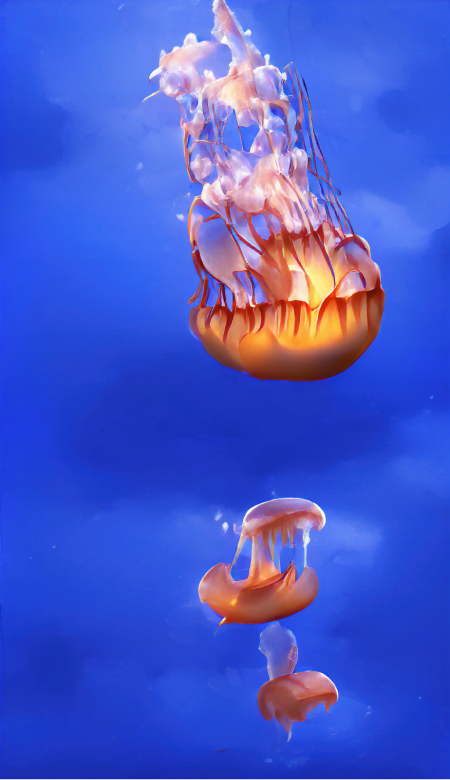
There once was a jellyfish ... by Entangled Others

Entangled Others

There once was a jellyfish ...

Edition of 88

Fragments:30.2051 N, 90.1121 W by Anna Ridler & Caroline Sinders

Anna Ridler & Caroline Sinders

Fragments:30.2051 N, 90.1121 W

Edition of 88

Vague Recollection by Mario Klingemann

Mario Klingemann

Vague Recollection

Edition of 88

Contemplating Motion by Scott Eaton

Scott Eaton

Contemplating Motion

Edition of 88

Solstice Sky Dream by Daniel Ambrosi

Daniel Ambrosi

Solstice Sky Dream

Edition of 88

Pixie by Vadim Epstein

Vadim Epstein

Pixie

Edition of 88

Fragments of Self by Terence Broad

Terence Broad

Fragments of Self

Edition of 88

Venuses (quantum bodies watched by Open Pose algorithm) by Libby Heaney

Libby Heaney

Venuses (quantum bodies watched by Open Pose algorithm)

Edition of 88

Strange Fruit by Mal Som

Mal Som

Strange Fruit

Edition of 88

Neighbors by Yuma Kishi

Yuma Kishi

Neighbors

Edition of 88

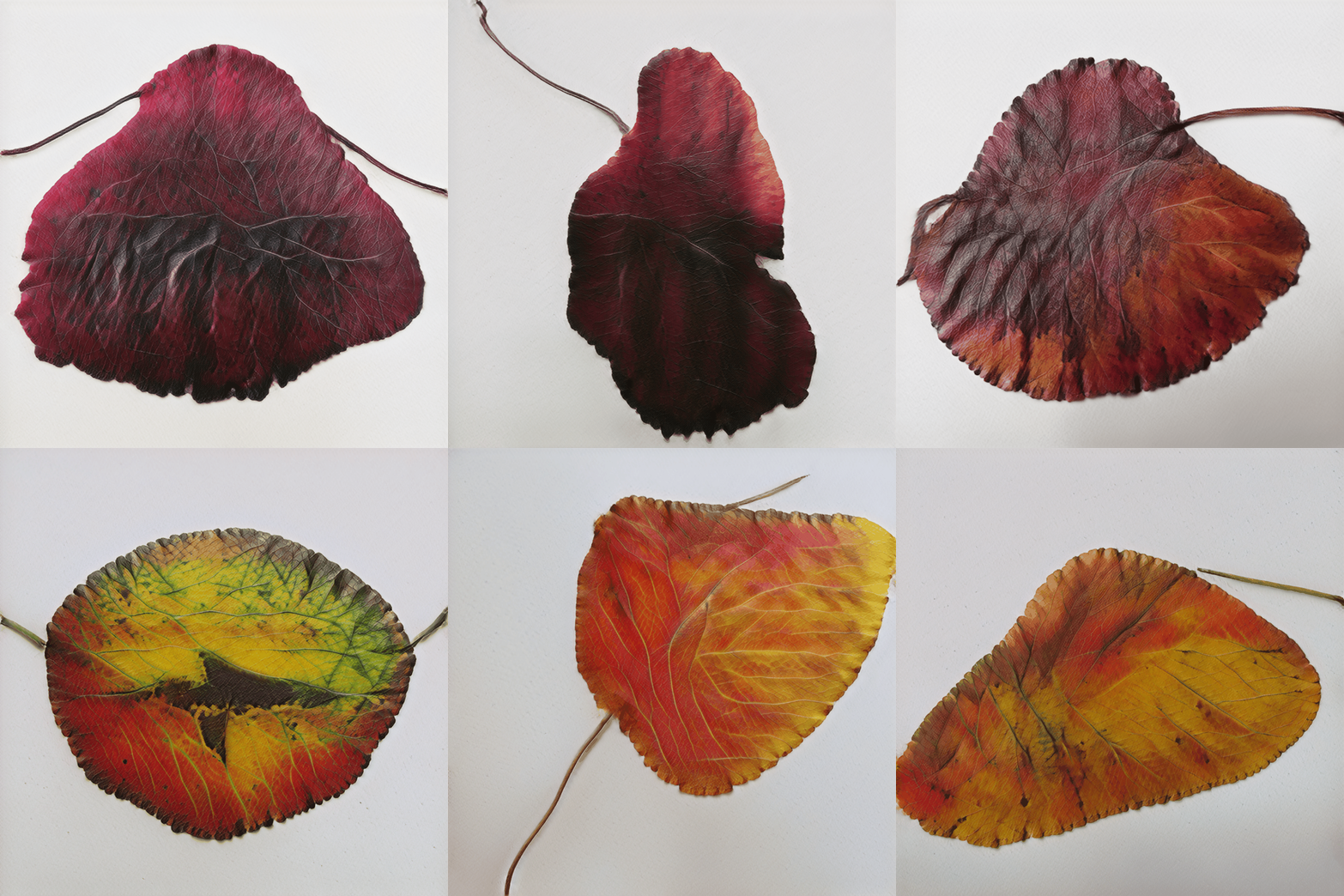
Leaves of Manifold, of Red and Gold by Helena Sarin

Helena Sarin

Leaves of Manifold, of Red and Gold

Edition of 88

CUSP - Marsh Birds by Jake Elwes

Jake Elwes

CUSP - Marsh Birds

Edition of 88

Entangled Others avatar

LocationBerlin, Germany

Entangled Others is the shared studio practice of artists Feileacan McCormick and Sofia Crespo. Their work focuses on ecology, artificial lifeforms and generative arts, with an emphasis on giving the more-than-human new forms a presence and life in digital space. This involves exploring questions of relationship, biodiversity, and awareness through biology-inspired technologies. They highlight how, through conscious efforts, new technology can be used to bring attention and awareness to the unseen that we are tightly interwoven with. Entanglement is a complex state one where no single entity can be said to be separate, or somehow unaffected, by any other present entangled, we cannot consider ourselves without others, act without interacting, speak without being heard.
View Full Profile
Anna Ridler & Caroline Sinders avatar
Anna Ridler is an artist and researcher who works with systems of knowledge and how technologies are created in order to better understand the world. She is particularly interested in ideas around measurement and quantification and how this relates to the natural world. Her process often involves working with collections of information or data— particularly data sets—and exploring how they are created in order to better understand society and the world. She has exhibited at institutions such as the Centre Pompidou, Ars Electronica, HeK Basel, Impakt, and the Barbican Centre and has degrees from the Royal College of Art, Oxford University and University of Arts London. She was a 2018 EMAP fellow and was listed by Artnet as one of nine “pioneering artists” exploring AI’s creative potential. Caroline Sinders is a machine learning researcher and artist obsessed with language, culture, and images. Her work explores the intersections between natural language processing, artificial intelligence, abuse, online harassment, and politics in digital, conversational spaces. Her work has been featured in the Victoria and Albert Museum, MoMA PS1, the Modern Art Museum of Bologna, Ars Electronica, as well as others. She is the founder of Convocation Design + Research, an agency focusing on the use of machine learning and design for public good.
View Full Profile
Mario Klingemann avatar

LocationMunich, Germany

Mario Klingemann is an artist who uses algorithms and artificial intelligence to create and investigate systems. He is particularly interested in human perception of art and creativity, researching methods in which machines can augment or emulate these processes. Thus his artistic research spans a wide range of areas like generative art, cybernetic aesthetics, information theory, feedback loops, pattern recognition, emergent behaviors, neural networks, cultural data, or storytelling. He has been active in the field of blockchain-based art since early 2020 and played an instrumental role in the stewardship and emergence of the ecologically responsible and self-governed NFT community Hic et Nunc. He was winner of the Lumen Prize Gold 2018, received an honorary mention at the Prix Ars Electronica 2020, and won the British Library Labs Creative Award 2015. He was artist in residence at the Google Arts & Culture Lab and has been recognized as a pioneer in the field of AI art. His work has been featured in art publications as well as academic research and has been shown in international museums and at art festivals like Ars Electronica, the Centre Pompidou, ZKM, the Barbican, the Photographers' Gallery, Colección Solo Madrid, Grey Area Foundation, Mediacity Biennale Seoul, the British Library, and MoMA. He is represented by Onkaos, Madrid and DAM Gallery Berlin.
View Full Profile
Scott Eaton avatar

LocationLondon, UK

Scott Eaton is a multi-disciplinary artist exploring the boundaries of figurative representation and abstraction using machine learning (AI) alongside traditional and time-based media. Within this scope, his work strives to examine the human condition and our increasingly complex relationship with technology. His experimental practice uses AI to interpret the form and motion of the figure by combining machine learning with drawing, video, animation, and sculpture. The aesthetic of the work is continually evolving, often mirroring early-Modernist explorations around geometric abstraction and a reductive approach to representing the natural world by simplifying complex forms into primitive surfaces and shapes. But rather than creating still images alone, the magic of machine learning affords the possibility of animating and pushing these abstractions through time, creating a dynamic, unpredictable interplay of forms mediated by the machine but responding to artistic direction. Scott’s education spans his interests in art and technology—he studied engineering at Princeton University and MIT, academic drawing and sculpture in Florence, Italy, and contemporary art at the Royal College of Art. His work has been featured in Wired, GQ, Vanity Fair, and the New York Times and exhibited and collected around the world.
View Full Profile
Daniel Ambrosi avatar

LocationCalifornia, U.S.

Daniel Ambrosi combines computational photography methods with DeepDream technologies to create highly detailed landscape images as a form of human-AI hybrid art. Based near Silicon Valley in Half Moon Bay, California, Ambrosi has been exploring novel methods of visual presentation for almost 40 years since entering the Program of Computer Graphics at Cornell University where he earned a Bachelor of Architecture degree and a Masters in 3D Graphics. In 2011, Ambrosi devised a unique form of computational photography that generates exceptionally immersive landscape images. More recently, Ambrosi's "Dreamscapes" build upon his previous experiments by adding a powerful new graphics tool to his artistic workflow: an enhanced version of “DeepDream,” a computer vision program evolved from Google engineers’ desire to visualize the inner workings of deep learning artificial intelligence models. With proprietary access to a customized version of DeepDream expressly modified by two software engineers, Joseph Smarr (Google) and Chris Lamb (NVIDIA), to operate successfully on his giant images, Ambrosi has created large scale artworks that display exquisite sensitivity and intricacy. Ambrosi's engaging AI-augmented artworks and grand format landscape images have been exhibited at international conferences, art fairs, and gallery shows, installed in major tech offices, featured in multiple publications, and are collected worldwide.
View Full Profile
Vadim Epstein avatar

LocationMoscow, Russia

Vadim Epstein is a media artist, theorist, and practitioner; leading Russian VJ; former IT consultant and theoretical physicist. He has worked in various fields such as net.art, science art, and avant-garde club events since 1996, eventually focusing on visual media. Nowadays, his practice encompasses multimedia vandalism and numeric taxidermy. His current focus is on AI, generative graphics, new media art, and creative coding in general. As an artist and curator, he has made visuals for hundreds of concerts, festivals, parties, and commercial events. His artworks have been exhibited worldwide in Montreal, Vancouver, Stuttgart, Paris, Basel and at institutions such as the New Tretyakov gallery, Moscow Biennale, and HeK Basel. His personal style tends towards bold recognizable aesthetics, combining generative and figurative, with high impact native to post-industrial cultures. Since March 2009 Epstein is the founder and creative director of in[visible] studio, pooling masters of hi-tech visual design and multimedia art. Besides commercial and personal projects, he has delivered numerous lectures, workshops, and training courses at art schools.
View Full Profile
Terence Broad avatar

LocationNewcastle, UK

Terence Broad is an artist and researcher living and working in Newcastle Upon Tyne. He has a research-led practice exploring new methodologies for computational image making. Since 2015 he has been making art using machine learning, engaging with themes of replication, simulation and representation. His research explores new methods that allow for the manipulation of ‘black-box’ AI models, and other strategies for uncovering the latent aesthetic possibilities of generative AI systems. His practice is a process of humanizing technology and giving rise to the possibility for a subjective machine. His art and research have been presented internationally: at conferences and journals such as SIGGRAPH, Leonardo, NeurIPS, EvoMUSART, and ICCC; and museums such as The Whitney Museum of American Art, Garage Museum of Contemporary Art, Ars Electronica, The Barbican, and The Whitechapel Gallery. In 2019 He won the Grand Prize in the ICCV Computer Vision Art Gallery and in 2021 he served on the Jury for SIGGRAPH. His work is in the city of Geneva’s contemporary art collection. Terence Broad is currently a Ph.D. candidate at Goldsmiths, University of London and is a visiting researcher at the UAL Creative Computing Institute.
View Full Profile
Libby Heaney avatar

LocationLondon, UK

Libby Heaney is a visual artist with a PhD in quantum physics, whose moving image works, performances and participatory experiences explore the impacts of emerging technologies such as quantum computing and machine learning. After 8 years as a lecturer and researcher at institutions such as University of Oxford and the National University of Singapore, Heaney became disillusioned by the lack of critical discourses within physics. She retrained as an artist not only to investigate the power structures of technology from wider viewpoints, but to also propose alternative, queer realities subverting the predominent uses of these tools. Now, Heaney uses noise, nonsense, surrealism and affect to create new expressions of collective identity and belonging with each other and the world—a shape-shifting posthuman spirituality. Heaney's work uses diverse media and modes like blurring, combining, remixing, weaving (derived from quantum physics) to unsettle or 'diffract' standard conceptions of 'truth.' From these foggy modes emerge strange new forms that question the distinction between fake and real, visible and invisible, private and public, the individual and the collective, especially where those categories are mediated by technology. She has exhibited widely in the UK and internationally including at the V&A, ICA & Tate Modern in London, Sonar and CCCB in Barcelona as well as Ars Electronica in Linz.
View Full Profile
Mal Som avatar

Artist

Mal Som

LocationBerlin, Germany

Mal Som is an artist made in Cambodia, planted in Los Angeles, and currently based in Berlin. Growing up in the United States as a first-gen Cambodian with Buddhist upbringings, his philosophies have married ancient Eastern views with modern Western pop-culture beliefs. He’s able to reflect on both sides. In an age where everyone is more connected than ever, how do we understand information from another culture in a sensitive way and make use of it? Ignoring other cultures can lead to miscommunication. By exploring cultural conflicts, we can foster deeper understanding and bring new possibilities. This has touched all aspects of his work. Now based in Berlin, he has begun to explore the realm of AI-generated art. While other AI artists explore the expansive and infinite possibilities this medium represents, Mal has concentrated his focus on what he described as “the collapse of diversity in a system.” Mal is a self-taught designer/coder. His background is in philosophy, which he studied at California State University in Long Beach, CA. His key focus in AI is on identity bias, ethical practices, datasets diversity, and its impacts on humans. In general, he gravitates towards experiments that break or stress the limitation of a system. His work explores a constant occurrence in machine learning models, known as mode collapses.
View Full Profile
Yuma Kishi avatar

LocationTokyo, Japan

Yuma Kishi is a contemporary artist working with AI and the human form. Kishi considers AI not as something that imitates people, but as an alien intelligence from another dimension. By relying on it in his artistic process, he creates works in which the digital intelligence and the analog body are always placed in a parallel relationship. In his works, he often borrows motifs from past art history, which are distortedly combined with technology to evoke a sense of momentary dislocation in the viewer's awareness of the self and the world that exists in the here and now. Kishi received his MFA in Image Generation Algorithms from the University of Tokyo in 2019 and is currently a graduate student at Tokyo University of the Arts. He has been part of a number of group exhibitions in Tokyo, including at Mitsukoshi Contemporary Gallery, T-Art Hall, and Gallery Water as well as in online galleries such as the NeurIPS Creativity AI Art Online. This year, he has his first solo exhibition at the Block House in Tokyo. His work has also been featured by Nike and Vogue.
View Full Profile
Helena Sarin avatar

LocationNew Jersey, US

Helena Sarin is a visual artist and software engineer working with cutting-edge technologies for tech companies. At the same time, she has done commission work in watercolor and pastel, as well as in the applied arts like fashion, food, and drink styling and photography. Art and software had always run as parallel tracks in her life —software in the digital realm and art in the analog—until she discovered GANs. Since then, generative models became her primary medium. Sarin is known for her artisanal AI art practice, where she works with small datasets made up of her own sketches, ink drawings, engravings, and photographs, which—through the help of AI technologies—are transformed into images that lie across the digital and the analog realm. Her still lifes inherit the particularities of the media in her datasets—we see traces of pastels, newspapers, and photographs as well as the specifics of the AI models. The results are colourful, energetic, and highly personal. She is a frequent speaker at machine learning conferences delivering invited talks at institutions such as MIT, Eyeo Festival, Library of Congress and TEDx Konstanz. Her artwork has been exhibited at a variety of AI Art exhibitions including in Zurich, Dubai, Oxford, Shanghai and Miami. Sarin has published a series of artist books including the sell-out “The Book of GANesis” followed by “GANcommedia Erudita”.
View Full Profile
Jake Elwes avatar

LocationLondon, UK

Jake Elwes is a media artist living and working in London. He studied at The Slade School of Fine Art, UCL (2013-17). In his art Elwes engages with both the history and tropes of fine art and the possibilities and consequences of digital code with a recent focus on machine learning. His projects explore how we interact with and conceive of technology and artificial intelligence, exploring the technology, philosophy, and ethics behind it, asking questions such as what happens to artistic agency when working with artificial intelligence? What does it mean to collaborate creatively with an unpredictable algorithm, learning from data sets unsupervised, and how does this fit into a history of conceptual and systems art? His practice looks for poetry and narrative in the success and failures of these systems, while also investigating and questioning the code and ethics behind them. His current works in the Zizi Project explore AI bias by queering datasets with drag performers. They simultaneously demystify and subvert AI systems. Jake's work has been exhibited in museums and galleries internationally, including the ZKM, Karlsruhe, Zabludowicz Collection, Ars Electronica, Victoria and Albert Museum and Centre for the Future of Intelligence. He has been featured on ZDF & BBC.
View Full Profile

Reflections in the Water smart contract:ethereum, tezos