
On Generative Ecologies
06 October 2021
On Generative Ecologies
On the occasion of Reflections in the Water, Sofia Crespo and Mario Klingemann spoke to Alex Estorick about the prospects for art after the Anthropocene.
This exchange between editor Alex Estorick and artists Sofia Crespo and Mario Klingemann took place over email in September of 2021.
Alex Estorick: Your works have often revealed new and uncanny forms of life. What prompted your specific contributions to Reflections in the Water?
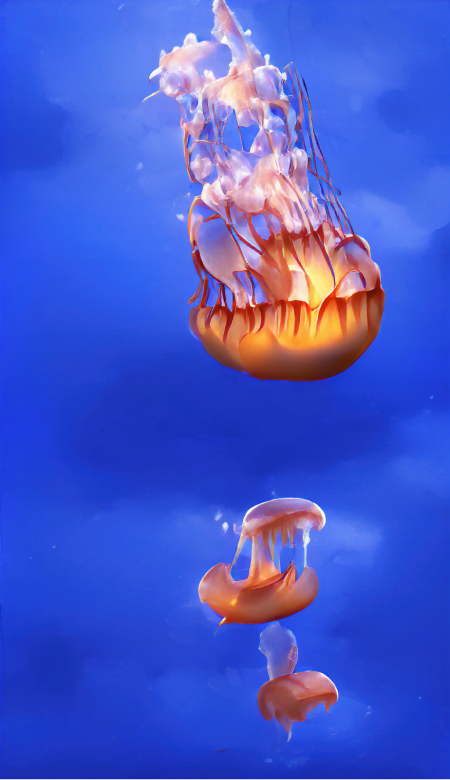
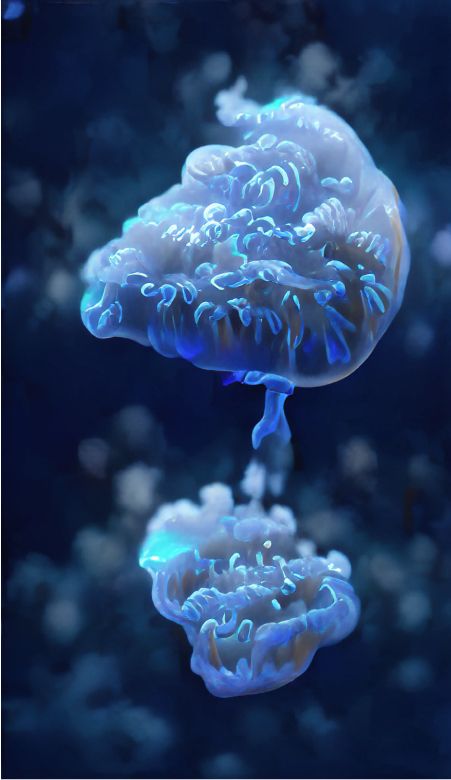
Sofia Crespo: As my main focus is nature and ecology, a lot of my time is spent collecting and creating datasets, often with an aquatic focus. I’ve often experienced the seemingly familiar as highly complex, to the point of being hard to experience, comprehend, or even begin to translate into imagery. For Reflections in the Water I wanted to share some of the wonder and difficulty we face in experiencing even a single “life” of a jellyfish. The reality is we only experience small glimpses of a life far more diverse and mutable than our own. I wanted to try and tell a little fragment of that story.
Mario Klingemann: The aim of my explorations is not to create or reveal new forms of life but rather to find out how much or how little is necessary so that we perceive an artificial system to be “alive,” attribute some form of intelligence to it, or recognize parts of ourselves in it. Deep learning and neural architectures have allowed me to mimic or simulate some of nature’s processes where complexity arises from the interplay of very simple elements.
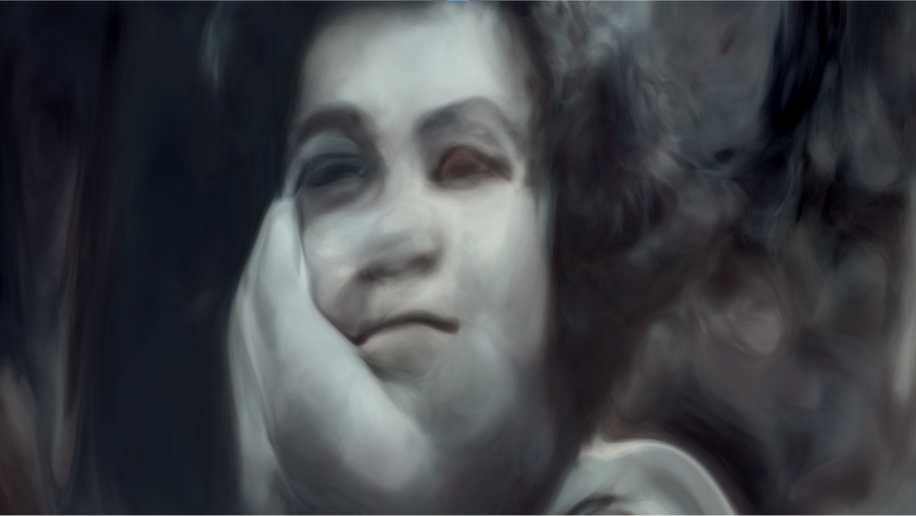
One aspect that never ceases to amaze me is the sheer improbability that beauty or interestingness might arise from noise. “Noise” in this case is “every combination that is possible to create from a given set of choices.” Just as our own planet and civilization is an extremely improbable outlier in the infinite vastness of the universe, so are some of the images or forms that emerge out of the interplay of numbers in neural networks. In my work “Vague Recollection” (2021), the fluctuations of 4096 numbers produce a visual plasma which, for just one moment, finds a configuration where all the numbers are in the “right” relationship to each other, managing to form a face that we might recognize before dispersing into chaos once again.
What does nature mean to you after the Anthropocene? How do you see it evolving and what role can art play in that evolution?
SC: “Nature” in itself is a bit of a loaded term, one that generally implies a division between a natural and an artificial world. Thinking in terms of the Anthropocene has been useful insofar as it has helped us to grasp the contours of the scale of influence we have had on the planet in recent decades, but we shouldn’t lean too heavily on it either. For me art has the potential to help us explore ways of seeing ourselves as part of the world’s ecosystems, nourishing empathy and a greater sense of connectedness and diversity.
It might seem strange to work in digital media with these goals in mind, but even if we experience the digital as somehow separate from the physical, it is in fact tightly intertwined with our world, influencing and in turn influenced by the human and more-than-human alike. Why shouldn’t we be able to have meaningful, positive interactions with the more-than-human in digital as well as physical space?
MK: Nature is currently the only system known to us that is able to temporarily withstand the forces of entropy in the universe. On our planet, processes evolved that managed to transform sunlight into molecular arrangements of a higher order, or as I prefer to call it, “information.” I see art as one of the most complex outcomes of this process since generally speaking it does not serve any purpose other than itself––it is not necessary for our survival and until now humans were the only ones capable of appreciating it or drawing some form of reward from it. But with the advent of deep learning or “AI,” we are now beginning to create entities that might be able to understand or at least perceive art, too. Some of these entities might continue to do so after the extinction of humanity –– as the only “beings” that will remember us or at least tell our story to other intelligent civilizations out there. So I see the transformation from the physical to the digital and towards pure information as a way for our civilization to preserve its creations for posterity and eventually to receive the attention of someone else. As the title of a famous deep learning paper states: “Attention is all you need.” Creating information is not enough, since without someone willing to invest their time in perceiving it––by paying attention to it––it is but a tree falling in a forest.
How would you like to see the blockchain flourish as an ecosystem?
MK: Sustainably. At the moment we are in a “survival of the loudest” phase where the quality of the artwork is not really the important factor of its success, but rather the ability of the players to get noticed at all and their talent to sell their product to an excitable audience with a story they want to hear. My hope is that after this Cambrian explosion where a lot of new possibilities are being tried out (which is a good thing) the capacity for critical review catches up and that we will get to grow and enjoy some gardens within the untamed wilderness. I also hope that in the long run, ecologically responsible proof-of-stake chains or other less energy demanding solutions will prevail.
SC: I think we are still in the very early phase of blockchain ecosystems in the context of art. I’d like these various attempts to keep evolving with the goal of creating healthy, sustainable platforms for artists and collectors. A lot of hype seems to be focused on the purely profitable end of NFTs, i.e. art as an investment, which is fine and perfectly valid, but it isn’t necessarily sustainable for artists or really very different from the traditional art market. It’s important not to forget that art has value beyond the purely monetary. Should we want digital platforms to offer something more, then we need sustainable spaces for artists to create and share with those who would like to experience it.
How do you view the role of the artist when GANs (generative adversarial networks) have become such a fertile means of generating new visions? What kind of originality can we speak of here?
SC: In my practice, GANs are a tool, or an augmentation, that enables me to manifest in a very particular way some of the processes and concepts at the core of what I’m striving towards as an artist. The works, even if GANs are used in their creation, are still the result of a very personal, subjective process. For me the key qualities of GANs are that they allow us to explore the essential qualities of a dataset as “distilled” by a certain set of algorithms––a way of creating a new interface to what we might consider familiar or mundane. Capable of generating countless outputs from a single model, the scale at which we can generate images, videos, and more allows us to navigate the aesthetic space that would normally be obscured by the labor involved in generating an equivalent number of outputs.
MK: GANs or other neural architectures that are able to output ordered information are just unrealized potential, they are yet unexplored new worlds that might hide interesting new species or stunning views. However, without those who set foot into these worlds, who explore and gain the experience that allows them to distinguish the common from the uncommon and to spot the extraordinary, they are only a compact block of unrealized information. This exploration is the role of the artist, but their originality depends on each individual’s ability to add what they find into their personal context and experience in order to catalyze it into something interesting for their audience.
What is the place for a viewer who can no longer differentiate human from machine creativity? Which valley lies beyond the uncanny?
MK: In the end, everything you see that has been created with the help of AI is still the result of human creativity. The role of the machine is that of a lever or a filter that allows those who work with them to concentrate their time and effort better in order to extract what is relevant and interesting from the space of possibilities. The role of the viewer is to be able to distinguish those who are using such capabilities well––who deserve their attention because they are not merely adding more noise but rather enriching experience.
For a valley, one needs mountains. My hope is that the next waypoint on our route out of the valley will be a higher place––one which offers new prospects for our next journey.
SC: I find the question of machine creativity a bit misleading. For now algorithms are still largely restricted in what they can generate by the datasets on which they are trained. As with the images we experience, they are also dependent on conceptual and contextual framing in order to produce outputs that are meaningful in one way or another. I think that the stories we tell are our way of transcending the uncanny and the more-than-human. No matter how real or unreal the outputs, the story itself is what leads to enrichment and growth in a viewer.
The COVID-19 pandemic has flattened the experience of previously discrete image economies. Is digital art the last game standing?
SC: Not at all! I think the pandemic has helped to speed up digital developments and to legitimize generative arts, which has in turn helped many artists through the pandemic. I don’t believe we have reached any kind of endgame as far as the arts are concerned. It’s true there has been a lot of focus and hype lately on the digital end of the arts, but we are best served with as much diversity in media and modes of display as possible in order for artists to maintain a sustainable, healthy practice.
MK: Thanks to COVID-19, the digital has finally been granted the recognition it deserves along with a seat at the grown-ups’ table. However, human beings are still physical creatures and we will never get tired of physical experiences, so I don't think that other forms of art will ever be replaced by the digital. For a while the older folk have had to rest while the youngsters were raving in the ballroom, but the party is not over yet.



