Feral File logoFeral File logo

The Bardo: Unpacking the Real - Art exhibition on Feral File

Curator’s Note

Julie Walsh avatar

Julie Walsh

20 May 2021

The Real and (un)Real

The Bardo: Unpacking the Real is an international exhibition featuring artists from Vienna, Rome, Los Angeles, and New York that quantifies the ephemeral as it relates to the liminal landscape of sculptural art in the digital age. The exhibit examines, 1) the real and (un)real in digital sculpture; 2) questions about what it means to view and collect digital sculptures; and 3) the role of NFTs (in this case, Bitmark NFTs) in the creation of the featured artists' work. When I was three years old my mother began her studies with a high Tibetan lama who lectured from the Kagyu-Nyimgma lineages. While most of my friends were being taught about Western ideas of heaven and hell, I was learning about being “mindful.” As part of my upbringing, I also learned about a concept from The Tibetan Book of the Dead called “the Bardo.” The Bardo is conceived of as a liminal state of being after death, in which you are presented at first with total darkness and empty space as your senses of hearing and sight leave you. Then you see colors, and ultimately you are exposed to images and sounds that you must identify as real or illusion. In this process of unpacking the real, you choose what is real and what is (un)real. If you have spent your life meditating, then you are able to see these images and sounds as emanating from within you, not “real.” Thus, you are able to transcend illusion, the (un)real, and follow a bright light toward reincarnation. If you become afraid of what you see and hear, you assume it is “real,” and you become trapped. In life, fooled by our delusions and illusions, because we are not in touch with what is real, we may arrive in a state which is not dualistic. Buddhism also explores concepts of “relative reality” (the grind of our daily lives) versus “absolute reality,” which is your real self. As my mother often said, “We are always in a Bardo.” In other words, we are always in a state of becoming. These concepts inspired the title of this exhibition for Feral File. Just as we are always in a state of becoming, so could one say that the recreation of sculpture in a digital format is also in an exciting state of flux. When I first began to conceptualize this exhibition of digital art, I had quite a different idea of the real and the (un)real. My idea was to curate a digital sculpture show in which each artwork would incorporate a unique NFT and be sold. During the last month, as a result of the absurd media hype given to NFTs and digital art, I reflected more deeply on how to create a show with the depth and substance that truly resonates with each artist's “absolute reality.” The explosion of sudden interest in NFTs seemed dreamlike and unreal to me. Because of this, the show needed a conceptual reboot. Thus, I reflected on the most dreamlike, unreal, and liminal state of being I could think of-the Bardo. In a recent conversation with my 87-year-old mother, she said that after attending one of my social VR exhibitions, “No art is real. It is all a construct.” If no art is real, then traditional art and digital art become equally constructs, or (un)real. What is digital sculpture? Is it real sculpture? How do you own something that is ephemeral? What is ownership in digital art, anyway? In the Bardo, we each have the opportunity to choose what we believe is real or (un)real. Similarly, one can choose to think about whether digital art is real or not. With questions like these, the artists and I reconceptualized the show as a digital sculpture exhibition where the concept of what and how NFTs are used would become central to the creation and thinking behind the work. “Don't just show your digital art on Feral File; figure out how the NFTs can be more like a medium to be explored.” The question generated a conceptual leap that the artists were eager to explore. To put it another way, we decided to think of using NFTs in the conception of the artworks as being closer in nature to creating site-specific installations, using Feral File as the site. Kant's idea of “the thing in itself”- that we can't comprehend reality in itself, the “monumental world,” because we are too trapped in our own categories and preconceptions-informs this view. As the real becomes more (un)real, or at least immaterial, through digital (re)interpretation, our ability to comprehend, categorize and “place” it requires greater and greater ingenuity if we are ever to approach Kant's ideal. The work in this exhibition demonstrates the unparalleled power of the arts to explore the complexity of such questions in ways that are largely unavailable to other disciplines. As we prepared for this show, the artists had many collaborative discussions about the real and (un)real, and figured out how to take the idea of a sculpture to the next level by reinventing how sculpture can be seen and collected. These digital sculptures can be viewed online in a variety of ways, and some are downloadable as desktop applications, AR apps, and VR experiences. A few of the artists took 3D scans of existing physical objects and used these as a departure point as they merged these IRL (in-real-life) objects, such as face or body scans, with sculpted forms from their imagination. Thinking about the real and (un)real also led the artists to ask how you can own something that is ephemeral, such as a digital file, and how a collector can use what she has purchased. As such, The Bardo: Unpacking the Real features many different innovations around the notion of ownership. A range of solutions were created, including buying a ticket that gives you a secret password to view a file, to “owning” the right to see what's inside a peep box, to accessing not just the ability to see a sculpture, but the privilege of using it for new purposes, thus giving a new life to the digital file. This is an exhilarating time to be curating a show of digital sculpture art, as the possibilities of what sculpture can be-and how one can view sculpture-is in a constant state of flux. The Bardo: Unpacking the Real exemplifies the creativity, enthusiasm, and energy (both human and electromagnetic) that reflects this historic time in art history.
Kiki.object by Claudia Hart

Claudia Hart

Kiki.object

Edition of 200

peep-o-rama by Carla Gannis

Carla Gannis

peep-o-rama

Edition of 200

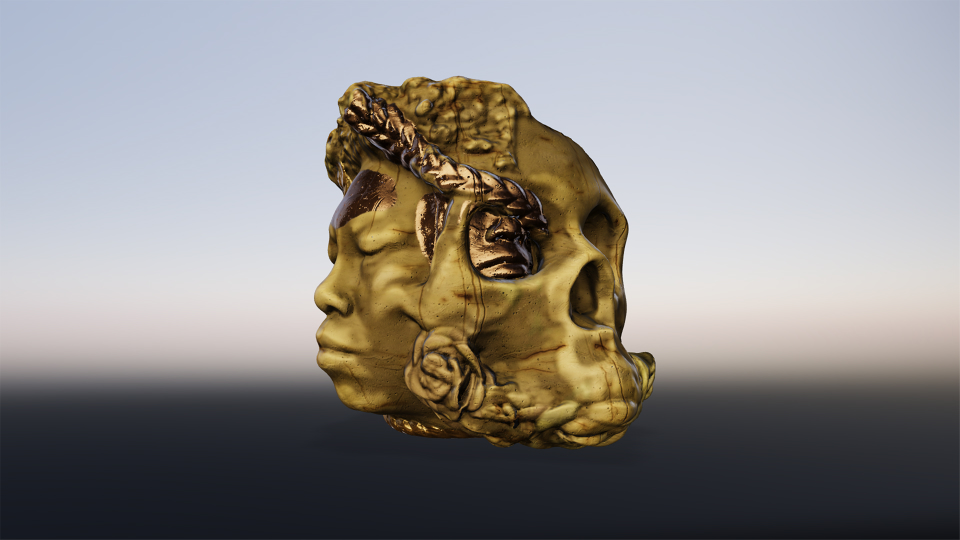
The Mystery [v5-dv1]  by Auriea Harvey

Auriea Harvey

The Mystery [v5-dv1]

Edition of 200

it's a matter of perspective by Martina Menegon

Martina Menegon

it's a matter of perspective

Edition of 200

Spectrality (from The Divers, IX) by Sophie Kahn

Sophie Kahn

Spectrality (from The Divers, IX)

Edition of 200

Slipstream 001 by Nancy Baker Cahill

Nancy Baker Cahill

Slipstream 001

Edition of 200

Earmark by Matthew D. Gantt

Matthew D. Gantt

Earmark

Edition of 200

Claudia Hart avatar
Claudia Hart emerged as part of the generation of ’90s intermedia “identity” artists. Hart’s first works were feminist critiques of patriarchy and power, taking the form of fake children’s books for adults. In 1995, Penguin published Hart’s A Child’s Machiavelli, a series of oil paintings which was republished last year as a new edition. In 1998, the artist expanded to become an early adopter of 3D animation, her intentions now updated by new media. Simulations technologies pushed her practice to explore issues of the body, perception, and nature collapsing into technology and back again.
View Full Profile
Carla Gannis avatar

LocationNew York

Carla Gannis is an interdisciplinary artist based in Brooklyn, New York. She produces works that consider the uncanny complications between grounded and virtual reality, nature and artifice, and science and science fiction in contemporary culture. Fascinated by digital semiotics, Gannis takes a horror vacui approach to her artistic practice, culling inspiration from networked communication, art and literary history, emerging technologies, and speculative design. Gannis’ work has appeared in exhibitions, screenings, and internet projects across the globe. Recent projects include “Portraits in Landscape,” Midnight Moment, Times Square Arts, NY and “Sunrise/Sunset,” Whitney Museum of American Art, Artport. A regular lecturer on digital art and extended reality, in March 2019 Gannis was a speaker at the SXSW Interactive Festival on the panel “Human Presence and Humor Make Us Better Storytellers.” Gannis holds an MFA in Painting from Boston University. Currently, she is Industry Professor at New York University (NYU) in the Integrated Digital Media Program, Department of Technology, Culture and Society, Tandon School of Engineering. She is also a Year 7 Member of NEW INC, in the XR: Bodies in Space track, New York, NY.
View Full Profile
Auriea Harvey avatar

LocationRome, Italy

Auriea Harvey is a Rome-based artist whose practice encompasses virtual and tangible sculptures, drawings, and simulations while blending digital and handmade production. She is primarily concerned with making the mythological world visible through form, interaction, and immersion. Her works are a synthesis of art historical reference and imagination, and she is engaged across time, media, and material to define what sculptural production means in the present moment.

Harvey is half of the award-winning artist duo known as Entropy8Zuper!/Tale of Tales/Song of Songs, known for their pioneering works in internet art, video games, and mixed reality. Her work can be found in the permanent collections of institutions such as the Whitney Museum of American Art, Buffalo AKG Art Museum, Walker Art Center, KADIST Collection, RF.C Collection, and Rhizome’s Net Art Anthology. Her video games and VR works have been featured internationally within exhibitions at the Tinguely Museum, Basel; the Victoria & Albert Museum, London; the New Museum, New York; Brooklyn Academy of Music, New York; and ZKM, Karlsruhe.

View Full Profile
Martina Menegon avatar
Martina Menegon is an artist working with interactive and extended reality art. In her works, Martina creates intimate and complex assemblages of physical and virtual elements that explore the contemporary self and its synthetic corporeality. She experiments with the uncanny and the grotesque-including the self, the body, and the dialogue between the physical and virtual realities-to create disorienting virtual experiences. Martina is a University Assistant and Lecturer at the department of Transmedia Art at the University of Applied Arts in Vienna, where she teaches “Digital Design and Virtuality.” She also teaches multimedia tools for interactive arts at the IUAV University in Venice (MA Digital Exhibit, BA Multimedia Arts) together with Klaus Obermaier and Stefano D'Alessio. She is currently Head of Extended Reality and Curator at “Area for Virtual Art,” a platform for immersive experiences and get-togethers. She is also part of the curatorial team of the new media art festival of Vienna, CIVA Festival. Martina Menegon currently lives and works in Vienna, Austria.
View Full Profile
Sophie Kahn avatar

LocationNew York, U.S.

Sophie Kahn is a Brooklyn-based sculptor and digital artist whose work addresses technology’s failure to capture the unstable human body. She was born in London and grew up in Melbourne. She earned a BA (Hons) in Fine Art/History of Art at Goldsmiths College, London; a Graduate Certificate in Spatial Information Architecture from RMIT, Melbourne; and an MFA in Art and Technology at the School of the Art Institute of Chicago. Her recent exhibitions include Dematerialized, Mozilla Hubs/VR; In the Bardo, Feral File; Synthetic Corpo-Reality, MEET Digital Art Center, Milan; Transfigured, C24 Gallery, New York; and Out of Body - Sculpture Post-Photography, bitforms, New York. Her work has also been included in numerous festivals including the Japan Media Arts Festival and Transmediale. She has taught at Pratt Institute in New York and at Columbia College in Chicago and completed residencies at NARS, the Museum of Arts and Design, Pioneer Works, and the Elizabeth Foundation for the Arts Studio Program. Kahn is a New York Foundation for the Arts Digital and Electronic Arts Fellow.
View Full Profile
Nancy Baker Cahill avatar

Nancy Baker Cahill is an interdisciplinary artist and expanded filmmaker whose hybrid practice focuses on systemic power, consciousness, and the human body. She creates research-based immersive experiences, video installations, and conceptual blockchain projects rooted in the history of drawing. Her monumental augmented reality (AR) artworks extend and subvert the lineage of land art, often highlighting ecological imagination, civics, and a desire for more equitable futures. She is the Founder and Artistic Director of 4th Wall, a free, AR public art platform exploring site interventions, resistance, and inclusive creative expression.

Baker Cahill’s globally-exhibited geolocated AR installations have earned her profiles in The New York Times, Frieze, and The Art Newspaper, among other publications. In 2023, the Georgia Museum of Art exhibited her first solo mid-career survey, which will travel through 2025. The Whitney Museum of American Art commissioned and acquired CENTO, the museum’s first participatory AR project co-built by a global audience, on view through 2024. She will premiere her immersive, expanded film SEEK in 2024, marking the inaugural art experience at COSM in Los Angeles.

Baker Cahill is an artist scholar alumnus of the Berggruen Institute and a TEDx speaker. In 2021, she was awarded the Williams College Bicentennial Medal of Honor and a C.O.L.A. Master Artist Fellowship. She is a 2022 LACMA Art and Tech Grant recipient, and 2024-5 Harvard metaLAB Affiliate. Her work is held in the collections of the Los Angeles Museum of Contemporary Art, Los Angeles, CA; Whitney Museum of American Art, New York, NY; The Museum of Art and History, Lancaster, CA; RFC Art Collection, Miami, FL; and 0x Collection, Prague, CZ.

View Full Profile
Matthew D. Gantt avatar

LocationTroy, NY

Matthew D. Gantt is an artist, composer, and educator based between NYC and Troy, NY. His practice focuses on sound in virtual spaces, generative systems facilitated by idiosyncratic technology, and digital production presets as sonic readymades. He worked as a studio assistant to electronics pioneer Morton Subotnick from 2016 - 2018, and has been an active participant in the New York creative community, presenting or performing at spaces such as Pioneer Works, Issue Project Room, Roulette, Babycastles, New Museum, SVA Visible Futures Lab, Panoply Performance Laboratory, and countless DIY venues across the US as well as abroad (IRCAM Academy, Paris, Koma Elektronic/Common Ground, Berlin). Gantt releases music with Orange Milk and Oxtail Recordings, and has taught experimental composition at both institutional and DIY spaces, including NYC non-profit/public media studio Harvestworks, CUNY Brooklyn, Bard College, Sarah Lawrence, and a variety of community workshops aimed at creating equitable access to developing technologies. Gantt’s work has been featured in The Wire magazine, Pop Matters, Exclaim!, Tiny Mix Tapes, Bandcamp New and Notable and similar. In Fall 2019, he joined the Electronic Arts PhD program at Rensselaer Polytechnic Institute/EMPAC, researching spatial sound in virtual reality, telematic performance, and strategies for leveraging experimental arts practice as a frame to refigure immersive media futures.
View Full Profile

The Bardo: Unpacking the Real smart contract:ethereum