
How Digital Sculpture is Blurring and Bending Reality
20 May 2021
How Digital Sculpture is Blurring and Bending Reality
Curator Julie Walsh on using art to jump between dimensions, being playful with the concept of ownership, and how artists are decloaking the NFT format.
This conversation happened on May 5, 2021 between Julie Walsh—the curator of The Bardo: Unpacking the Real—and editor Willa Köerner.
Can you walk us through the top-level ideas in the exhibition you’ve curated for Feral File, The Bardo: Unpacking the Real?
“The Bardo” refers to a liminal state where we are put to the important task of figuring out what is real versus what is unreal. When we’re able to recognize imagery and sounds as unreal or self-created, we are then able to transcend the Bardo into enlightenment. In a similar way, viewing “unreal” digital sculpture can bring up questions about our blended realities, and help us interpret what’s “real” outside of binary terms.
In many cases, the artists in this exhibition are translating IRL (“in real life”) objects into the liminal space of the internet. The sculptural work in this show walks a fine line in terms of what we call “reality.” For example, if a 3D model can be 3D printed, in my mind, that’s a way of jumping between realities. In Buddhism they say, “We are always in a Bardo, or a state of becoming.” You could also say that digital art is in a constant state of becoming.
What draws you to digital sculpture in particular, and to works that prod at our concept of reality?
Digital sculpture is a topic that I’ve been quite obsessed with lately. It is fascinating to me how the trajectory of sculpture-making throughout time has evolved in many ways—but also stayed the same. It always starts with a person who is inspired by something, and then uses their imagination and their hands to work with clay, or wood, or any other medium, to create form. With digital sculpture, it’s a very similar process—except they’re translating whatever inspired them into an “unreal” format.
The first time I engaged with digital sculpture, it was like a light going off in my mind. As somebody who had a gallery for 18 years and did many, many exhibitions of sculpture in real life, the idea that you could take an ephemeral file and have this very intimate, personal encounter with a sculptural object in an entirely new kind of space felt remarkable to me.
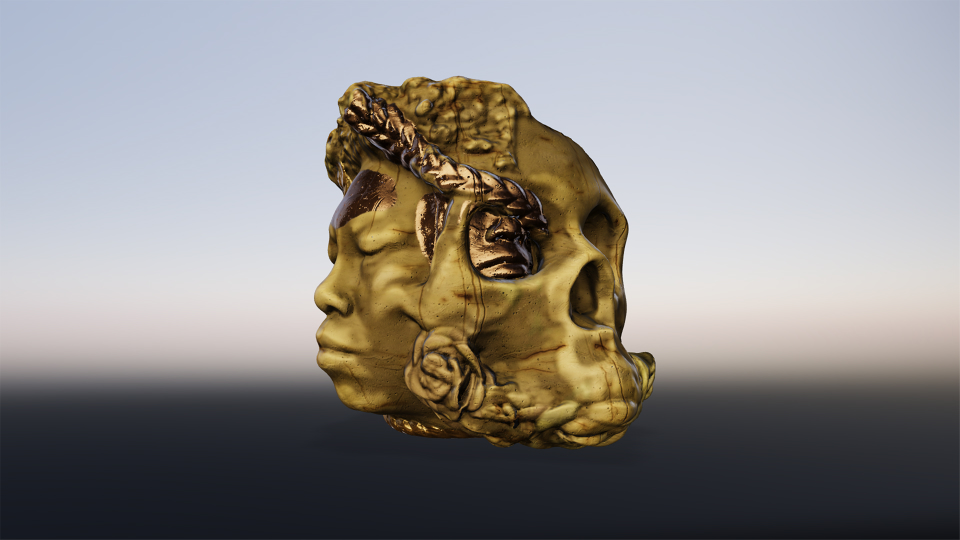
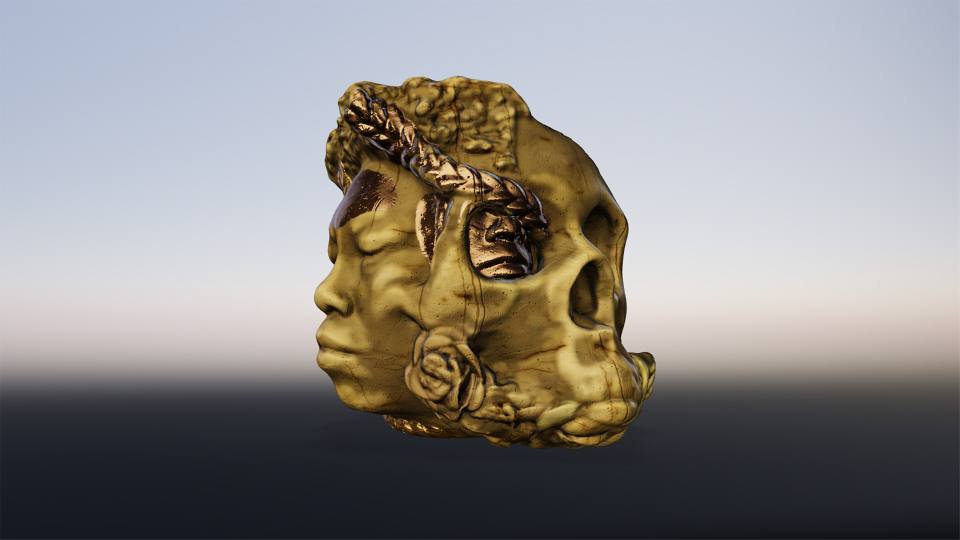
Artist Auriea Harvey, for example, has a long history of creating physical sculptures, and her digital work takes physical, real objects and scans them into 3D models. In this way, she creates this fusion between real-life objects and their digital counterparts. As another example, Sophie Kahn’s work explores what happens when you take a 3D object, laser scan it, and then transmit that data into a digital space, asking questions like, “What is lost? How does the work translate?” Similarly, Martina Menegon’s work explores notions of reality and truth, and digs into how those concepts change with digitalization and technology. I find these kinds of reality-bending explorations thrilling.
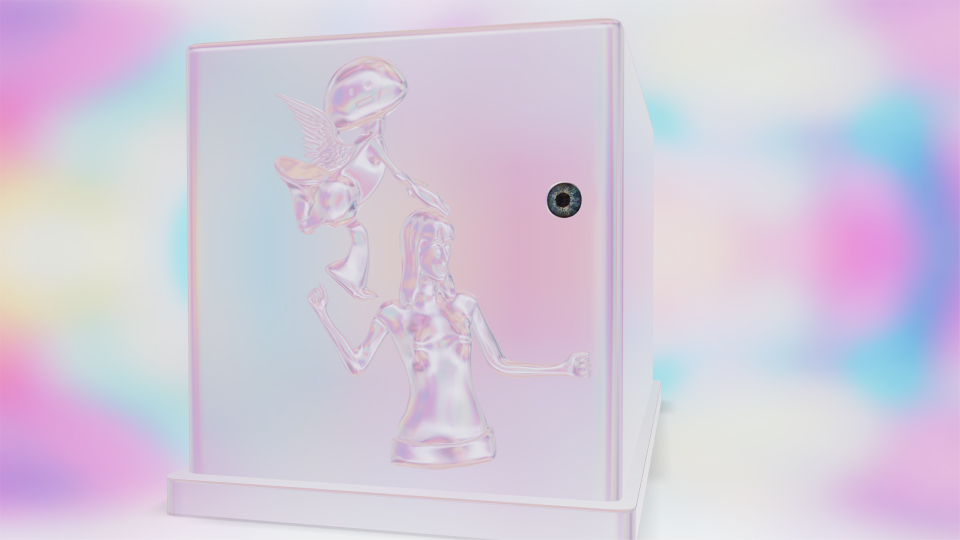
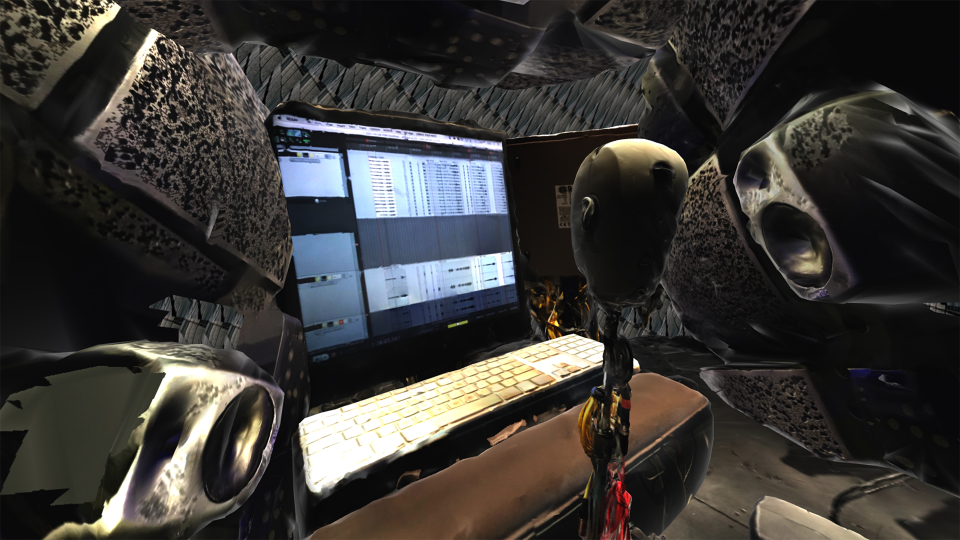
With so many of the artists in this exhibit, their digital sculptures are meant to be enjoyed in new ways. Fundamentally, they are something you can engage with—something you can put on your desktop, something you can interact with by turning it upside-down, or even entering it, in the case of Carla Gannis’ “peep-o-rama” piece. And Matthew D. Gantts’ piece is quite interesting, as you’re able to move through a virtual environment while listening to sound sculptures that, while completely ephemeral, are based on distortions of real instruments. I think it’s this sense of limitlessness in terms of how you can interact with these formats that is so fascinating to me.
Where do you see digital sculpture heading? Are there certain trends you’re starting to see emerge now that you think will continue to develop?
In the future, I think we’re going to see more and more of these blended realities—like when you have a traditional sculpture exhibited in real life, and there’s also an augmented reality overlay on it. With that kind of experience, your phone lets you see an entirely new part of the sculpture that you wouldn’t be able to access if you were just looking at it with your eyes. This trend of using art and technology to blend physical and digital realities is something that will continue to evolve and grow.
One thing I noticed is that a lot of the artists in your show have created multi-layered digital experiences that can only be seen or unlocked once a collector has purchased a piece. What has it meant for the artists in your show to explore these questions of access and ownership in relation to digital sculpture and, more specifically, in relation to the NFT format?
It all circles back to the question of ownership. In developing this show with the artists, we wanted it to be more than just a digital sculpture show—we also wanted to stage a serious investigation of how the NFT format can be integrated into an artist’s work. Thoroughly thinking this through felt like taking a quantum leap for everybody, especially as we considered what it means to own an NFT.
All of the artists in this show were considering, “What does it mean to own a digital file?” And so, the artists were able to come up with these great solutions and innovative ways of thinking about that—whether purchasing their NFT is like buying a ticket to a special experience or giving you a secret password.
On Feral File, works can be purchased in a variety of file formats. As a collector, this gives you huge flexibility in terms of what you do with the pieces you collect. In some cases, for example with Auriea Harvey, she really wants people to use the different file formats that are downloadable with her piece in whatever way is most meaningful to the collector. Her idea is that this gives her files a new life, which I think is an interesting concept too.
In your curator’s note, you mentioned that the recent explosion of NFTs has felt “dreamlike and unreal” to you. Can you say more about that?
When I was first working on this show, I was imagining it as just a digital sculpture show. But then I happened to get a concussion. When you have a concussion, your processing speed is greatly reduced—I suppose it’s equivalent to being in a perpetual brain fog. Right at the same time, the digital art world was in the process of becoming something entirely different, with the sale of the Beeple NFT for over $69 million. Suddenly, there was all of this drama and insanity and media hype.
Meanwhile, with my concussion, I wasn’t supposed to look at a screen or even read. So I was getting all of this information third-hand from my husband, who was reading my emails to me as artists were sharing all of these things that were going on in the digital art landscape with NFTs. As it was happening, it really seemed unreal to me—partly because of my concussion, and partly just because the scale of the escalation happened so quickly and felt so out of the blue.
The NFT boom made me think of when I ran a gallery that specialized in contemporary Asian art, and one of the artists that I had represented suddenly started doing very well. But it turned out his price point had been artificially inflated by a dealer going to auction houses and planting people to bid on his work to intentionally drive up his prices. While that worked for a while, ultimately the value of his work tanked, because the demand for it had been pumped up artificially.
In the same way, these insanely high NFT sales feel artificial and unreal to me. So while I had my concussion, and while I was conceiving of this show, it became important to me to use the platform as a way to create a serious response with well-known and respected artists who were capable of de-cloaking the NFT format of its hyped-up reputation, and seeing what else could be possible.
The artists in The Bardo: Unpacking the Real are not just taking an image or GIF of their work and putting it on the blockchain. Instead, they’re really incorporating the technology of the NFT—and what it’s capable of—as an element to be played around with.
Yes, absolutely. The artists were thinking about, “If 200 people are going to own one single piece of mine, what can that mean in relation to the work? What type of flexibility can I give to the collector to optimally experience my work in the most fascinating way possible?”
Another cool thing is that with other NFT platforms, the artists are restricted to a few kinds of file types and the artwork is limited in file size. Feral File, on the other hand, allows for more ambitious and multi-part artworks. So, for example, when you collect Carla Gannis’ piece, you are able to experience all these different versions of her work. There’s a Mozilla Hubs experience, there’s a social web-based experience, there’s a VR version—and you can download all of these.
With Auriea’s piece, you can actually send the downloadable files to be 3D printed. She says, “Go ahead. You can have this printed, and here’s how you do it—and you can do it as many times as you want.” That’s remarkable.
That’s a good point. Most other NFTs also stop short of giving collectors a clear way to live with the works, and in many ways that’s always been the trickiest part of collecting digital art: how do you create the right conditions to appreciate ephemeral digital art in the way you can perpetually live with and enjoy a painting on your wall?
With the Bitmark NFT, the property rights, the collector rights, and artist rights are all integrated into the NFT, which is very unique. This gives both the artists and collectors so many different ways to approach the question. As I said before, it comes down to not just appreciating what you own, but being able to engage with it in some way—whether it’s putting a poster on your wall, or printing out a set of Auriea Harvey’s 3D beads that you turn into a necklace.
With digital work, there can also be a variety of ways to enjoy the art without worrying about messing it up. This makes it less sacred and just more approachable. The fact that you can rotate a digital sculpture and turn it around and upside-down, or use an AR app to walk around and see the work in your home or backyard, wherever it is. This is a whole new way of interacting with your art collection.
As a final question, do you feel like there is a distinction between what’s real and unreal—or is that sort of a fabricated binary?
You know, this is a very deep question, because it touches on a lot of other topics ranging from philosophy to psychology. And with mental illness, the boundaries between the real and the unreal are even more complicated. For a person who is schizophrenic, they may see hallucinations, which may feel extremely real to them. But it just goes to show that it’s a continuum—what’s real and unreal exists between many shades of gray.
Now, with all of these innovations happening in technology, distinctions between what’s real and unreal are becoming more and more ambiguous. Even something like the pandemic has thrown reality into question. I periodically will look down the street and see everybody wearing masks, and ask myself, “Is this really happening?” So, I don’t know, we’re in a strange period where I feel like the rules of reality are being rewritten on a day-to-day basis.
Yeah, it’s very true. We’re all inventing our own personal realities while simultaneously trying to come to terms with a shared reality we can all agree upon.
Being the mother of three kids, I can’t stop wondering, “What will happen to toddlers who spent kindergarten online? How different is their idea of reality going to be?” For them, a Zoom call is just like a walk in the park. There is not a big difference. They’re seeing their classmates, they’re seeing their teacher. You think about how many people didn’t know what a Zoom call was before the pandemic, and now, everybody just thinks of it as a normal part of their day.
This shift we’re experiencing now—where digital experiences are being fully embraced as part of our everyday realities—is going to have a huge impact on the way that digital art is perceived. In my mind, it will finally be getting the recognition it has always deserved.



