Feral File logoFeral File logo

WETWARE - Art exhibition on Feral File

Curator’s Note

Mindy Seu avatar

Mindy Seu

15 June 2022

Cyberfeminism Mutates

Cyberfeminism is a mutating word with a nebulous history. Its evolution is less a single root system with multiple branches than a network of entangled rhizomes, constantly and multidirectionally moving. Coined in the early 1990s by the British cultural theorist Sadie Plant and artist collective VNS Matrix, the word cyberfeminism takes on its prefix “cyber” — recast from Cybernetics, a 1948 book by Norbert Wiener, and “cyberspace,” from William Gibson’s 1984 novel Neuromancer — as a provocation. This cyberspace of the 1980s was stocked with and characterized by cyberbabes and fembots, a techno-utopian imaginary of the male gaze. “Cyberfeminism” prompted women and marginalized communities to imagine how a reoriented cyberspace could look. By now, three decades after its origination, cyberfeminism has shifted from a loose artistic movement exploring the emancipatory potential of cyberspace towards a collective drive to provide software, hardware, and wetware education and to get marginalized groups online. Today, with questions of technology more and more clearly “bound together with questions of ecology and the economy,” as noted by Cornelia Sollfrank, the term is self-reflexive: technology is not only the subject of cyberfeminism, but its means of transmission. It’s all about feedback. WETWARE showcases nine artists to celebrate and support their work and the upcoming publication CYBERFEMINISM INDEX, slated for an October 2022 release with Inventory Press. Drawn from the terms “hardware” and “software,” wetware, by definition, applies to the computational ability of biological life forms, though the term has become slang for biotechnologies. Here, we twist the term, calling WETWARE to focus on the embodied, slimy components of technology, and the organic, rhizomatic nature of networks. Shown in chronological order, we present seminal cyberfeminist artworks from the early 1990s to pornographic and techno-spiritual pieces from the early aughts, and contemporary adaptations and brand new commissions from 2022. Each artist is also featured in the publication CYBERFEMINISM INDEX and suggest a wide web of cyberfeminism’s continuous evolution. Preorder the book: http://www.inventorypress.com/product/cyberfeminism-index
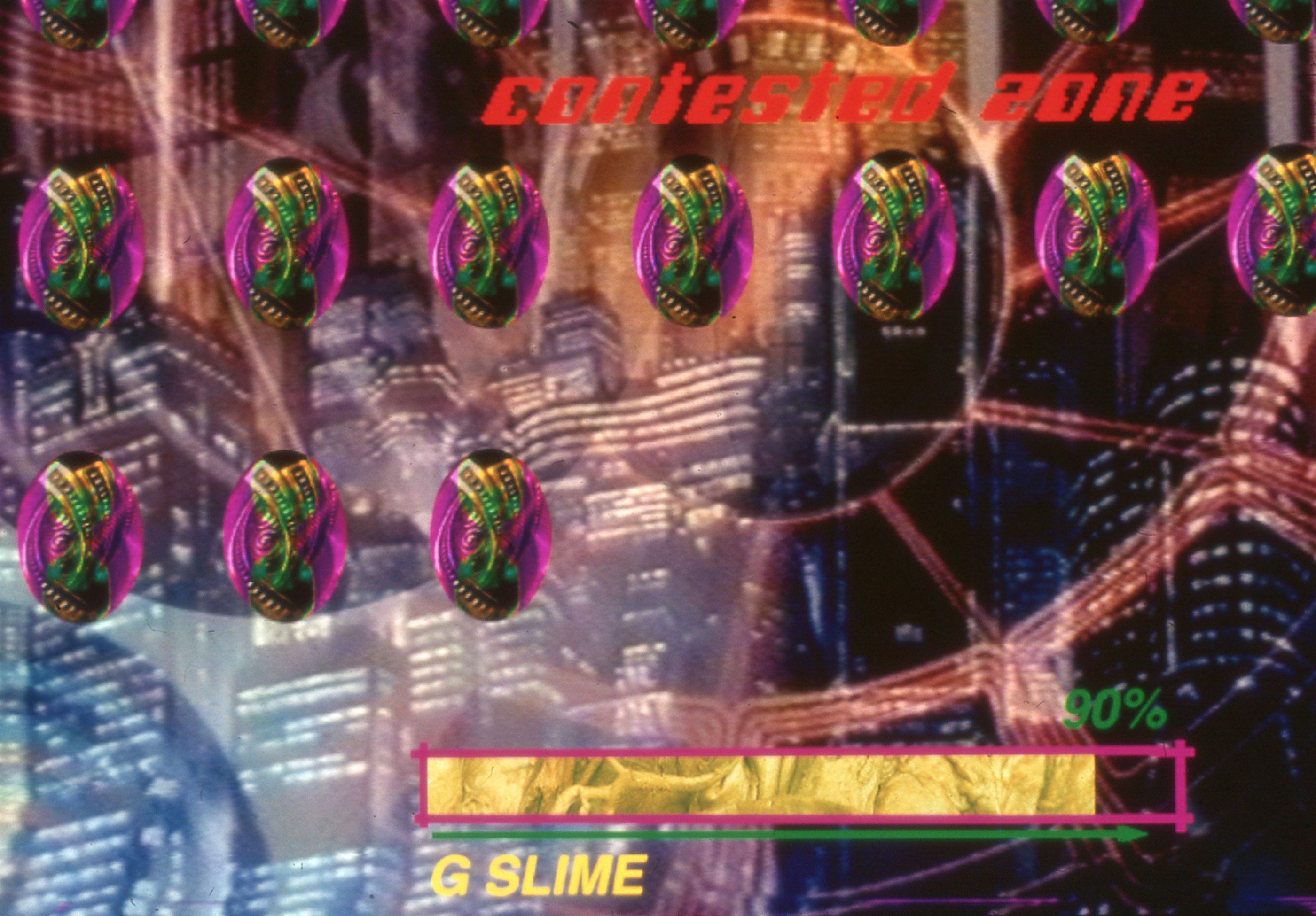
Contested Zone thumbnail

VNS Matrix

Contested Zone

Edition of 80

Cyberflesh Girlmonster-4 Recuperated Stills thumbnail

Linda Dement

Cyberflesh Girlmonster-4 Recuperated Stills

Edition of 80

Bindigrl by Prema Murthy

Prema Murthy

Bindigrl

Edition of 80

IKU: Expand, an interface by Shu Lea Cheang

Shu Lea Cheang

IKU: Expand, an interface

Edition of 80

TimeTravellerTM Trailer by Skawennati

Skawennati

TimeTravellerTM Trailer

Edition of 80

Housewives Making Drugs by Mary Maggic

Mary Maggic

Housewives Making Drugs

Edition of 80

A la recherche de l'information perdue thumbnail

Cornelia Sollfrank

A la recherche de l'information perdue

Edition of 80

Estroworld Now: The Quarantine Edition by Mary Maggic

Mary Maggic

Estroworld Now: The Quarantine Edition

Edition of 80

MAJLIS AL-JINN: Huma + The Archive by Morehshin Allahyari

Morehshin Allahyari

MAJLIS AL-JINN: Huma + The Archive

Edition of 80

Social Capital Fights by Danielle Brathwaite-Shirley

Danielle Brathwaite-Shirley

Social Capital Fights

Edition of 80

Putins a WASTEMAN by Danielle Brathwaite-Shirley

Danielle Brathwaite-Shirley

Putins a WASTEMAN

Edition of 80

VNS Matrix avatar

LocationAustralia

VNS MATRIX is an artist collective founded in Adelaide, Australia, in 1991, by Josephine Starrs, Julianne Pierce, Francesca da Rimini, and Virginia Barratt. Taking their point of departure in a sexualised and socially provocative relationship between women and technology, their works subversively question discourses of domination and control in the expanding cyber space. They are credited as being the first artists to use the term cyberfeminism and are generally regarded as the founders of the international cyberfeminist movement, alongside their highly influential 1992 text and artwork “A Cyberfeminist Manifesto for the 21st Century.” During the 1990s, VNS Matrix was invited to exhibit internationally. Australian galleries also recognized the work of VNS Matrix with exhibitions at Experimental Art Foundation (1993), Artspace Sydney (1994), Australian Center for Contemporary Art Melbourne (1995) and more. The work of VNS Matrix has been written about extensively in Art+Text, Wired, Flash Art, and Artlink, among many others. They are studied in universities across the world and are written about in scholarly, art, and popular culture publications. In 2016, VNS Matrix celebrated their 25th anniversary with the performance of a new text, “A Tender Hex for the Anthropocene.” Since this milestone their work has continued to be exhibited at museums and galleries, including Rhizome at New Museum New York, Institute of Contemporary Art London, and Migros Gallery Zurich, among many others.
View Full Profile
Linda Dement avatar

LocationGadigal Land (Sydney), Australia

Linda Dement (she, her) has worked in arts computing since the late 1980s. Originally a photographer, her digital practice spans the programmed, performative, visual, and virtual. Her work deals with issues of disturbance, commingling psycho-sexual and environmental corporeality with the digital and electronic, giving form to the difficult territory of the unbearable and conflicted. Dement’s solo and collaborative work has been widely exhibited internationally including ACCA Melbourne, the Institute of Contemporary Art London, Ars Electronica Austria, and Transmediale, among others. She is twice winner of the Australian National Digital Art Award and has been awarded a New Media Arts Fellowship by the Australia Council for the Arts. Her work is held in collections such as ArtBank, the Bibliothèque Nationale de France, and Australian Video Art Archive, among others.
View Full Profile
Prema Murthy avatar

LocationNew York, U.S.

Prema Murthy (she, her) is an American artist based in New York. Her work includes painting, video, digital media, and installation. Employing line, form, geometry, and algorithmic processes, she examines the intersection of embodiment and abstraction. She received a BA in art history and women’s studies from the University of Texas, Austin and an MFA from Goldsmiths College, London. She has exhibited in numerous shows including PS1/MoMA Contemporary Art Center, the Whitney Museum of American Art, the Generali Foundation-Vienna, among others. She is the co-founder of the artgroup Fakeshop, known for its pioneering large-scale performative installations using live video conferencing technologies. Her work has been written about in the New York Times, Art Asia Pacific Magazine, the Wall Street Journal, and Artforum. Murthy has received numerous awards and commissions including a New York Foundation for the Arts Fellowship, a Creative Capital Grant in Emerging Fields, and an Urban Artists Initiative Grant from the Asian American Arts Alliance, among others. She has taught Digital Art at City College (CUNY) and Sarah Lawrence College, NY.
View Full Profile
Shu Lea Cheang avatar

LocationParis, France

Shu Lea Cheang (Chinese: 鄭淑麗) (she, her) is a Taiwanese-American artist and filmmaker. Since the 1980s, as a multimedia and new-media artist, she has navigated topics of ethnic stereotyping, sexual politics, and institutional oppression with her radical experimentations in digital realms. She drafts sci-fi narratives in her film scenario and artwork imagination, crafting her own “science” fiction genre of new queer cinema. Cheang is regarded as a pioneering figure in internet-based art, with her multimedia approach at the interface between film, video, internet-based installation, software interaction, and durational performance. Her project “Brandon” (1998–1999) was the first piece of web art commissioned and collected by the Guggenheim Museum in New York. Her work employs film, video, net-based installation, and interface to explore “...ethnic stereotyping, the nature and excesses of popular media, institutional—and especially governmental—power, race relations, and sexual politics.” Cheang has written and directed the feature films I.K.U., Fluidø, and the upcoming UKI. Cheang received a BA in history from the National Taiwan University in 1976 and an MA in Cinema Studies from New York University in 1979.
View Full Profile
Default avatar

LocationMontreal, Canada

Skawennati (she, her) investigates history, the future, and change from her perspective as an urban Kanien’kehá:ka woman and as a cyberpunk avatar. Considered one of the first indigenous net artists, her early adoption of cyberspace as both a location and a medium for her practice has produced groundbreaking projects such as CyberPowWow and TimeTraveller.™ Her machinimas (movies made in virtual environments), still images, textiles and sculpture have been presented internationally, and they are included in the collections of the National Gallery of Canada and the Thoma Foundation, among others. Recipient of an Honorary Doctorate from the Minneapolis College of Art and Design, she is also a proud member of the Guild of Future Architects and a founding board member of daphne. Skawennati has founded numerous organizations, including Nation to Nation and Aboriginal Territories in Cyberspace, a research-creation based at Concordia University that she currently co-directs. She is represented by ELLEPHANT. Originally from Kahnawà:ke Mohawk Territory, Skawennati resides in Montreal.
View Full Profile
Mary Maggic avatar

LocationVienna, Austria

Mary Maggic (they, them) is a non-binary Chinese-American artist currently based in Vienna, Austria. Their work spans amateur science, public workshopology, performance, installation, documentary film, and speculative fiction. Since 2015, Maggic’s research has centered on hormone biopolitics and environmental toxicity, and how the ethos and methodologies of biohacking can serve to demystify invisible lines of molecular (bio)power. Since completing a Masters from MIT Media Lab, their work has been exhibited internationally including Migros Museum of Contemporary Art and Institute of Contemporary Arts London, among others. In 2017, their project “Open Source Estrogen” was awarded Honorary Mention at Prix Ars Electronica Hybrid Arts, and in 2019 Maggic completed a 10-month Fulbright residency in Yogyakarta, Indonesia exploring the connection between Javanese mysticism and the plastic pollution crisis. Maggic is a current member of the online network Hackteria: Open Source Biological Art, the laboratory theater collective Aliens in Green, and the Asian artist collective Mai Ling Vienna.
View Full Profile
Cornelia Sollfrank avatar

LocationBerlin, Germany

“A smart artist makes the machine do the work” — net.art-generator.com With the mindset of a conceptual thinker and a hacker, Cornelia Sollfrank (she, her) has explored technical innovations and translated them into sophisticated and timeless art since the mid 1990s. As founder of the Old Boys Network, she was an influential figure in early cyberfeminism. After her PhD on art and copyright, she has become a researcher in digital commons. She still writes and publishes on technofeminism. Her latest book is The Beautiful Warriors.
View Full Profile
Morehshin Allahyari avatar

LocationNew York, U.S.

Morehshin Allahyari (Persian: موره شین اللهیاری‎) (she, her) is a NY-based Iranian-Kurdish artist using 3D simulation, video, sculpture, and digital fabrication as tools to re-figure myth and history. Through archival practices and storytelling, her work weaves together complex counternarratives in opposition to the lasting influence of Western technological colonialism in the context of SWANA (Southwest Asia and North Africa). Morehshin has been part of numerous exhibitions, festivals, and workshops around the world including Venice Biennale di Architettura, New Museum, The Whitney Museum of American Art, Pompidou Center, Tate Modern, Queens Museum, Museum für Angewandte Kunst, among others. Her work has been featured in the New York Times, BBC, Huffington Post, Wired, National Public Radio, Parkett Art Magazine, Frieze, Rhizome, Hyperallergic, and Al Jazeera, among others. In 2021, she received the United States Artist Fellowship. Her artworks are in the collection of the Whitney Museum of American Art, San Francisco Museum of Modern Art, and the Current Museum.
View Full Profile
Danielle Brathwaite-Shirley avatar

LocationLondon, England & Berlin, Germany

Danielle Brathwaite-Shirley is a Berlin/London-based artist. They received a BA from the Slade School of Fine Art, London in 2019. Brathwaite-Shirley works predominantly in animation, sound, performance, and video game development. Their practice focuses on intertwining lived experience with fiction to imaginatively retell the stories of Black Trans people. Their work has been the subject of solo exhibitions and performances at institutions such as SCAD (2023), Artnight Dundee (2023), Villa Arson, Nice (2023), FACTLiverpool (2022), Project Arts Centre, Ireland (2022), Skänes konstförening, Malmö, Sweden (2022), QUAD, Derby, England (2021), Albright-Knox Art Gallery, Buffalo (2021), Science Gallery, London (2020), and MU Hybrid Art House, London (2020). Their work has been included in group exhibitions at institutions such as Julia Stoschek Foundation, Berlin (2022); Münchner Kammerspiele, Munich (2019); Les Urbaines, Lausanne (2019); and Barbican, London (2018).

View Full Profile

WETWARE smart contract:ethereum, tezos