
Dynamics of Sketch
20 October 2022
Dynamics of Sketch
On the occasion of Simulation Sketchbook: Works in Process, curator Jesse Damiani speaks to 21c Museum Director and Chief Curator Alice Gray Stites and LACMA Art + Technology Lab Program Director Joel Ferree about the dynamics of sketch and process for artists working in new media and experimental modes.
Jesse Damiani: Alice, you work closely with artists whose materials run the gamut of analog to digital. Can you share a bit about what you’ve observed being specific about new media artists’ relationship with their materials?
Alice Gray Stites: I think that much like artists working with conventional materials, it starts with the material. For me, one definition of “visual artist” is someone who thinks through the material they’re working with in such a way that the material itself is expressive of whatever the idea or vision is (or will come to be). So, thinking about artists working in new media, what comes to mind is we have this huge monumental installation by Astrid Krogh at 21c Cincinnati, which is a tapestry made out of fiber optics, custom color wheels. Watching her weave the fiber optics on a loom in her studio, that really made the piece — and the effect that it would have on the environment, the architecture of the building, on people’s experience walking through it—come to life. It’s very much like watching someone sculpt with wood or marble, it speaks to the form and function of what the final piece will be. The same thing has been true for artists who have been working with digital animation, watching them layer the colors and forms, like Chris Doyle’s work, for example — watching him develop it from the code to final product. Learning to listen to that language and hear that language has expanded my appreciation as a curator.
I’m also thinking about artists who are using new tools and new forms and new ways of interacting with work to achieve a variety of different purposes and expressions. I’m thinking of Jakob Kudsk Steensen, whose work we started collecting six to seven years ago — how his work, which is code-based and research-based in nature, has taken different forms. The first work was high-definition video, which then became an interactive VR experience — always about addressing the environment, environmental degradation, and the squandering of resources and threats to various species, how articulate those forms have become. He has also adapted some of those VR experiences back into video so that a larger audience can engage with it. I love how artists who are early adopters of new technologies can be innovative and inventive about using those tools in different ways to reach broader audiences. It reveals a bit about the evolution of those processes.
JD: Joel, your work is unique in that much of it is spent with artists while works are being developed. Can you share a bit about that experience? What does that in-development process with them look and feel like? Anything that might surprise folks who don't have the same access?
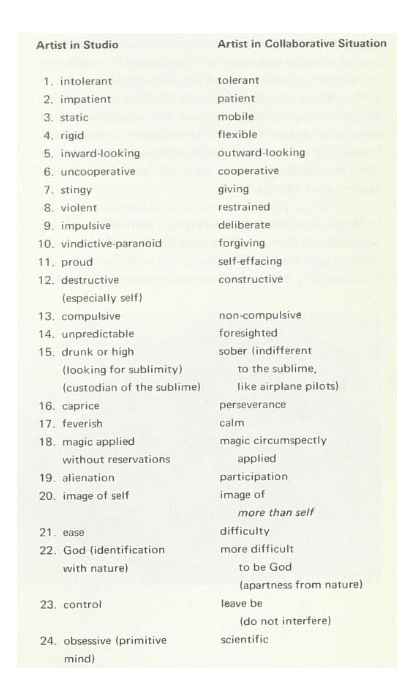
Joel Ferree: Our program emphasizes experimentation and iteration, and the project development process is often dynamic and fluid. This open-endedness can be difficult to navigate or adjust to, and some of our grant recipients stick to their proposal, word for word. Others thrive in this space. Much of this boils down to engaging with folks and being comfortable with uncertainty. We often collaborate or partner with other organizations to create a broader platform for a project, but with that comes ceding some control. In the original LACMA Art & Technology Program (1967-1971) catalog (p. 269) there is this fabulous chart by Claes Oldenburg illustrating "the transformations an artist must undergo in order to deal successfully in the corporation technology arena." Not all of our collaborations are corporate, but this chart really hits the nail on the head.
JD: I hope this exhibition gives glimpses into the practices of new media artists in part to counter the misperception that their work is automated, mostly authored by machines. Can you speak to the degree of craft and human labor involved in creating this kind of work? Or maybe to the types of engagement that these artists have with their digital/technological materials?
AGS: In digital art in particular, because the final product often appears on your screen, there’s a sense that it’s just magic, that there isn’t the degree of labor in other art forms. I think of the artist Quayola, and trying to explain how his work is really complex data visualization. The way I often explain it to people is that he is using technological tools, computer-based software, and data visualization in the same way a sculptor is laying down material. You’re looking at what you think is a forest in southern France which is actually a two-dimensional image that has been made as if it were in three dimensions; every single data point in that image has gone through a process very much like a labor-intensive sculpture. People are dazzled by the images, and they are mesmerizing, but I find that it’s helpful to then use the language of conventional art-making to help show how this work is engaging in complex subject matter and materials, all of which is embedded behind the screen, if you will. People are attracted to screen-based aesthetics because we’re used to being in that space most of the time. The virtual world is just as real as the physical one for almost everyone. We have phones in-hand for many, many hours every day. This both demystifies the output but simultaneously mystifies the process. The process is more hidden, with the final output just “appearing.” People are drawn to it because they feel comfortable looking at things on-screen. Artists are often the earliest adopters of whatever tools civilization comes up with. They’re also able to look at how we interact with those tools and technologies, and make art that reflects what our relationship is to the virtual and to the real, and how those things are coming together. We’re all living in an increasingly hybridized condition, and artists are best able to express and navigate a rich and nuanced understanding of what the future holds.
JF: Someone once said to me, the problem with technology isn't technology, it's what people do with technology. I think the same holds for the flipside as well. What humans, and to be more specific, artists do with it, is what makes it powerful. It's a question of whose hands it's in. And it is work. Technology is a static tool. Yes, it's a powerful tool that can vastly expand an artwork's scale and scope, but it's nothing without someone behind the wheel, someone making decisions. And these creative decisions remain as difficult as ever. There is a saying in cycling that even with rigorous training and top-of-the-line components, "it doesn't get easier, you just go faster." I think this is the same for artists working with technology.
JD: New media art is often described as a shift from object-based art to process-based art, and in some ways I think the lack of containability has perpetuated the division between analog and digital arts practices (even as most of us spend so much of our lives in digital contexts). As two people who straddle these worlds, do you see the act of foregrounding new media artists' processes as a sensemaking endeavor for folks who feel they lack the fluency to grok art made using new technologies?
JF: I certainly think it's important to communicate the artist's approach as clearly as possible. Technical jargon can be problematic. Digital literacy or fluency is increasingly expected in cultural institutions, but it's a big learning curve. There's the problem of control, not just in terms of power, but in engaging with and keeping these new media works in good working order in the face of rapid technological obsolescence. Just like the sculptures and paintings in its collection, LACMA is responsible for caring for its new media artworks into posterity. Best practices in much of this area are still in their earlier stages of development. Some don't even exist yet. So what do you do when the traditional approaches of working with and caring for objects as well as the workflows that support these practices break down as artists work with newer and newer digital tools? I think this is where process comes in. You have to get into the habit of figuring out best practices as you go, continually refining them. You have to become comfortable with more uncertainty. We have some bright people in various departments who are taking on this challenge, stepping out of their silos and talking with each other, being interdisciplinary. It requires a lot of conversation as well as a humble mindset. It requires participants to think more like a study group of graduate students than a team of professionals. This, however, is a stopgap solution, and sooner rather than later, you have to find a way to sustain this continuous knowledge sharing and co-learning. Give staff the time and space to dedicate themselves more to this process. Give them the resources to do so. Organizations like JPL do this pretty well. They have talented facilitators whose job is to specifically get folks in different areas to talk to one another and tease out new ways of doing things. Will cultural organizations follow suit? Let's hope so.
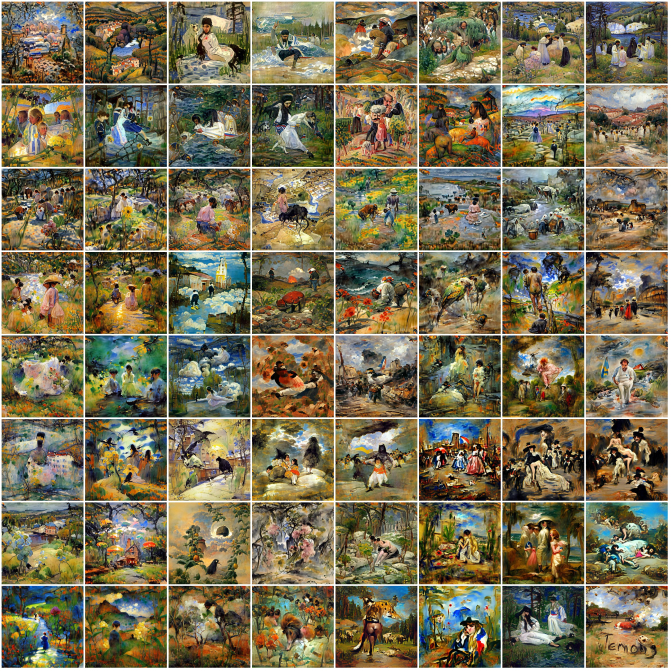
“Cluster: #069” by Botto. Image courtesy of the artist and Feral File.
AGS: This also brings up the conversation that’s been going on for a number of years around the dematerialization of the art object, and ephemerality — especially of code-based artwork, which is the ultimate dematerialization. Until you print an image or project something on a containable monitor, you won’t have an object at all. A big part of this discussion is the work’s relationship to the market — how things are valued, how the market interacts with the world of art critique. I do think there’s a really exciting way that the dematerialization of the art object challenges the forces of the market, which doesn’t always reflect the most innovative work, the artists who are reflecting how human existence is changing. It’s (generally) harder to sell something that you can’t hold. It’s harder to sell something that can be infinitely reproduced. How do you put value on that? It’s an interesting question about how we decide what’s valuable, which is of course part of what’s playing out with the rise of NFTs and Web3. What is valuable, who is valuable? The last two years have thrown that latter question into sharp relief; who is valuable, who has rights? So: does the art object itself have value or do the ideas put into the work have value? It goes hand-in-hand with having access. Certainly work that can be shared digitally can be more broadly accessed. How does this intersect with existing control of the art market and its power structures — and by extension, the world of who is collected in museums, who is in important private or public collections? How do we decide what is valuable and what should be shared? So the force of dematerialization that the explosion of digital art, digital artists, and web3 practices has brought about is really provoking these important questions about what is essential, and what do we want the future to look like?
JD: What forms have you seen sketches take for these artists when they're not pencil and paper? Any examples to share?
AGS: Everything from fiber-optic weaving to light sequencing to coding (which I don’t read myself) to written notes or narratives. Existing photographs that prompt new lines of research.
In the very beginning of some of the projects that we’ve done — if they’re commissions and they’re responding to a particular site or opportunity — are conversations. It’s a process of listening to their ideas when they’re thinking about a certain condition or site, or whatever they’re responding to — in a sense sketches are ideas in their purest form. That process can be much more intimate and interactive when working with artists using new tools and technologies. Very few of these projects emerge from traditional sketches — that’s not something I’d expect to receive. Usually it’s ideas in some form, existing images they find inspiration in, then a whole variety of different materials they might end up working with.
A good example of a site-specific artwork that’s code-based is by Brian Knep, called Healing Tiles. It’s an interactive work, with projection on the floor. Forms tear apart as you walk across it, and tear apart differently for each person, and then they heal back together. They heal together like a scar, differently each time. I had seen a project he had done like this at Harvard, he was the first artist-in-residence at Harvard Medical School. With Cincinnati, I thought that sensibility was appropriate for a number of reasons. It’s a public artwork that would have embedded in it a portrait of all the people who walk across that space over time. It’s poetic, and a thoughtful way of connecting everything that happens in this building. Cincinnati, for many black Americans, was the first stop in the Underground Railroad coming from Kentucky to Ohio. No one necessarily sees that impetus for commission, but it’s quite embedded in the idea and the way that it comes to life in these vibrant orange, yellow, and green biomorphic patterns that people play with. It has the depth of history and response to the human condition in a variety of ways that makes it really interesting. Knowing that Brian developed this practice — although the project at Harvard was quite different visually — really made sense to me for that particular space. It’s also projected adjacent to a historic tile floor in this building. Having an artwork that relates to the history of the city and space, as well as future possibilities, seemed like a wonderful way to transform the space and people’s interaction with it. So I just come back to the notion that the material itself, whether you can hold onto it or not, should be embedded and expressive of whatever idea, concept, or issue that the work is responding to, and I often see this play out in unexpected and resonant ways with the new media artists I work with.
JF: This is a fun question! I always ask for things in a format that's more pedestrian, but I've received sketches as 3D prints, Sketchup, and Solidworks formats, various audio and video formats. There is an elegance when something is sent simply as a .txt. It's also interesting when the selected format is "wrong" for the sketch, such as when a series of images are presented in a .xls or a one-paragraph descriptive summary without images is just sent as a ppt. My favorite sketch I've received is a cocktail napkin drawing that was photographed and then displayed on a cracked phone screen and rephotographed and sent to me as a .jpg early one morning.



