
Ikebana Meets Gene Splicing
20 April 2023
Ikebana Meets Gene Splicing
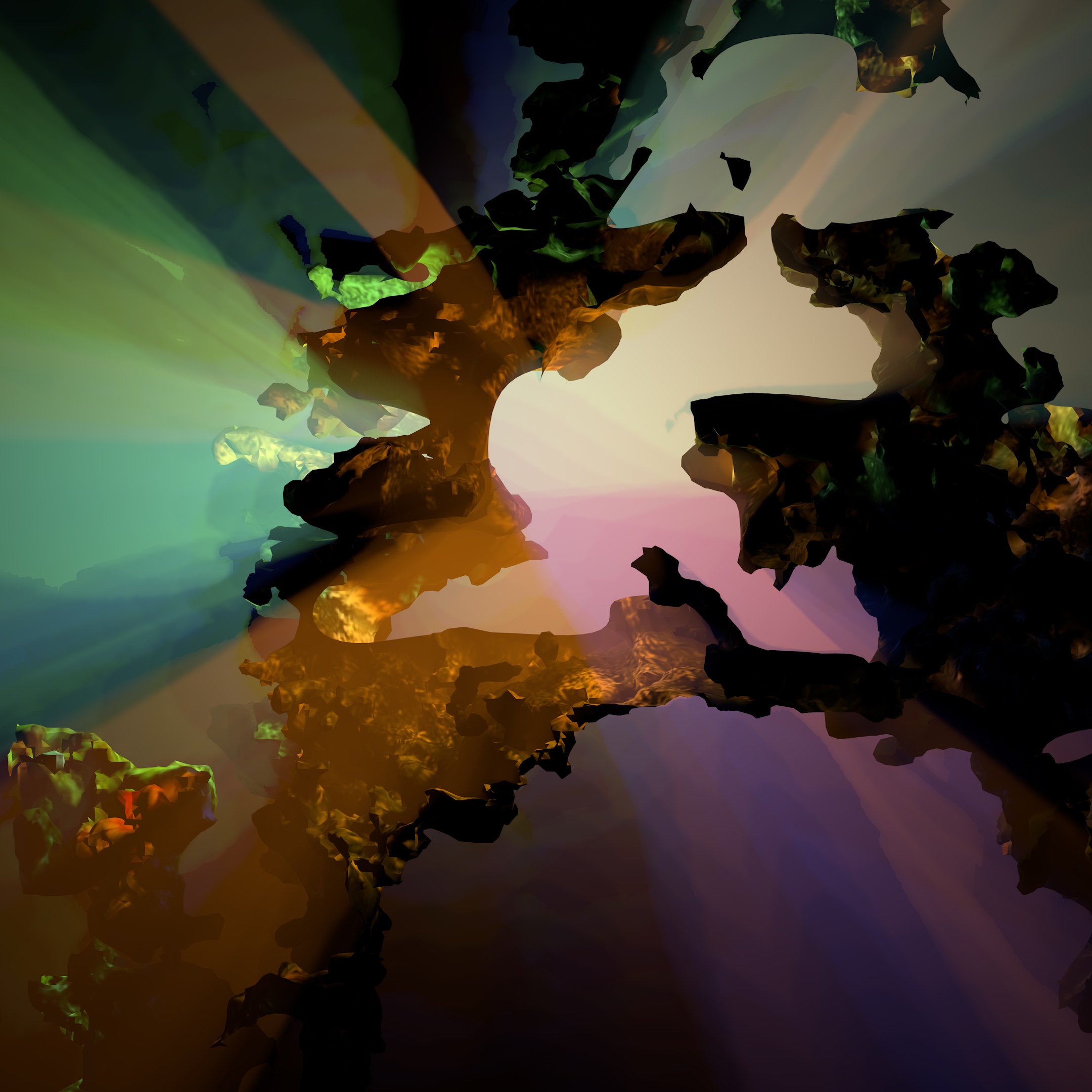
Artist Rick Silva speaks with writer and musician Claire L. Evans on plant desires, garden scanning, and the “weirding and warping” of nature.
Your work BLOOMCORE got me thinking about plant intelligence and the way plant intelligence has been portrayed in horror fiction as this kind of unknowable vegetable mind.
I love what you write in the exhibition text about plant intelligence and will. Early on in the project I was thinking about that Michael Pollan book Botany of Desire; it posits that plants are using us for their desires, as much as we are them — that to ensure their survival, plants are appealing to our sense of beauty, taste, and intoxication, and manipulating us to propagate them. With BLOOMCORE, perhaps it’s the plants that are knowingly entrancing me into placing them on the blockchain.
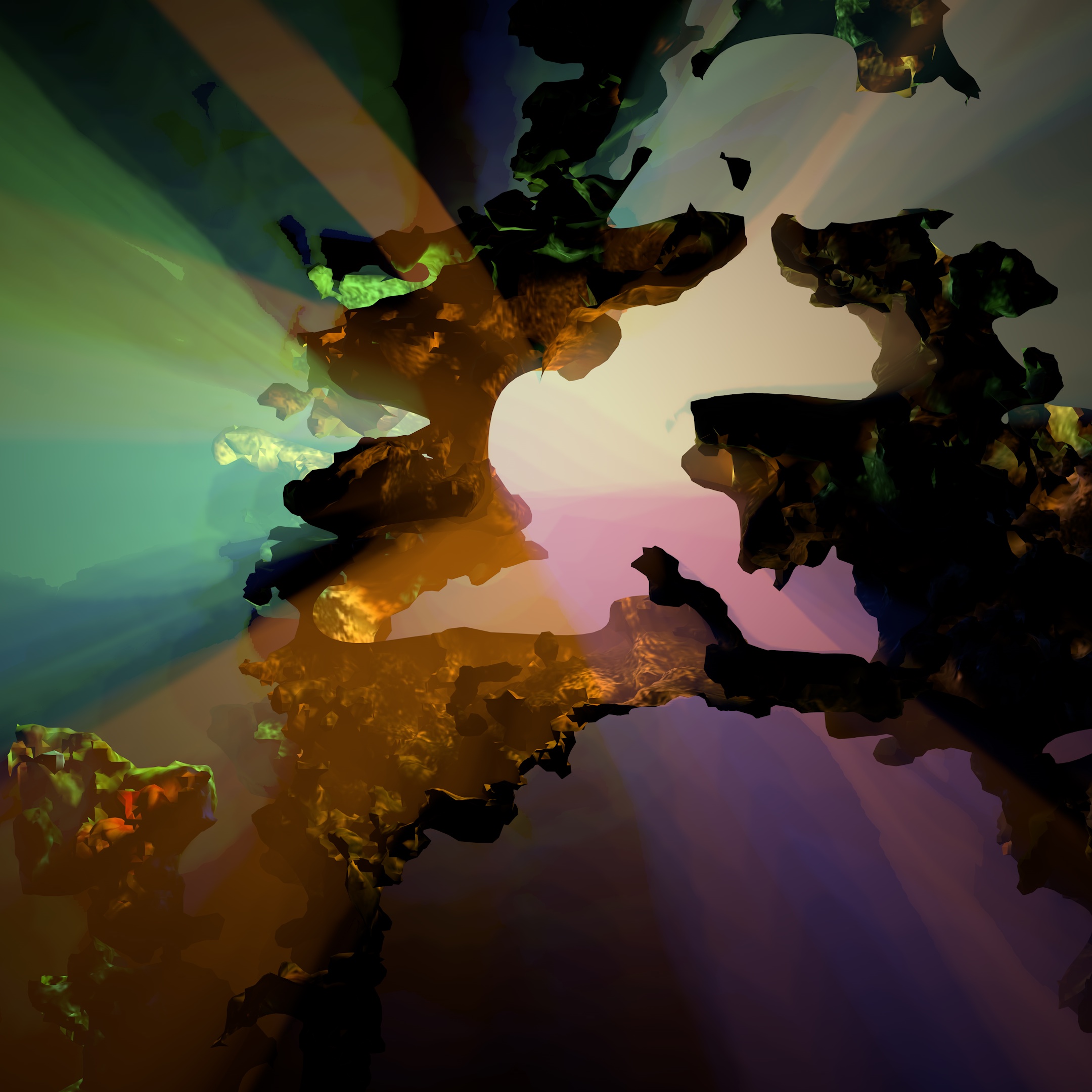
BLOOMCORE is a series of videos made from hundreds of 3D scans of blooming plants in the Pacific Northwest. Can you tell me a bit more about the environments where you did the 3D scans? And what was the process like?
The process was me and my then-new iPhone that has a Lidar scanner: the old story about technology that cost tens of thousands of dollars a few years ago and is now in your pocket.
It was spring 2022, and everything in Oregon was starting to bloom. I started in my own yard scanning rhododendrons, then onto the local botanical gardens, and spiraled further and further outwards from there. I would search for and go to locations where I knew plants were blooming, like the Portland Rose Garden and the Oregon Garden. But also I would just have the phone on me and ready to scan at any moment, too — like on hikes or on a walk around the neighborhood. Other locations included a poisonous pitcher plant habitat on the Oregon coast, and the special collection greenhouse at Oregon State University. I had about 20 scan sessions, which produced 250 scans that then were combined to form the 55 works you see in the show.
So the plants in the show are composites? They don’t actually exist in nature?
They both exist in nature and are composites. While the polygons and textures are sourced from actual physical plants, in the digital version they are positioned in this way that only virtual space can intersect objects.
Of course, things get lost in the journey from a rose garden into digital space.
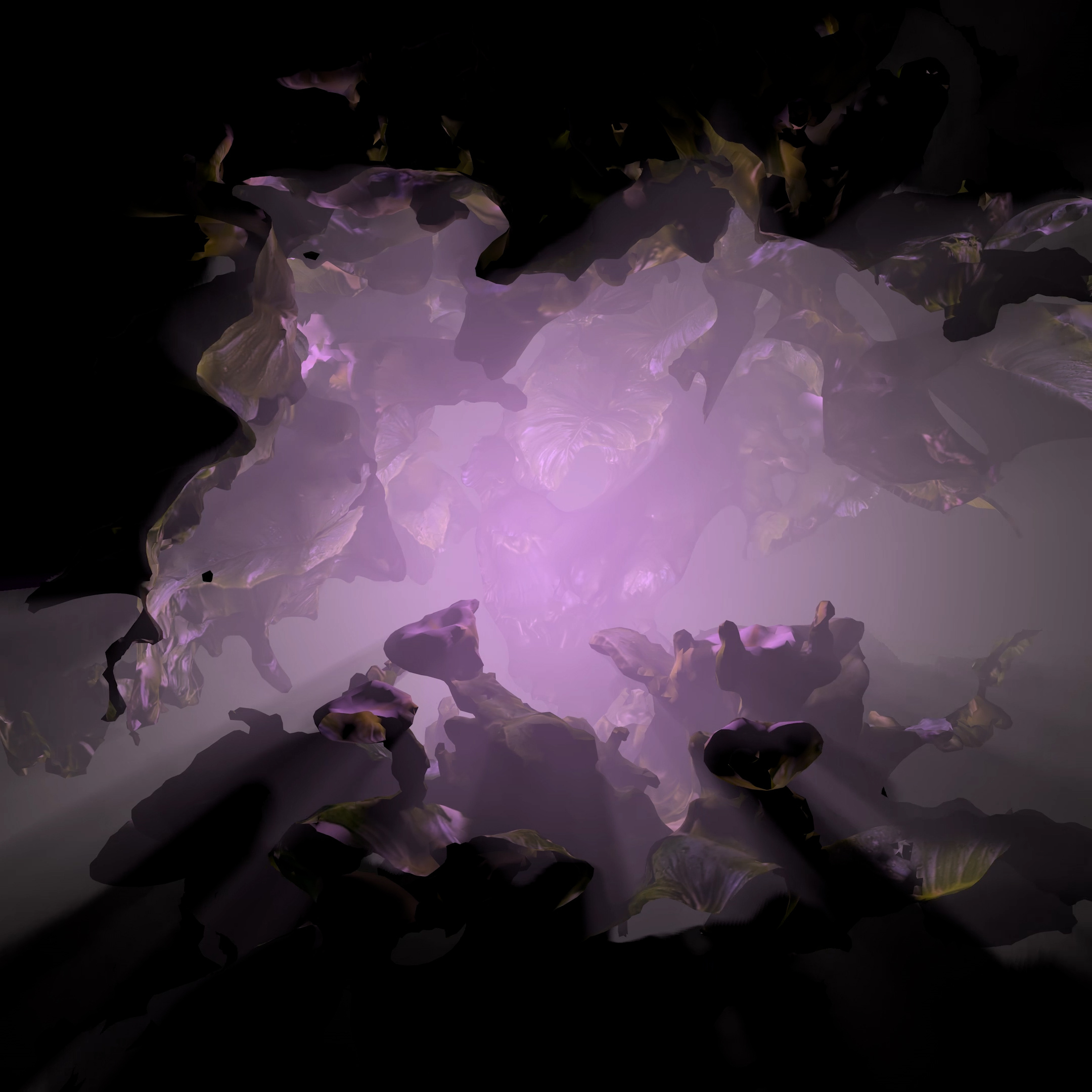
Like a lot of my work, I like the early glitchy part of a technology that is not quite there. The scans are just good enough to convey plantness, organicness, but still very digital. I had to learn which plants scan well or not: broad leaves and stems are best, anything thin and wispy was invisible to the phone scanner.
It’s almost as though the plants resisted being scanned — they were too complex, too alive to be fully captured. But then of course that glitchiness opens up creative possibilities for you.
It was a bit like a bee gathering pollen and bringing it back to the hive, the studio, the computer. Working with the scans on my laptop, it was more like ikebana energy meets grafting and gene splicing. Volumetric lighting, rotating 3D objects, and Boolean / 3D clipping are techniques I’ve been using in my work for years, all of which are unique to 3D animation. That shell surface that the scans and 3D do is also pretty specific to the medium.
Did you have any influences in mind as you were working?
Oregon is the biggest influence for BLOOMCORE. I started making plant-based art soon after moving here in 2012. My projects like Random Seed (2012), Self Portrait with Plants (2013), Render Garden (2015), Accelerationist Ikebana (2017), and now this exhibition are all heavily influenced by the lush flora of the Pacific Northwest.
Jennifer Steinkamp is the OG (.obj gardener :)) of spinning and floating 3D plants.
I was also thinking a lot about Mary Menken’s 1957 experimental film Glimpse of the Garden, do you know that one? The 16 mm print projection is so good, but you get an idea with the YouTube version. I was channeling that sort of observation and gathering.
Love this film — I’d never seen it. Reminds me of Germaine Dulac’s arabesques, which of course look terrible on YouTube too.
Oh wow, hadn’t seen that Dulac, so good! Would love to see the film print projected.
The last time you and I worked on something together was in 2014, when you asked me to write a short story to accompany your series The Silva Field Guide to Birds of a Parallel Future, a project where you created a sequence of higher-dimensional bird forms. What is it about mutating and warping nature that appeals to you so strongly?
I’m mimicking the processes that nature is already so adept at. Nature is already always weirding and warping itself, and even more now as it’s accelerated by science and climate. The mediums of 3D scanning and animation also lend themselves to these strange mutations, ones where objects overlap, materials go missing, and physics breaks. Since we just brought up two brilliant avant-garde women filmmakers, Menken and Dulac, let me summon another one here, in her essay “An Anagram of Ideas on Art, Form and Film,” Maya Deren writes:
The history of art is the history of man and of his universe and the moral relationship between them. Whatever the instrument, the artist sought to recreate the abstract, invisible forces and relationships of the cosmos, in the intimate, immediate forms of his art, where the problems might be experienced and perhaps resolved in miniature. It is not presumptuous to suggest that cinema, as an art instrument especially capable of recreating relativistic relationships on a plane of intimate experience, is of profound importance. It stands, today, in the great need of the creative contributions of whomsoever respects the fabulous potentialities of its destiny.
I love this idea—that art is a way of working through the complexity of the natural world in miniature. Every one of your mutant blooms implies a much larger garden, somewhere beyond the frame.



