
The Dawn of Computer Art and 1968
28 April 2024
In this series, we aim to explore and carve new paths through the relatively unexamined wilderness of Japan's early computer art scene. To achieve this, it is essential to cross-examine the footprints of the pioneers of computer art. Japanese pioneers include philosopher Hiroshi Kawano, who produced the first computer-generated image in Japan in Spring 1964; the Computer Technique Group (CTG)1, formed in 1966, who created plotter-based computer art and interactive artworks; SARASVATI2, who produced Japan's first computer animation in 1967; and Eiichi Izuhara, who developed a program to generate tree structures in 1973. While the "dawn" primarily refers to the 1960s to early 1970s, we also intend to occasionally discuss subsequent developments.
Furthermore, we plan to shed light on the dawn of computer art from various perspectives, such as the relationship between engineers and artists, the connection between computer art and poetry, and the presence of underrecognized female computer artists, specifically Mutsuko Sasaki, who had works published in "Computers and People" magazine in the 1970s. The extent to which these topics will be covered in the series is yet to be determined.
Since 2021, I have taken an interest in digital art and blockchain as a medium, which has gained attention with the rise of NFTs, and have discussed these topics occasionally. My interest is directed towards the dawn of computer art, as well as generative art, which has been revalued with the emergence of NFTs. Generative art gains value through circulation in the NFT market, thereby promoting the reassessment of early computer art. This reevaluation trend is particularly prominent in the West, with contributions from marketplaces, media, galleries, and collectors. For instance, multiple exhibitions have been held and numerous articles written about Herbert W. Franke, who passed away in 2022, and Vera Molnár, who died in 2023, following the rise of NFTs.
The early computer art movement spanned from the 1964 Tokyo Olympics to the 1970 Osaka World Expo (EXPO '70, officially the 'Japan World Exposition'). Interestingly, the current rise of the NFT movement aligns with the period from the 2020 Tokyo Olympics—postponed to 2021 due to COVID-19—to the upcoming 2025 Osaka-Kansai World Expo (EXPO 2025). This coincidence intrigues me, perhaps because I am Japanese. The excitement around early computer art and art and technology in Japan subsided after the 1970 Osaka Expo, which had rallied post-war avant-garde artists. A review of "Bijutsu Techo," a leading Japanese art magazine, shows that while the magazine featured special issues on Op art and "Art in the Electronic Age" by Katsuhiro Yamaguchi during the late 1960s and articles on computer art, such topics dwindled after the expo concluded in 1971.
The next significant attention to computer-utilized art did not occur until the 1980s with the emergence of CG artists like Masaki Fujihata and Yoichiro Kawaguchi, who gained international exposure through SIGGRAPH3. This decade not only saw technical innovations and the widespread adoption of computers but also a generational shift.
Now, will the current excitement around NFTs and generative art following this sustain its heat, or will it fade as a transient movement like the dawn of computer art? Indeed, generative art pieces have gained permanence through NFTs, creating historical events and networks of players and communities. However, the focus on the commercial aspects, such as token value and dense communications accompanying transaction histories, seems to dominate the discourse, potentially discouraging critique of the artworks. Therefore, reconsidering the path of early computer art could be meaningful, as it might prompt a reevaluation of the current state of generative art.
Yoshiyuki Abe, an artist conducting an archive of Hiroshi Kawano's materials, mentioned in a 2007 article about the genealogy of computer art pioneers that algorithms, due to their perfect heritability, could lead to the spontaneous emergence of successors transcending time and space. Abe also noted, "Mastering computer art techniques involves understanding algorithms, but you should also understand that the creation of algorithms is not the same as carrying out computations. Understanding what pioneers thought deeply on will tell you that.4" This insight is crucial in considering the future of today's generative art and understanding what occurred during the dawn of computer art and what the artists of that era thought.
The State of Early Computer Art Research in Japan as of 2024
While discourse on computer art in Japan during the 1960s exists across various mediums, largely because it straddles the boundaries between art, design, and technology, comprehensive surveys or studies that delve into the discussions of that time are not sufficiently accumulated in Japan.
There are, however, some important works on the subject. For example, as a comprehensive history of Japanese media art, including computer art, Jung-Yeon Ma's "A Critical History of Media Art in Japan" handles computer art, including the works of Hiroshi Kawano and CTG, in the first half of "Chapter 2: Computers in Art." "Chapter 1: Experiment as Origin" discusses avant-garde art, the Osaka Expo, and video art. Ma analyzes the reasons for the decline of computer art in the 1970s, including the limitations of expression bound by hardware limitations, the rapid transformation of computers bringing changes to the relationship between art and computers, and the decline of avant-garde art in Japan, which diminished expectations for computer art, which was part of the avant-garde.
Kazufumi Oizumi's "The Genesis of Computer Art: The Trajectory and Thought of CTG 1966-1969" is based on primary materials from two truckloads stored by CTG member Masao Komura, detailing the activities of CTG over nearly three years. Oizumi's work is arguably the best resource for understanding the state of computer art in Japan at the time, with an impressively extensive bibliography. CTG, an important group in Japan's dawn of computer art, gained international fame by participating in the "Cybernetic Serendipity: the computer and the arts" exhibition at the ICA in 1968. Much of my description of CTG relies on Oizumi's research.
Regarding Hiroshi Kawano, all materials were donated to ZKM by Kawano himself, and the ZKM site lists archive information5, and artist Yoshiyuki Abe's homepage contains archive information6 (unfortunately, the links to PDFs on Abe's site are broken). Influenced by and acquainted with Max Bense's information aesthetics, Kawano decided to donate all his materials to ZKM following the 2010 exhibition at ZKM commemorating the 100th anniversary of Max Bense's birth7. A comprehensive study of Kawano's career, "Hiroshi Kawano (1925-2021) Japan’s Pioneer of Computer Arts" by Simone Gristwood, provides detailed insights8. Papers like this about Kawano have not been written in Japan. Even Kawano's major work, "Computer and Aesthetics" (1982) is out of print in Japan, indicating the difficulty of obtaining materials related to computer art at the time.
Other important resources include several exhibition catalogs that focused on pioneers of computer art such as Hiroshi Kawano, CTG, SARASVATI, Chihaya Shimomura, and Eiichi Izuhara. Specifically, catalogs from the "ARTS ON COMPUTER" exhibition held at the O Art Museum in 1987, the "20th Century Computer Art: Beginnings and Developments " exhibition at the Tama Art University Museum in 2006, and the "Digital Media and Japanese Graphic Design: Its Past and Future" exhibition at Tokyo Midtown Design Hub in 2016 are worth mentioning.
The 1968 'Cybernetic Serendipity' Exhibition and the '1st Computer Art Contest'
The year 1968 is known as a year of heightened resistance movements against states and powers worldwide, with simultaneous occurrences of student movements such as the May 1968 events in Paris, anti-war demonstrations, and civil rights movements, later discussed as a significant turning point in post-World War II politics and society. In such a year, a pivotal exhibition for the dawn of computer art was also held. It was "Cybernetic Serendipity: the computer and the arts."
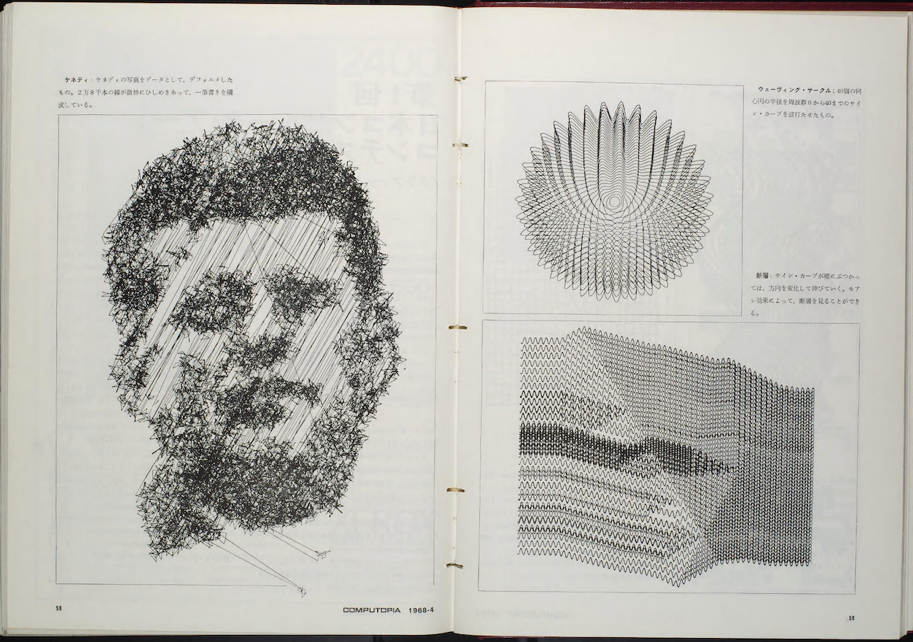
From August 1968, curated by Jasia Reichardt, the Cybernetic Serendipity exhibition at the Institute of Contemporary Arts (ICA) in London became a major event in the history of computer art and widely recognized for its subsequent influence. CTG from Japan was the sole participant, displaying several pieces from the "Computer is a good illustrator" series using photographs of John F. Kennedy, pioneering techniques known today as morphing with works like "Return to a Square," "Running Cola is Africa!," and "Deformation of Sharaku," which were highly acclaimed9. The exhibition catalog for Cybernetic Serendipity10 includes works such as "Shot Kennedy No.1" and "Diffused Kennedy," showing the inclusion of pop art elements related to death, akin to Andy Warhol's work following the assassination of President Kennedy in 1963.
According to Kazufumi Oizumi, CTG had the opportunity to present their work to Reichardt in 1967 through the introduction of Yoshishige Saito, a professor at Tama Art University at the time. Saito was a prominent artist with significant influence in Japan and played an essential role in computer art. Many students gathered in Saito's classroom at Tama Art University, not only CTG's Masao Komura but also Nobuo Sekine, who later created "Phase - Mother Earth," a precursor to the Mono-ha movement, and other junior members who were Saito's students. It's notable that CTG's only solo exhibition was held at the Tokyo Gallery, which had an exclusive contract with Yoshishige Saito.
Oizumi states that participation in the Cybernetic Serendipity exhibition was a turning point for CTG, suggesting that had they not exhibited, all subsequent opportunities to participate in international exhibitions would likely have been closed to them. He highlights the importance of being able to present a significant number of representative works at the time11. The success of CTG at the Cybernetic Serendipity exhibition undoubtedly marked an important event for Hiroshi Kawano and other computer art practitioners.
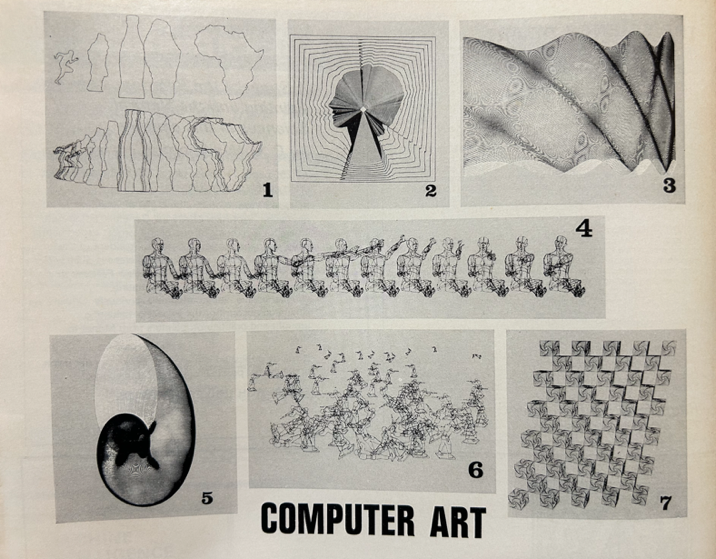
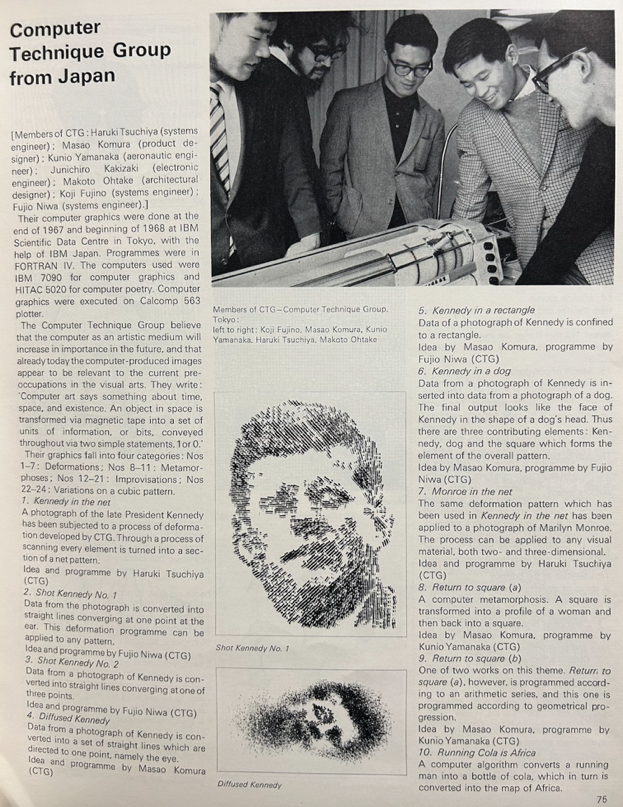
On the other hand, when we look at Japan in the same year of 1968, in Tokyo, the "1st Computer Art Contest" was held in March on the 5th floor of the Sankei Building in Otemachi, followed in September by CTG's first and last solo exhibition "Computer Art Exhibition 'Media Transformation by Electronics'" at the Tokyo Gallery.
The "1st Computer Art Contest" appears to have been held for only two days, with a judging panel consisting of Shigeru Watanabe, a professor from the Engineering Department at the University of Tokyo, Hiroshi Kawano, Yoshishige Saito, a professor at Tama Art University, and the designer Kohei Sugiura, with artists Hiroshi Kawano, CTG, and SARASVATI participating. This exhibition was organized by the C.B.A (Computer Based Art) study group, which included Watanabe, Kawano, and Haruki Tsuchiya of CTG. According to Simone Gristwood, when she interviewed Kawano in 2009, he explained that this exhibition was of high quality for its time and had been held even before the Cybernetic Serendipity exhibition. It is plausible that Kawano, who could not participate in the internationally renowned Cybernetic Serendipity, might have felt a degree of dissatisfaction. Yet, it is conceivable that he took pride in having achieved such a pioneering display of computer art in Japan, albeit on a smaller scale. Details about the "1st Computer Art Contest" and the exhibited works were published in the April 1968 issue of "COMPUTOPIA"12. There, Kawano commented on computer art as follows:
It can be said that the present is an era of large-scale socialization of art. While traditional art was the privilege of a few, contemporary art aspires to be loved by all. The technology of mass communication provides an effective means to meet this demand of art, heralding the advent of new art. This new art must become a powerful weapon to organically reorganize the immense and extreme society of modernity, alienated from human emotions, into a community with human sensibilities. Only as such does this new art find its raison d'être in the contemporary age. And to truly exert the power of social organization, above all, it will require the softening (for example, one could metaphorically refer to light as a soft medium, as it lacks the heavy, 'hard' qualities of something like a painting) and electronification of its expressive mediums. The demand for a soft new art using electronics as its medium can be said to be the fundamental motivation behind the birth of computer art13.
Thus, Kawano argued that "new art = computer art" was open to all, unlike traditional art, and could become a weapon to organically reorganize the alienating social conditions of the contemporary world. This anti-authoritarian stance of Kawano may reflect the zeitgeist of 1968 but recurs throughout his various writings. Moreover, it is interesting to note Kawano's focus on the soft medium of electronics in computer art. Continuing with the cited passage, it becomes clear that Kawano perceived the nature of this soft medium as something that enables the "free artificial reconstruction of art." In his 1967 work "Aesthetics14," Kawano introduced "analytical aesthetics," "information aesthetics," and "experimental aesthetics," and presented an approach to the exploration of art through the simulation of art by computers. He believed that by utilizing this soft electronic medium, it was possible not only to create a free social environment for humans but also to elucidate the secrets of human artistic creation, clarify the theory of art, and foster artists' self-awareness of their original work. Kawano's perspectives on computer art, as expressed in the magazine title "COMPUTOPIA," might have been overly optimistic. Indeed, in his later years, Kawano lamented, "In the 1960s, I was tormented by the barren aftermath of the fervent creation of computer art15". However, Kawano's ambitious proclamation must be reconsidered as an expression of the attitude of Japanese computer artists in 1968.
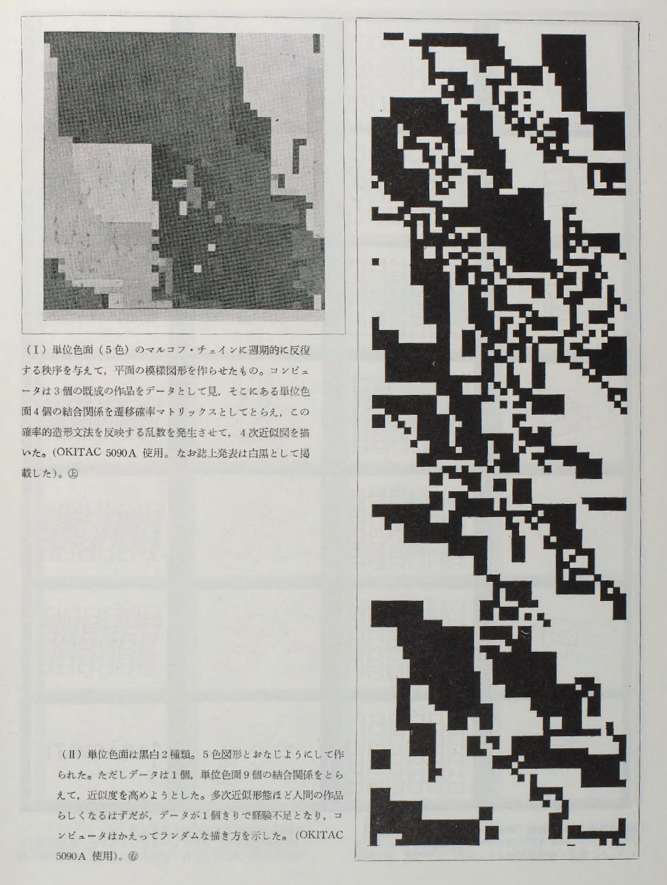
Here, I would like to overview the production techniques of Kawano, CTG, and SARASVATI. Although the titles of the works are not published, each of their works is featured in the April 1968 issue of "COMPUTOPIA." Additionally, Kawano categorizes computer art programs as follows:
- Those that describe the expression logic with a set of formulas.
- Those that describe the expression logic with a table of random numbers:
a. Those that generate free random numbers a priori.
b. Those that generate random numbers bound by experience through learning.
Of these, Kawano explains that CTG and SARASVATI's works correspond to 1) and 2) a., while Kawano's own works fall under 2) b. While 1) and 2) a. involve direct algorithmic expression, 2) b. is characterized by the idea of 'learning' through programming, a concept close to today's artificial intelligence. Kawano developed his own simulation model for art, which he called the 'K-System,' based on Shannon's communication channel model. It included 'eyes' that learn from existing image data and a process of analyzing received data and converting it into a transition probability matrix. The reason Kawano created such a mechanism likely reflects his view of computer art as 'art by the computer' rather than by humans. I would like to review and discuss Kawano's 'K-System' and its underlying programming philosophy in more detail next time.
On the other hand, in February 1968, in the magazine "Design NO.106," Komura of CTG described three techniques for creating works using a plotter. These three were 'data exchange,' 'pattern making,' and 'random composition.' 'Data exchange' refers to a technique of replacing X,Y coordinate values, which includes the random walk in the Kennedy series. 'Pattern making' involves generating patterns through algorithms to create new forms, with an example being shapes that radiate sine waves outward from a circle. 'Random composition' sets the general layout rules such as placement by humans, with the details determined by random numbers. Komura saw the potential for infinite creations through random numbers as a foothold for discussing 'the creativity of machines' and also pointed out that the development of computers possesses elements that negate the very basis of 'printing,' the foundation of graphic design's mass reproduction by the same edition.
Finally, I would like to examine the works of SARASVATI. Known as Japan's first computer animation, "The Art of Fugue" is a 3-minute work created by Tsukio and Yamada, graduate students at the Urban Engineering Department of the University of Tokyo, during the summer vacation of 1967 with the goal of submitting it to the 1st Sogetsu Experimental Film Festival. The names of musician Yasunao Tone and sound engineer Shinpei Kikuchi are also credited. They applied programs developed for urban planning research at their graduate school to create figures. At the time, since there were no CRTs for images, each frame was output by a plotter and then shot one by one with a 16mm camera.
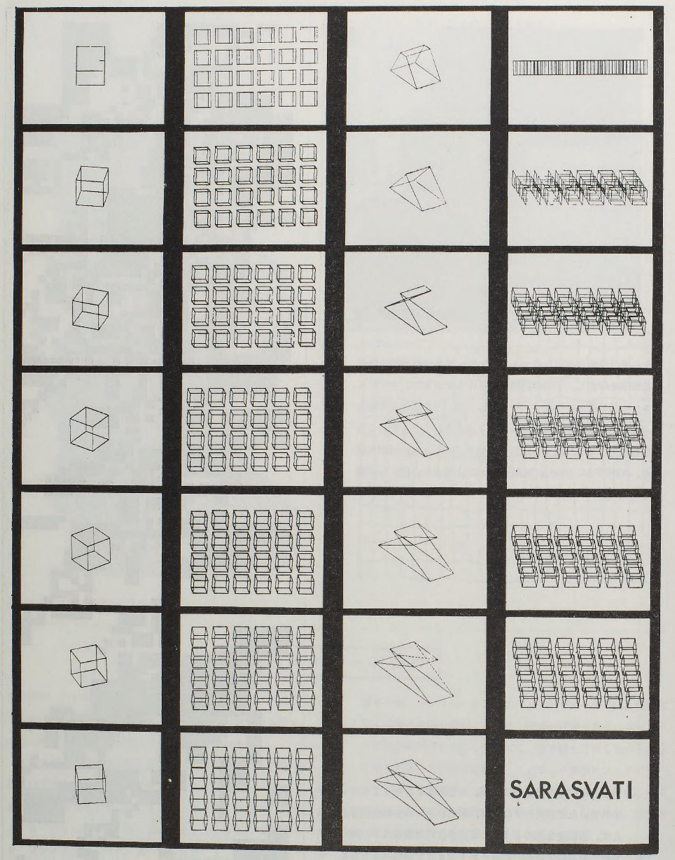
60s Computer Usage Environment
When we think of computer-assisted visual expression today, we usually imagine a display or screen. However, at least for Hiroshi Kawano and CTG's main computer art works, these weren’t something displayed on screens. Kawano’s works involved manual coloring added to outputs from line printers, and CTG’s works were produced with an X-Y plotter. Although CTG did use the IBM 2250, a vector scan display, for the production process of their animation works, to create animations, they needed to photograph the screen frame by frame with 16mm film, meaning their principal works were plotter-produced drawings that were then screen-printed or offset printed16.
Friedrich Kittler, in his text "Computer Graphics: A Semi-technical Introduction17," points out that by 1998, people had grown familiar with GUIs and tended to conflate computers with computer graphics. He reminisces that only older hackers would remember that computer images once consisted of merely white dots on an amber or green background, a legacy not of television but of wartime radar. Indeed, the SAGE (Semi-Automatic Ground Environment) system deployed by the US Department of Defense in the 1950s already featured cathode-ray tubes (CRTs) as monitors, which operated to track Soviet bombers during the Cold War18. So, while CRTs were around in the 60s, it appears Kawano, CTG, and SARASVATI did not use them. This was likely simply due to the lack of a readily available environment. Upon reflection, the fact that they could only produce their works through printing had its advantages, as it also allowed them to leave their works for future generations.
Here, I would like to examine how Kawano and his peers were able to use computers. Kawano, who worked as a research assistant in the department of aesthetics within the faculty of letters at the University of Tokyo until 1961, had access to the university's computer center, which was established in 1962. He began learning programming there in 1963 and was able to study assembly language using the OKITAC 5090A19. Additionally, he could use the HITAC 5020 starting from 1966.
CTG could use a computer because Tsuchiya was enrolled in the Department of Mechanical Engineering at the University of Tokyo, but it was not available for creating art until they applied for an IBM contest (Tsuchiya’s essay “Is Computopia Possible?” received an honorable mention)20, which led to them obtaining permission from an IBM director to use the computer for art production. CTG used a large computer (IBM7090) and a plotter (CalComp 563) from Japan IBM, and programmed with FORTRAN IV. Komura reminisces about the computer usage environment back then:
Computers in the 1960s were unimaginably large machines. At the time, companies like Boeing and General Motors had just begun introducing CAD as a design tool utilizing computers, and display devices like plotters were not yet commonplace or were prohibitively expensive. Back then, there was a data center in Iwamotocho, Kanda, jointly used by construction and shipbuilding companies. The usage fee was 1 million yen per hour for a large computer and 10,000 yen per hour for a plotter, prices of that era. We were able to use them for production thanks to the cooperation of Japan IBM21.
Tsukio of SARASVATI recalls, as a graduate student, "At the University of Tokyo's Institute for Advanced Studies, thanks to Fujitsu's generosity, a FACOM270/20 was installed, which could be freely used upon reservation, with a CalComp plotter connected as an output device22."
Thus, it required a significant amount of money to use large computers at that time, and it was difficult to use them unless one was an engineering researcher at a university or related to a computer company. It seems almost miraculous that Kawano, an aesthetician, and Komura, a student from Tama Art University, were able to use it. Or perhaps it was their insatiable curiosity and experimental spirit that drew such an environment to them.
Next time, I plan to discuss Hiroshi Kawano's computer art and his aesthetics.
- Jun-Yeon Ma, "A Critical History of Media Art in Japan" (『日本メディアアート史』), ARTES, 2014.
- Kazufumi Oizumi, "The Genesis of Computer Art: The Trajectory and Thought of CTG 1966-1969" (『コンピュータ・アートの創生 CTGの軌跡と思譳 1966-1969』), NTT Publishing, 2015.
- Jasia Reichardt, "Cybernetic Serendipity: the computer and the arts," Studio International, 1968.
- Simone Gristwood, "Hiroshi Kawano (1925-2012) Japan’s Pioneer of Computer Arts," Leonardo 52 (1), pp.75–80.
- Yoshiyuki Abe, "The Genealogy of the Pioneers," PAGE 66 Bulletin of the Computer Arts Society (Winter 2007/2008).
- "Special Issue: Art in the Electronic Age" (「特集エレクトロニック時代の芸術」), "Bijutsu Techo" (『美術手帖 1968年1月号』), Bijutsu Shuppan-sha, 1968.
- " Bijutsu Techo May Special Issue: Human and Technology" (『美術手帖 5月号増刊 特集=人間とテクノロジー』), Bijutsu Shuppan-sha, 1969.
- Noi Sawaragi, "War and Expo" (『戦争と万博』), Bijutsu Shuppan-sha, 2005.
- CTG, "The Philosophy, Method, and Vision of Computer Graphics" (「コンピュータ・グラフィックの理念・方法・ヴィジョン」), in "DESIGN No.106" (『デザイン2 DESIGN No.106』), Bijutsu Shuppan-sha, 1968.
- "1st Japan Computer Art Contest Magazine Announcement" (「第1回日本コンピュータ・アートコンテスト誌上発表」), "COMPUTOPIA April 1968 issue" (『COMPUTOPIA 1968年4月号』), Computer Age Company, 1968, pp.57-63.
- Hiroshi Kawano, "Aesthetics" (『美学』), Tokyo University Press, 1967.
- Hiroshi Kawano, “Informatics of Art (『芸術情報の理論』), Shinyo-sha, 1972”
- Hiroshi Kawano, "The Emergence of Network Aesthetics" (『ネットワーク美学の誕生』), Toshindo, 2009.
- Hideki Mitsui, "The World of Computer Graphics" (『コンピュータ・グラフィックスの世界』), Kodansha, 1988.
- Hideki Mitsui, "25 Years of Computer Art as seen at SIGGRAPH," "ICONICS Cinema Studies" (『ICONICS 映像学』vol.3 no.2), The Japan Society of Image Arts and Sciences, 1987.
- Association for Algorithmic Art and Tama Art University, "20th Century Computer Art: Beginnings and Developments -The work and thought of pioneers and contemporary practitioners of algorithmic art" (『20世紀コンピューター・アートの奇跡と展望 –現代アルゴリズム・アートの先駆者・現代作家の作品・思想−』), Tama Art University Museum, 2006
- JAGDA Internet Committee, "Digital Media and Japanese Graphic Design: Its Past and Future" (『デジタルメディアと日本のグラフィックデザイン その過去と未来』), Seibundo Shinkosha, 2017.
- "ARTS ON COMPUTER," O Art Museum, 1987.
- Friedrich Kittler, Translation: Keiichi Aizawa "Computer Graphics: A Half-technological Introduction" (「コンピュータ・グラフィックス 半ば技術的な入門」), in "Inter Communication No.28," NTT Publishing, 1998.
hasaqui
Artist and researcher, working with generative art using p5js and drawing works inspired by it. He has also participated in the exhibition "Proof of X" focusing on the medium of NFT and blockchain, and has published several essays related to NFT, including “NFT’s potential from an art perspective" ("The New Creator Economy: New Art Forms Created by NFT", BNN. 2022) and "NFT and Blockchain as ‘Inscription System'" ("Proof of X - Blockchain As A New Medium For Art," NEORT, 2023).
1. Haruki Tsuchiya and Masao Komura first met during an internship, which led to the formation of a group in 1966 with Kunio Yamanaka and Junichiro Kakizaki, growing to a maximum of ten members later on.
2. SARASVATI is a group named after the initial letters of the Japanese phrase meaning "A troupe searching for academically frivolous play, full of vitality and pretending to be foolish." The main members were Gaku Yamada and Yoshio Tsukio. However, in the 1967 work "The Art of Fugue" they were joined by musician Yasunao Tone and sound engineer Shinpei Kikuchi.
3. SIGGRAPH is a subcommittee of ACM and has been holding annual conferences focusing on computer graphics since 1974.
4. Yoshiyuki Abe, “The Genealogy of the Pioneers,” PAGE 66 Bulletin of the Computer Arts Society (Winter 2007/2008) p.1
5. ZKM Hiroshi Kawano Archives https://zkm.de/en/hiroshi-kawano-archives
6. Yoshiyuki Abe’s Homepage http://www.pli.jp/kawano/Kawano-j-index.html
7. Jung-Yeon Ma, "Hiroshi Kawano Retrospective at ZKM, Germany," Media Arts Current Contents, 2011. https://mediag.bunka.go.jp/article/zkm_1-60/
8. Simone Gristwood, "Hiroshi Kawano (1925-2021) Japan’s Pioneer of Computer Arts," Leonardo 52 (1), pp.75–80.
9. Masao Komura, "The Possibilities of Expression Created by Computer Art," in "Digital Media and Japanese Graphic Design: Its Past and Future," JAGDA Internet Committee, Seibundo Shinkosha, 2017, pp.54-57.
10. Jasia Reichardt, “Cybernetic Serendipity the computer and the arts”, Studio International,1968.
11. Kazufumi Oizumi, "The Genesis of Computer Art: CTG's Trajectory and Thought 1966-1969," NTT Publishing, 2015, p.281.
12. "1st Japan Computer Art Contest Magazine Announcement," "COMPUTOPIA April 1968 issue," Computer Age Company, 1968, pp. 57-63.
13. ibid p.57.
14. Hiroshi Kawano, "Aesthetics," Tokyo University Press, 1967.
15. Hiroshi Kawano, "The Birth of Network Aesthetics," Tosho Publishing, 2009, p. 269.
16. Kazufumi Oizumi "About CTG," published on the website of Research Institute for System Technology managed by Haruki Tsuchiya of CTG. https://www.systemken.com/ctg.html
17. "Inter Communication No.28," NTT Publishing, 1998.
18. Hideki Mitsui "25 Years of Computer Art as seen at SIGGRAPH," "ICONICS Cinema Studies" vol.3 no.2, The Japan Society of Image Arts and Sciences, 1987.
19. Simone Gristwood, "Hiroshi Kawano (1925-2012) Japan’s Pioneer of Computer Arts," Leonardo 52 (1), p.76.
20. "Interview with Haruki Tsuchiya of CTG (Computer Technique Group) 'Goodbye, Computer Art,' Interviewer: Jung-Yeon Ma," published on the website of Research Institute for System Technology managed by Haruki Tsuchiya of CTG. https://www.systemken.com/ctg.html
21. Masao Komura, "The Possibilities of Expression Created by Computer Art," included in "Digital Media and Japanese Graphic Design: Its Past and Future," JAGDA Internet Committee, Seibundo Shinkosha, 2017, p.54.
22. "ARTS ON COMPUTER," O Art Museum, 1987, p.24. According to Hiroshi Kawano's “Informatics of Art," Shinyo-sha, 1972, p. 288, "The Art of Fugue" was created by FACOM 270-30.



