
Enter the Glitch
14 September 2022
Enter the Glitch
On the occasion of Ecotone, curator Primavera De Filippi speaks to artist Beatriz Ramos and engineer Isaac Patka about what makes the Glitch residency such a fertile space for hybrid creativity.
Primavera De Filippi: What happens when artists and engineers collaborate?
Beatriz Ramos: Magic.
PDF: That sounds wonderful. What kind of magic, can you be more precise?
BR: In my experience, innovation happens through experimentation, which is essential for artistic practice. In this sense, artists and tech engineers feel comfortable exploring new grounds. While engineers are problem solvers, artists have imagination and a connection with the human. Together they can push technology forward to be the best that it can be.
Isaac Patka: The magic comes from the fact that, when artists and engineers collaborate, the result is different from everyone’s expectations going in. As an engineer, I have a strong understanding of the constraints and boundaries of my field, and I have assumptions about how an artist might play within and at the edges of that field. However, these assumptions are quickly challenged when the artist learns just enough to start asking the right questions. While the artist may initially be disappointed by some of the constraints and challenges which make their early vision infeasible, the process of adapting, fitting their vision to the medium, and pushing it to the edge is exciting for all parties involved.
PDF: What happened at Glitch in that regard?
IP: A common thread of many of the projects at Glitch is the desire to leverage the medium of blockchain in a way central to the art, rather than as an afterthought. There are many constraints in designing blockchain-based systems like low computational power, immutable data, asynchronous interactions, high fees, and adversarial environments. However, all of these can be harnessed in artistic expression rather than worked around.
Beyond thinking of tokens as URIs linking to a digital representation of some static artifact, artists at Glitch are interested in exploring other ways to use these tokens. Could tokens represent attribution, remix rights, liquid royalties? Could tokens own other tokens, and what would be the impact of that? What are the implications of sending tokens in permissionless fashion to another person without their consent? How can the artwork be made dynamic, responding to other changes on chain, over time, or as the art moves from owner to owner?
PDF: Did you engage in any collaborations with artists?
IP: Most of my time at Glitch was spent engaging at a system-wide level rather than teaching artists how to code. This often included whiteboarding a new system through which people could engage with a blockchain-based art piece, then role-playing all of the intended and unintended ways people might interact with that system. Sometimes the systems fell apart in an adversarial environment, but at other times we discovered interesting market dynamics that could make them resilient.
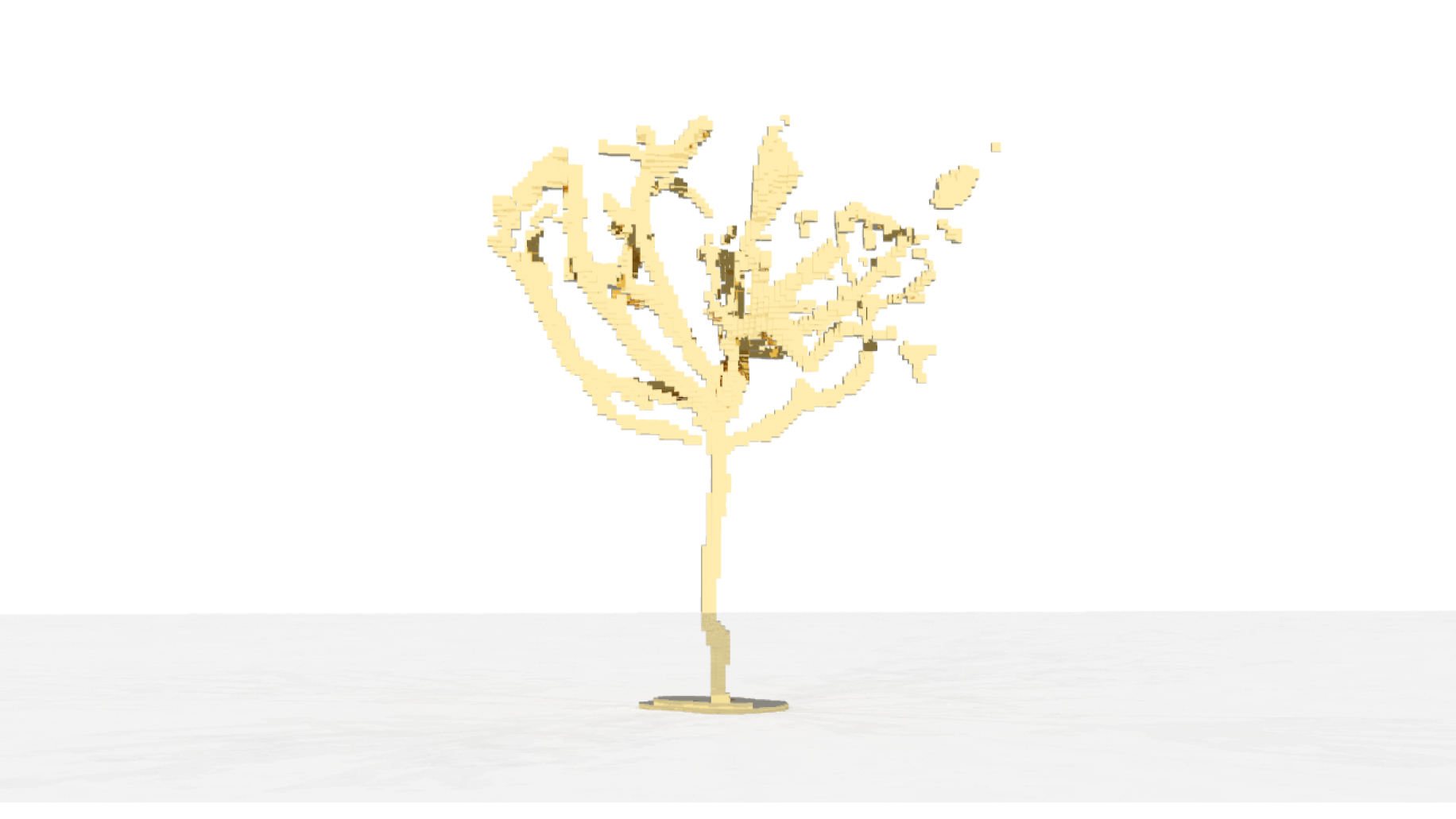
One project that I started collaborating on at Glitch was your Plantoid, a “blockchain-based life form” made out of steel and smart-contracts, which feeds off crypto and then uses that crypto to hire new artists to replicate itself. One of the main reasons I was interested to collaborate on Plantoid’s new smart contracts was to experiment with how programming the flows of money can incentivize creativity and a remixing of each other’s ideas, rather than the common market dynamic of IP hoarding and litigation.
PDF: Yes, and I am very thankful for that! The Plantoid project has had multiple iterations since I initiated it in 2014. Over the years, I have used this project as a means to teach myself how to code, how to develop smart contracts in Solidity, how to build Web3 interfaces to interact with those smart contracts, and how to work with electronics in order to bring the Plantoids to life. None of this would have been possible without the help of engineers who saw in the Plantoid the possibility to explore and experiment with an uncommon application of blockchain technology, focusing on scarcity and profitability.
I went to the Glitch residency with the specific intention to create a new species of Plantoids that would generate their NFTs as their own seeds. And, once again, the magic happened, as exceptional developers like you helped me to conceive and develop the new Plantoid smart contract as well as a Web3 interface to interact with these new Plantoids. Many other participants in the residency also supported me in this endeavor, helping me to figure out the electronics and sound engineering in order to bring this new species of Plantoid to life. It would not have been possible without them.
IP: Another initiative that I was engaged in during the residency was the Remix NFT project, which was interesting for the same reasons as the Plantoids. In a digital world where art is abundant rather than scarce, how can we encourage people to collaborate, mutate, and share each other’s works? How can we promote a digital economy based on abundance rather than scarcity?
PDF: Yes, the Remix NFT project was born precisely from the desire to show that NFTs are not only designed for scarcity and exclusivity, but can benefit artists who value collaboration over competition, and who believe that maximizing the visibility and replicability of their works will ultimately reap the most benefits. In fact, I’m convinced that NFTs are one of the most valuable gifts that the blockchain community has given to Creative Commons artists, and this project was intended to prove precisely that.
It is also a project that I believe is in line with the values of the DADA community, which Bea is stewarding with so much love and passion. As a community of NFT artists that collaborates to create visual conversations, DADA is exploring new ways to reward contributors without cultivating transactionality. Do you feel that the conversations at Glitch have helped you to further this objective?
IBR: Actually yes, during the residency we worked specifically on how to represent intrinsic rewards visually, and we received new insights after we shared our Dadagram with the Glitch community. The Dadagram is a sensing device that helps people assess what feels right to them. This is a new way to account for value that enables non-transactional distribution.
PDF: What language should we be using to define hybrid art practices that involve multiple literacies?
IP: We need language that describes how hybrid art is entangled with its medium and other literacies involved. I think it would be interesting to be able to describe art that is adjacent to its medium, rather than enclosed, dependent, or otherwise deeply integrated. Then, based on the relationship between the art and its medium, to assess how that is perceived by the “consumer” or other actors.
PDF: Indeed, we have words to describe artworks that address audiovisual and multimedia practices, but not many words to express the interdisciplinarity inherent to a specific artwork. To some extent, blockchain art –– as opposed to NFT art –– might be just that, since any artwork that uses the blockchain as its own medium of expression will inevitably require some degree of literacy in the fields of art, blockchain technology, economics, and game theory. Experience in the law also helps to ensure that the artwork does not qualify as an unregulated security.
Do you feel that blockchain technology is helping to emerge a new hybrid artist-engineer or engineer-artist?
IBR: Possibly –– I think people are creative. Whether they call themselves artists or engineers does not matter. In general, I think engineers use art as low-hanging fruit to experiment with smart contracts, but art involves much more than coding something with visuals. While the majority of artists are using NFTs simply as a way to commoditize and sell their digital art. In this respect, there is a long way to go.
IP: In my view, blockchain is just another medium that creative people are exploring, like other new technical media before it. Perhaps it’s producing more game theorist artists, economist artists, and legal artists. But for engineers, it’s exciting to use our skills to create outwardly beautiful things. I know that many engineers, myself included, see beauty and art in a well-architected application, state machine, or documentation. But these are not normally appreciated in the same way as works of art.
PDF: It is my strong belief that most exceptional engineers would make exceptional artists as well, if only they would let themselves move in that direction. Perhaps one of the most interesting outcomes of artist-engineer collaboration is getting artists to help engineers reveal the artists within them, and vice versa. Based on your experience of Glitch, what would you like to share with your fellow artists and engineers?
IP: I learned to challenge the constraints that I perceive in the tools I use, and to be ready for my assumptions to be invalidated as soon as I start working with an artist. Cross-disciplinary residencies are valuable for all parties involved, helping us all to break out of our self-imposed boundaries. I would encourage artists experimenting with the blockchain to think about it holistically in order to determine which of its unique properties can be entangled with their work.
IBR: For me it is all about the people, their concerns, and hopes for the future and how it shapes their use of blockchain technology. It was beautiful to be immersed in a community that felt so alive.



